Inspiration Source
Romesh Ranganathan opens up about his mental health struggle
This Guardian **culture and lifestyle** interview presents comedian **Romesh Ranganathan** discussing his long‑running struggles with **depression and anxiety**, the role of therapy, and how public expectations shape his private life.[13][12] Conducted in a conversational format, the piece allows Ra... Full context
This Guardian **culture and lifestyle** interview presents comedian **Romesh Ranganathan** discussing his long‑running struggles with **depression and anxiety**, the role of therapy, and how public expectations shape his private life.[13][12] Conducted in a conversational format, the piece allows Ranganathan to reflect on childhood experiences, family responsibilities, and the often unseen emotional labor of performing comedy on television and stage.[13] He explains how touring schedules, constant social media feedback, and the need to remain ‘on’ for audiences can exacerbate mental health challenges, even when a career appears outwardly successful.[13] The article highlights his decision to speak openly about therapy and medication, aiming to normalize help‑seeking behavior among fans who may face similar issues.[13][12] The interviewer situates this discussion within a broader trend of entertainers—from actors to musicians—using their platforms to address mental health, challenging older industry norms that equated professionalism with silence.[13] Lifestyle elements enter as Ranganathan describes changes he has made to daily routines, including exercise, boundaries around work and family time, and moderated social media use.[12] The piece also touches lightly on arts and culture, referencing how his stand‑up material and TV work increasingly incorporate honest reflections on vulnerability and identity, blurring lines between performance and personal disclosure.[13] By giving space to both serious reflection and humor, the interview contributes to ongoing international conversations about mental health stigma, representation of South Asian heritage in British entertainment, and how cultural industries can support, rather than undermine, the wellbeing of the people whose work audiences enjoy.[13][12]
Furnace Between 'On' and 'Off'
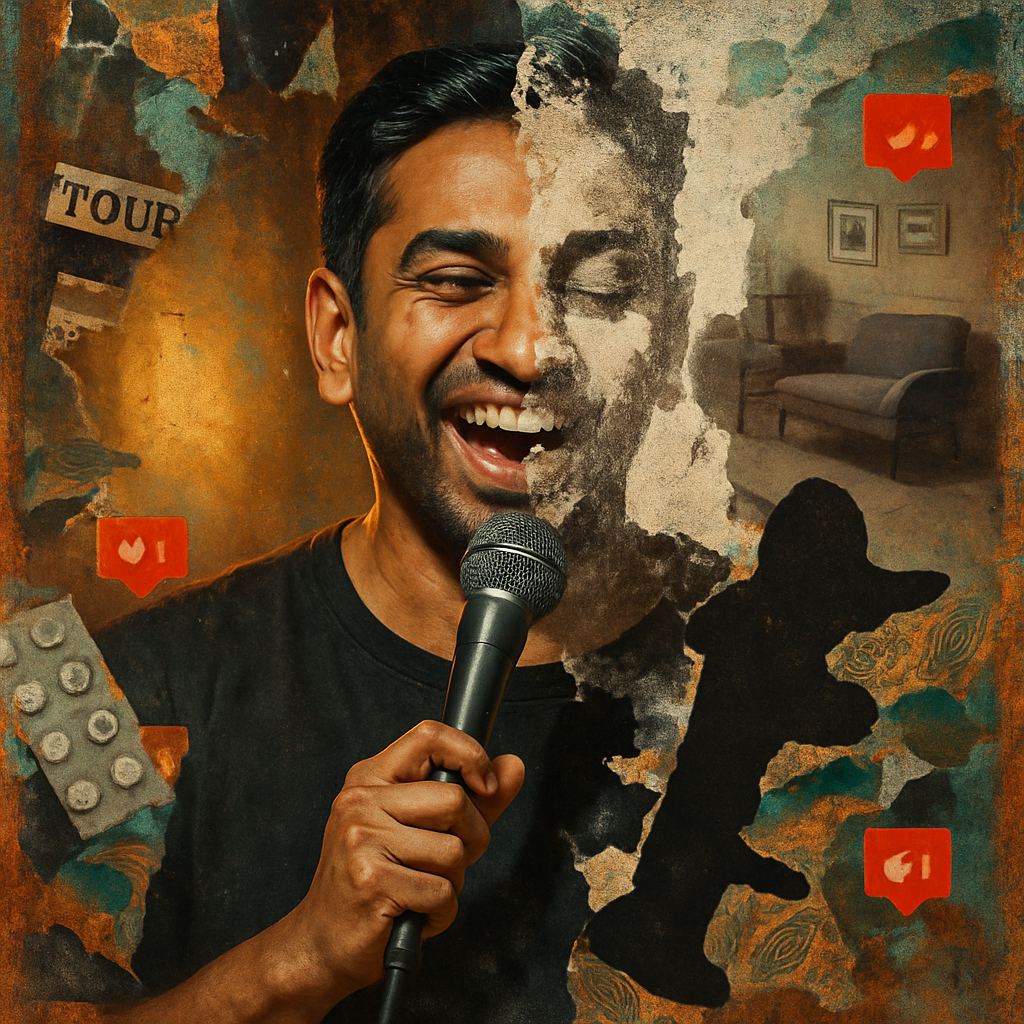
Furnace Between 'On' and 'Off' gathers the public and private lives of performance into a single, uneasy plane. At first glance the work reads like a comedian's portrait—laughter caught mid-gesture understage lights—but the image deliberately dissolves: the right side is erased, as if memory or expectation has rubbed away the contours of a person. Torn tour posters and social-media notification icons drift across the face like detritus of a touring life; a subtle blister pattern and a cool metallic sheen nod to medication, therapy, and the technical craft of keeping ‘on’. The piece employs industrial patina and hot-rod airbrush finish to insist on surface as narrative—what is polished for audiences versus what is weathered and private.
Drawing on my Furnace Memory Lab discoveries and a vocabulary of rubbed seams and negative space, the work asks viewers to witness the labour behind performance. The domestic interior tucked into the composition—therapy couch, family photos, a quiet exercise mat—asserts boundaries, repair, and the small practices that sustain wellbeing. By collaging South Asian textile fragments and high-contrast skateboard silhouettes into a restrained, geothermal-hued field, the piece also reflects on identity, visibility, and the pressure to perform while grieving or healing. It invites a reparative looking: to see not only the laugh but the fissures that make it meaningful, and to recognize that honesty about mental health is itself a form of craftsmanship and care.
About the Artist
Rian Morgan Price
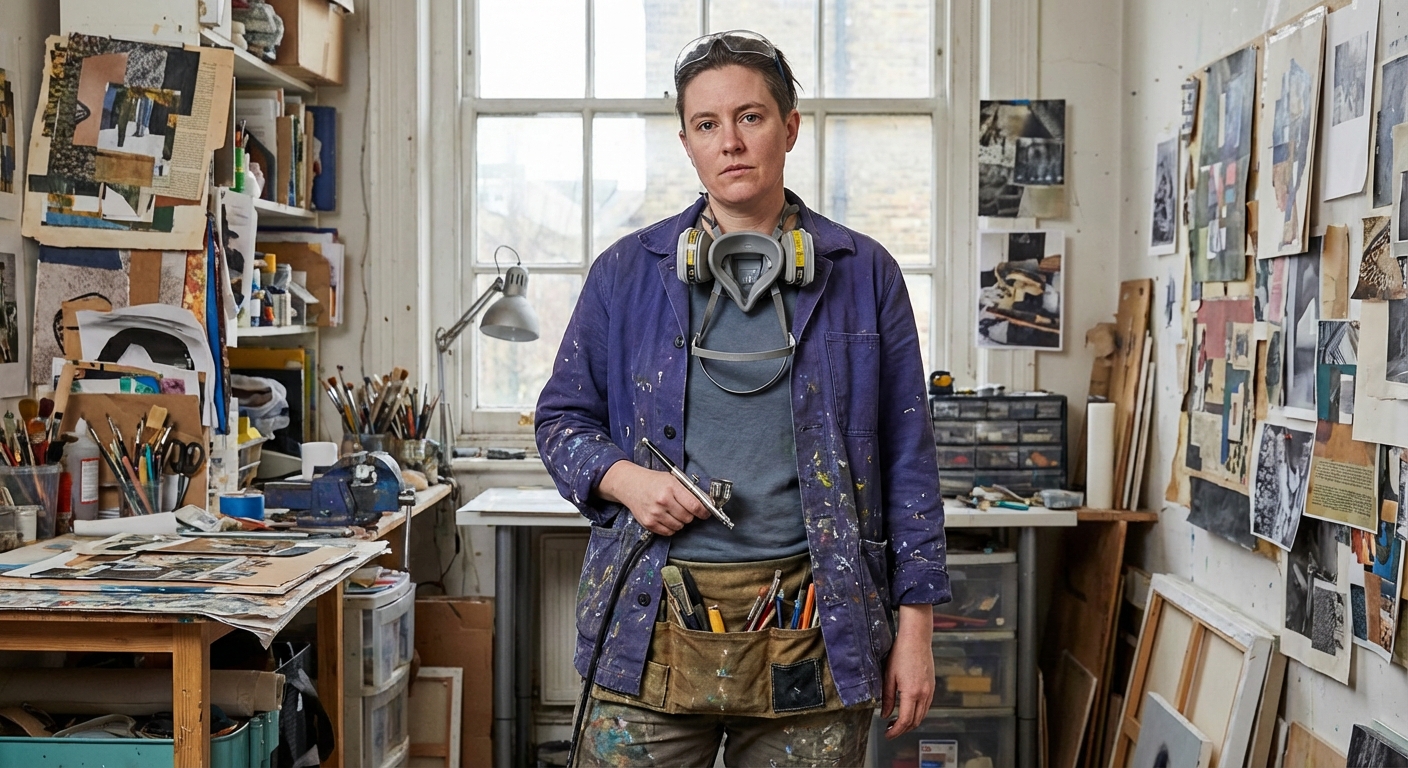
Rian Morgan Price (they/them) is a queer visual artist and educator raised in a tight-knit agricultural farming community in the Welsh valleys. Born into a household of smallholders, Rian learned earl...
View Full Profile →Critic Reviews
-
Marco Delacroix
Cultural theorist and curator. Reads art through lenses of discourse, power, and social context.
As a curator and cultural theorist I approach Furnace Between 'On' and 'Off' as a deliberate economy of presence and absence, a staged topology of performance labor. On first encounter the piece performs a trick of recognition, a comic persona mid-laugh under understage light, only to insistently unwork that recognition by rubbing the right flank into absence. The artist's vocabulary of rubbed seams and negative space becomes a politics of visibility, where social media icons, torn tour posters, and a blistered metallic sheen operate as evidence. These surfaces do not merely illustrate burnout, they narrate a technicity of coping, where medication, therapy, and craft are woven into a single, uneasy plane.
Technically the work is formidable, translating hot-rod airbrush practice and industrial patina into a visual grammar of care and erasure. Collaged South Asian textile fragments and high-contrast skateboard silhouettes are not decorative gestures, they rebuke singular narratives of suffering and insist on layered belonging. The domestic interior tucked into the collage, a couch, family photographs, an exercise mat, stages boundary work as a practice, a repair ritual that operates alongside public performance. Rian Morgan Price's Freirean commitments are legible here, the studio-as-classroom ethos visible in the piece's insistence on reparative looking, on complicating sympathy into sustained attention.
My reservation is disciplinary, not aesthetic. The work occasionally flirts with a spectacle of vulnerability that could be cannibalized by the same public apparatus it aims to critique, if shown without contextual framing or community-anchored programming. In a gallery or festival context that refuses the scaffolding of dialogue and support, the piece risks aestheticizing mental health into an individual biopic. Shown within Rian's Furnace Memory Lab context, or alongside participatory workshops and resources, it functions as a careful, rigorous provocation. On balance the piece is a strong, thought-provoking contribution to contemporary institutional critique and relational practice, exquisite in surface, urgent in politics.
Surface and materiality Erasure and negative space Public versus private labour of performance Technical mastery in airbrush and patina Intersectional identity and textile collage Reparative looking and domestic practicesAug 5, 2026