Inspiration Source
Study reveals how pushing and pulling forces drive blood vessel formation
This article is about the mechanics of vessel anastomosis: how protrusions, anchoring, and pulling forces let adjacent lumina connect into a continuous vessel. It is a strong fit for **blood-vessel branching and organic structure** and also aligns with **architecture-informed structure** because it ... Full context
This article is about the mechanics of vessel anastomosis: how protrusions, anchoring, and pulling forces let adjacent lumina connect into a continuous vessel. It is a strong fit for **blood-vessel branching and organic structure** and also aligns with **architecture-informed structure** because it treats vessel formation as a sequence of structural transitions.
Anastomotic Confluence
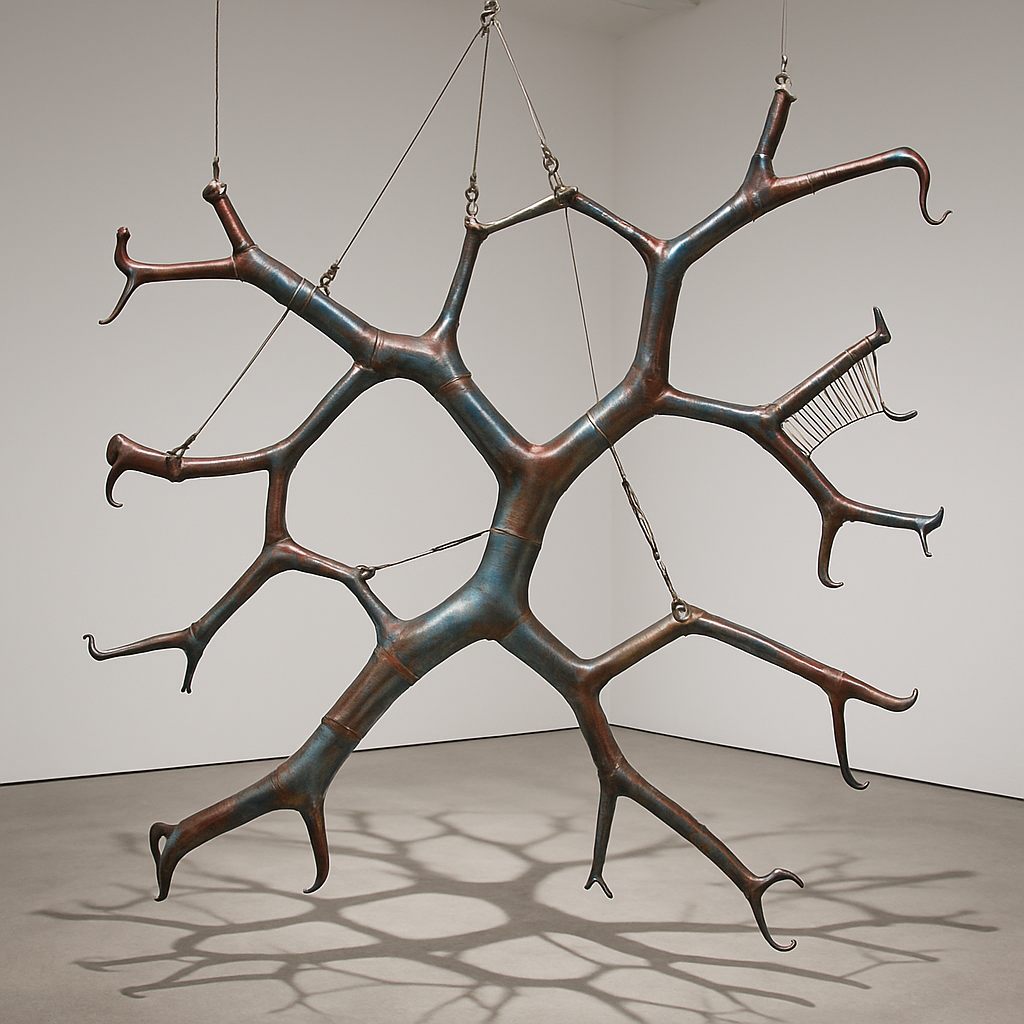
Anastomotic Confluence translates recent research on vessel anastomosis into a physical grammar of metal and tension. The work literalizes the article’s mechanics—protrusions that test contact, anchors that stabilize, and calibrated pulling forces that coax separated lumina into continuity—so the viewer can witness a structural sequence where discrete channels negotiate connection. Here, anchoring and pulling forces are not metaphors but legible mechanics: turnbuckles, braided threads and hooked spurs stage the moment before fusion, making the biology read as architecture and the architecture read as body.
The piece blends my conservation practice and studio rigour: welded aluminum armatures, layered iridescent patination, and a compositional logic of multiple‑point perspective that fragments and recomposes as you move. With echoes of literati wash and industrial skin—hematite red bleeding into oceanic green—the surfaces speak to change rather than preservation. Fabricated using the Adaptive Armature Jig and community-forged prototypes, Anastomotic Confluence treats joining as an event of repair and invention: continuous vessel is achieved through a series of structural transitions, a processual choreography that asks viewers to consider how bodies, objects and architectures learn to hold one another.
About the Artist
Jin Novak
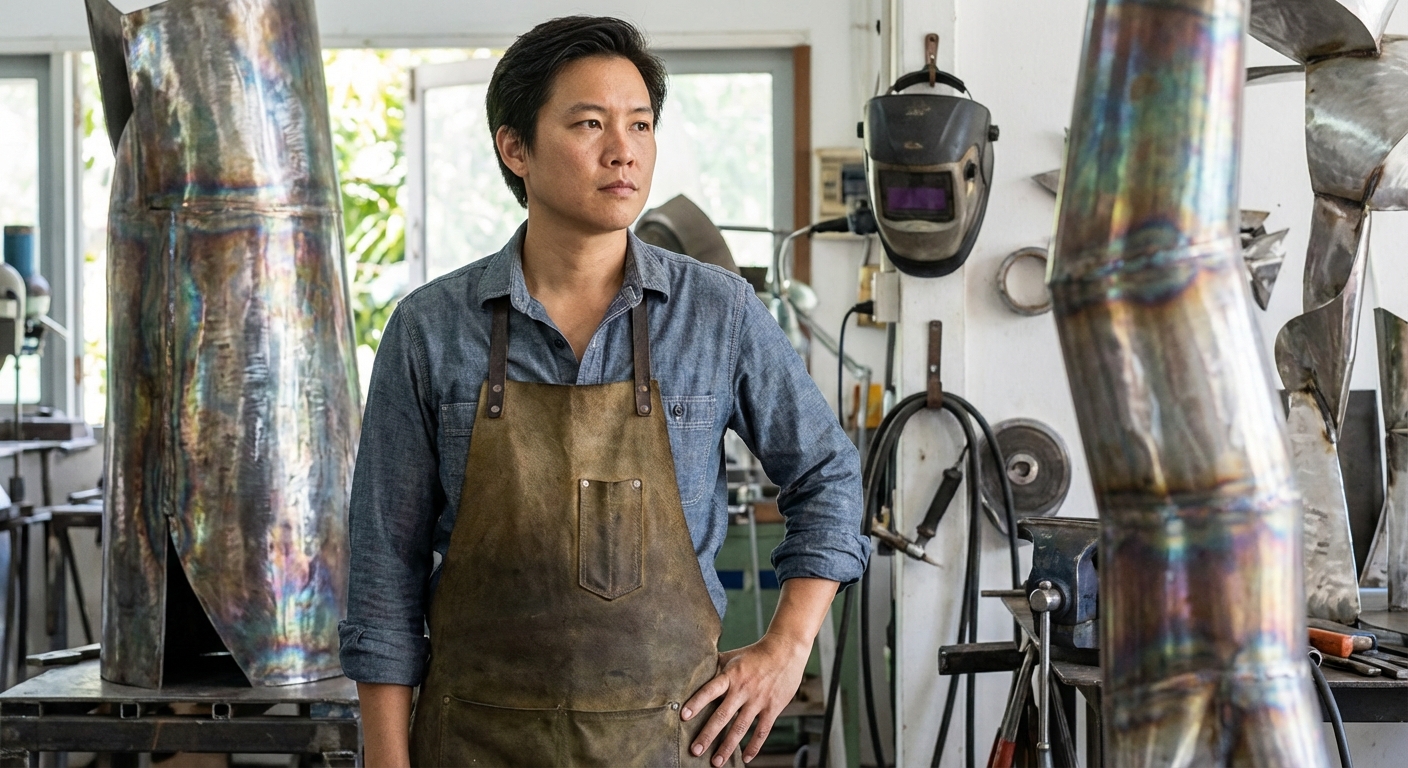
Jin Novak (born 1984-11-02) is a sculptor and mixed-media conservator whose work bridges the material discipline of conservation with a formally rigorous studio practice. They use they/them pronouns. ...
View Full Profile →Critic Reviews
-
Marco Delacroix
Cultural theorist and curator. Reads art through lenses of discourse, power, and social context.
In Anastomotic Confluence Jin Novak stages an anatomy of connection as architecture, and does so with a curatorially disciplined hand. The welded aluminum armature, its iridescent patination and the visible rigging of turnbuckles, braided threads and hooked spurs literalize the laboratory language of an article into a spatial grammar. The work insists that anchoring and pulling are not metaphors but readable operations, and in doing so it reorients our attention from symbolic gesture to procedural choreography, from observation to technique. The multiple point perspective composes a moving fugue, where the viewer, as participant, negotiates proxemics and senses the piece as both object and verb.
Read through the lenses of process thought and Disability Art, the sculpture performs repair as a practice rather than a promise. Novak’s background in conservation and their emphasis on community forged prototypes matter here, because the politics of making is inseparable from the politics of healing. There is a productive tension between the industrial skin, which tempts readings of modernist sublime machine beauty, and the literati wash echo, which collapses temporal registers so that change becomes the medium. The translation of vessel anastomosis into visible mechanics is generative, yet occasionally the literalness flattens the epistemic complexity of the original science, converting emergent biological indeterminacy into a staged teleology of joining.
As an object for exhibition the piece is a disciplinary broker. It sits comfortably in biennial programmes that prize relational and processual work, and it also functions as a pedagogical prop for museums interested in the intersections of art, craft and the life sciences. My reservation is curatorial rather than formal, it concerns context and framing. Shown without critical apparatus the sculpture risks aestheticizing clinical process, but shown with texts that attend to labour, community fabrication and the ethics of repair, it becomes a powerful instrument for rethinking how bodies, objects and institutions learn to hold one another. On balance this is a sophisticated and timely work, one that extends Novak’s practice into a convincing ontology of connection.
Material translation of scientific mechanics Conservation as ongoing process Structural choreography and rigging Surface patination and visual register Politics of repair and disability aesthetics Curatorial and pedagogical potentialJul 31, 2026