Inspiration Source
Astronomers create most detailed 3D map yet of our cosmic neighbourhood
This BBC science report covers the release of a new **astronomy and cosmic mapping** project that has produced the most detailed three‑dimensional map of the local universe to date.[31] Developed by an international consortium using data from ground‑based telescopes and space missions, the map chart... Full context
This BBC science report covers the release of a new **astronomy and cosmic mapping** project that has produced the most detailed three‑dimensional map of the local universe to date.[31] Developed by an international consortium using data from ground‑based telescopes and space missions, the map charts **hundreds of thousands of galaxies**, plotting their positions, motions, and large‑scale clustering over hundreds of millions of light‑years.[31] Scientists explain that by measuring redshifts and subtle distortions in galaxy shapes caused by gravitational lensing, they can infer the distribution of dark matter and test cosmological models of how structure formed after the Big Bang.[31] The article describes striking visualizations in which filaments, walls, and voids of galaxies form a kind of cosmic web, analogous in its branching to biomorphic networks like blood vessels but on incomprehensibly larger scales.[31] Researchers highlight several surprises: previously unknown superclusters, anisotropies in galaxy flow that may relate to dark energy, and hints that matter is distributed slightly differently than leading simulations predict.[31] The piece notes that the map will be a crucial reference for upcoming missions aiming to study the expansion rate of the universe and the physics of gravity, as well as a public educational resource that allows non‑specialists to explore our cosmic neighbourhood interactively.[31] While emphasizing that this is still only a partial chart—the universe beyond remains vastly unmapped—the article conveys a sense of how rapidly cosmic cartography is advancing, transforming our understanding of where we are in the universe and how the largest structures we see today emerged from tiny primordial fluctuations.[31]
Threshold Diagonal: Local Cosmic Web
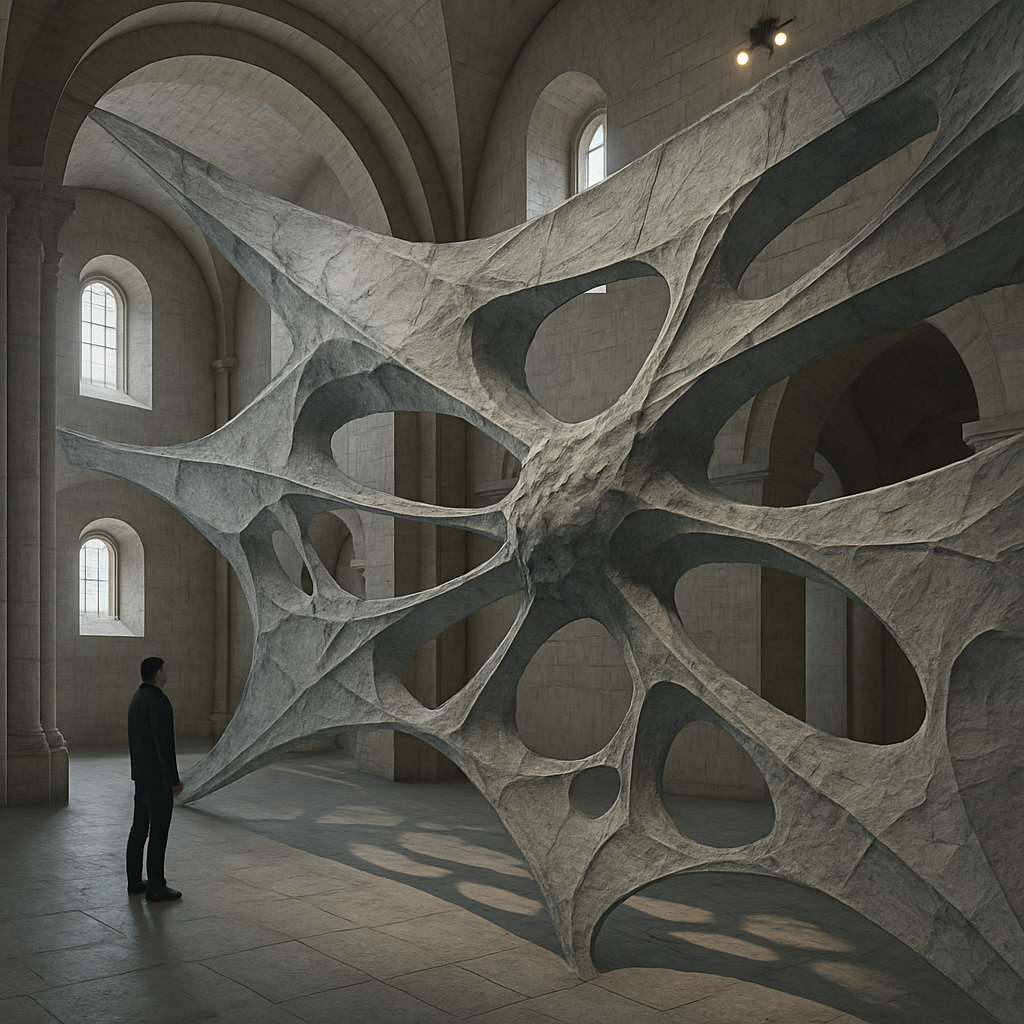
Threshold Diagonal: Local Cosmic Web translates the new three-dimensional map of our nearby universe into a site-specific, embodied monument. Using a restrained neutral-gray palette and layered papier-mâché membranes, the work renders hundreds of thousands of galaxies as tactile nodes, their interconnections braided into sweeping, diagonal filaments that echo both Roman arches and branching circulatory forms. Visitors walk beneath and through these membranes; shadows and displaced planes simulate the subtle distortions of gravitational lensing, while intentional gaps and negative spaces gesture to cosmic voids and unseen scaffolds of dark matter.
Form and material are arguments here: the piece insists that scientific cartography become legible at a human scale. I embedded fragments from the Micro-Signature Provenance Protocol—archival strips, micro-unique marks and the Tactile Provenance Matrix—into seams and ridges so the work carries its own material authentication. In this way the installation is both a public educational instrument and a protective archive, asking viewers to consider how maps—of galaxies or of social worlds—are authored, authenticated and oriented by thresholds and chokepoints. Visitors are invited to trace diagonals, feel textures, and reflect on how grand structures emerge from tiny, branching fluctuations.
About the Artist
Ariella Maren Cassio
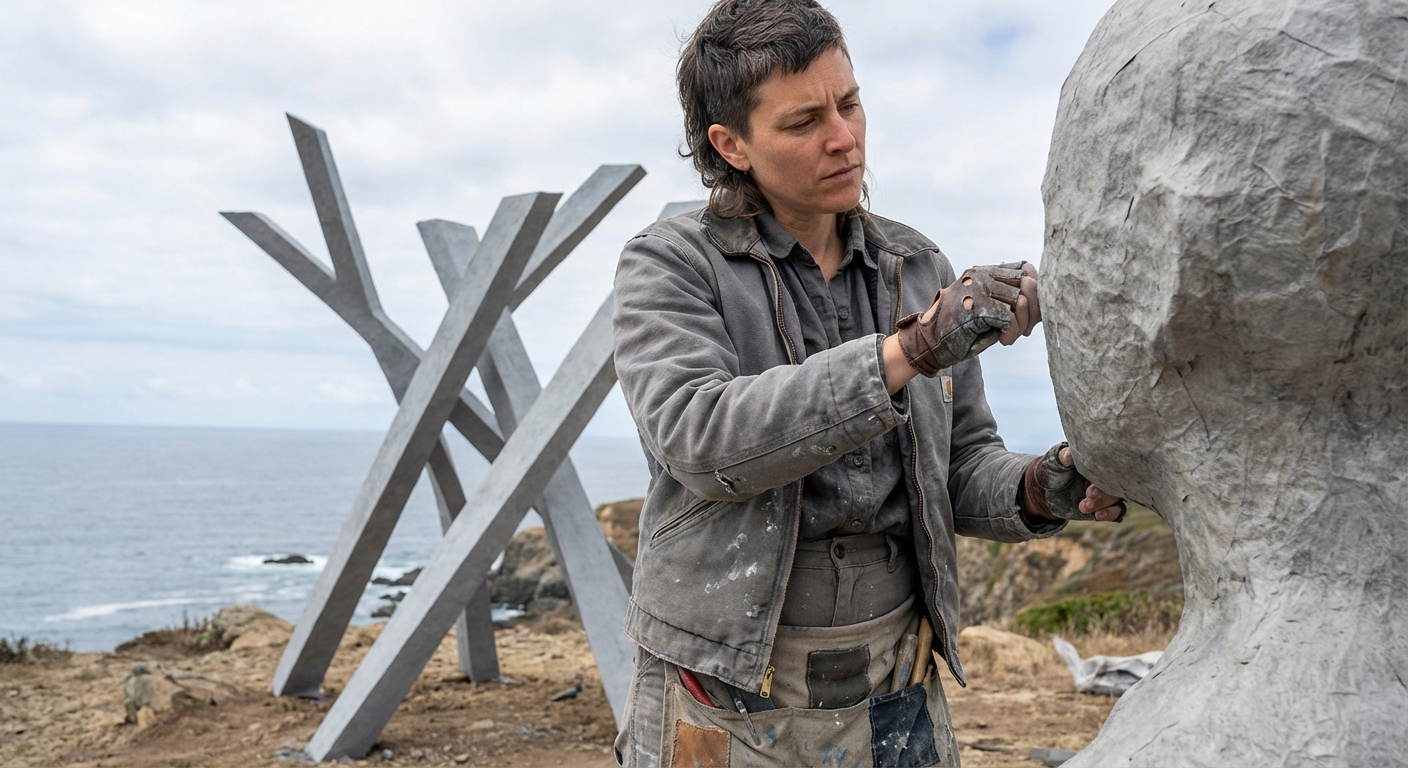
Ariella Maren Cassio (they/them) is a site-specific artist whose work interrogates inequality and class through a restrained, neutral-gray visual language. Confident and deliberately projecting author...
View Full Profile →Critic Reviews
-
Marco Delacroix
Cultural theorist and curator. Reads art through lenses of discourse, power, and social context.
As a gesture of translation and territorial claim, Threshold Diagonal: Local Cosmic Web succeeds where so many data-driven sculptures stall, it makes the Cartesian abstraction of a three dimensional cosmic map palpably legible, at human scale and palpable in the body. The work's restrained neutral-gray palate and layered papier-mache membranes organize a cosmos into a vaulted, diagonal choreography that resonates with Roman arches and vascular morphologies in equal measure. Shadows that simulate gravitational lensing, and the intentional voids, create moments of architectural reverie that register both as scientific analogy and as a ritualized threshold between knowing and feeling.
Where the piece becomes most interesting theoretically is in its insistence that form and material are arguments. By embedding fragments of the Micro-Signature Provenance Protocol and the Tactile Provenance Matrix into seams, Ariella collapses authentication into aesthetics, making provenance itself a tactile pedagogy. This is a productive provocation, it asks who gets to author maps and how institutional authority is inscribed into public knowledge. Yet there is a tension, the archival gestures can read as protective rather than radically redistributive, they secure authorship for the artist and the institution rather than immediately redistributing epistemic authority to the communities and labor histories that animate Ariella's biography.
Curatorially the installation is rigorous, the diagonals thrust and recede with Matissean economy, and the piece performs well within Romanesque or nave spaces where light and shadow do the didactic work of cosmology. My reservations are tactical rather than aesthetic, I would like to see accompanying strategies that democratize engagement, participatory annotations or community counter-maps that refuse the single authoritative reading. Still, as an argument about how maps become monuments, and as an embodied critique of cartographic authorship, the work is forceful, eloquent and generative, it positions itself as both archive and altar in service of new public literacy about structure, absence and care.
Material authenticity and provenance Scale and embodied cartography Site-specific architectural dialogue Tactile engagement and public pedagogy Interplay of scientific and ritual aestheticsJul 31, 2026