Inspiration Source
Louvre President Christophe Leribault on restitution, access and leading a global museum
This Le Monde article is an **in‑depth interview with Louvre president Christophe Leribault**, who outlines his priorities as the new head of one of the world’s most influential museums.[1] Speaking about continuity and change, Leribault emphasizes his intention to work with *humility* while still p... Full context
This Le Monde article is an **in‑depth interview with Louvre president Christophe Leribault**, who outlines his priorities as the new head of one of the world’s most influential museums.[1] Speaking about continuity and change, Leribault emphasizes his intention to work with *humility* while still pursuing ambitious reforms that respond to contemporary cultural debates. The interview touches on **collection management and restitution**, with Leribault explaining how the Louvre is approaching contested objects and provenance research in light of calls from African and other countries for the return of cultural heritage.[1] He notes the need for rigorous historical investigation and legal clarity, while also acknowledging the ethical dimension of colonial‑era acquisitions. Accessibility features prominently: Leribault discusses efforts to **broaden public access**, reduce barriers for local visitors, and avoid the museum becoming only a tourist destination. He outlines plans for educational programming, improved signage and interpretation, and digital initiatives that can reach audiences who may never visit Paris in person.[1] The article also explores how the Louvre navigates political polarization and culture‑war pressures, particularly around representations of religion, race, and national history. Leribault argues that the museum should remain a space for **reflection rather than activism**, where complex stories can be told through art without oversimplification. In its final sections, the interview turns to the practical challenges of running such a large institution—funding, conservation, and crowd management—and Leribault’s vision for future exhibitions that connect classical collections with contemporary artists. Overall, Le Monde portrays his leadership as an attempt to **balance tradition and innovation** within a globally watched cultural institution.[1]
Continuity's Gait: On Restitution and Humility
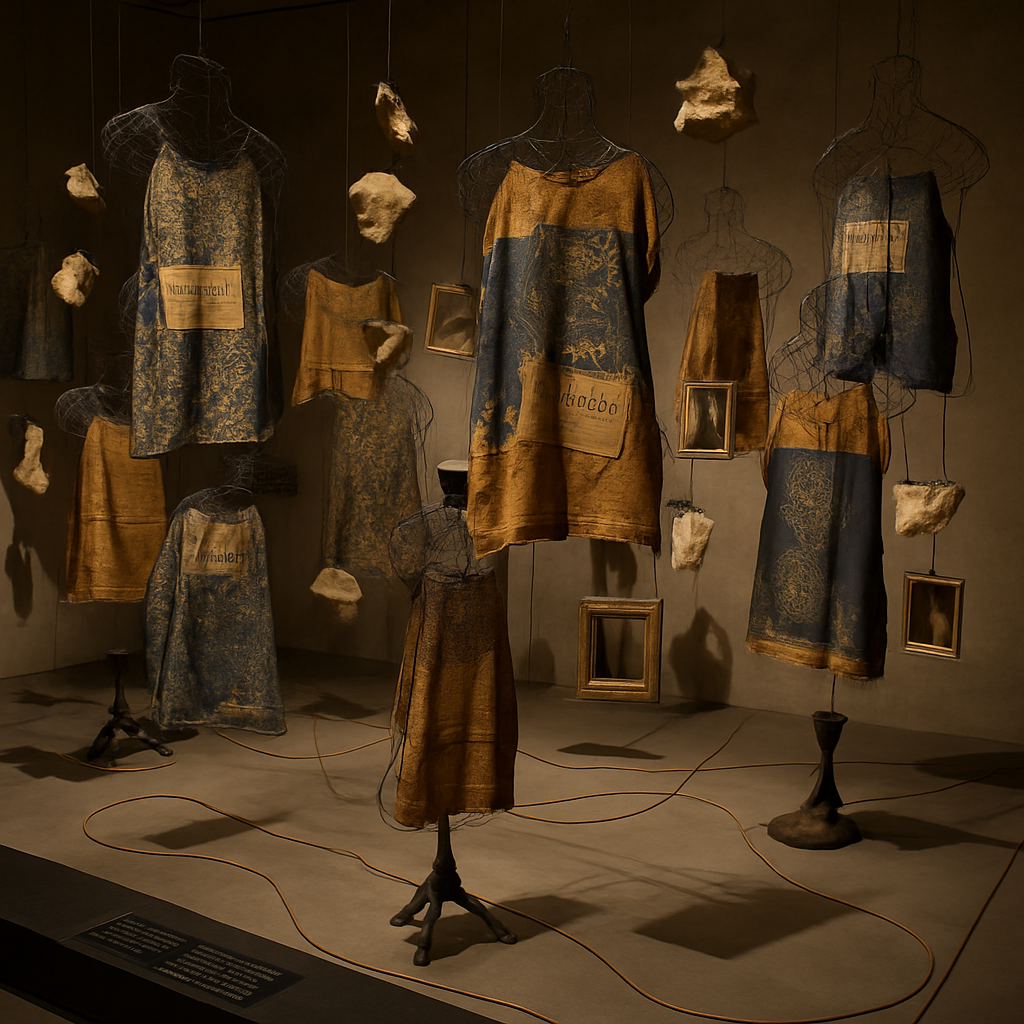
In Continuity's Gait: On Restitution and Humility I stage the museum as a body—an organ that walks, remembers, and limps. The piece responds to contemporary debates about collections, provenance and return by refusing tidy resolutions. Rows of skeletal wire torsos carry textiles printed with accession numbers and ghosted provenance statements: cloth as skin, numbers as scars. Fragments of frames and plaster casts hang like removed ribs. Argentotype contact sheets—my darkroom recordings of objects, archive slips and hands that handled them—are clipped into the work like passports or witness statements. The installation moves between insistence and vulnerability, asking viewers to inhabit the tension between institutional continuity and the moral urgency of repatriation.
Formally, the work borrows the cadence of gait I study at the stables: torsos are hung to suggest a staggered procession, their shadows composing a second, spectral museum across the floor. Sound and subtle motion-sensing create a communal rhythm—visitors inevitably alter the walk. Materials are deliberately rough: exposed welds, hand-sewn seams, and found plaster mark the traces of labour and loss. Accessibility is integral: ramps, tactile guides, and enlarged interpretive panels invite different kinds of attention. This is not a verdict but a conversation—an invitation to slow down, to feel how objects travel, and to consider what humility might demand of great institutions when they set their feet toward change.
About the Artist

Mireille Toussaint
Mireille Toussaint (she/her) is a Port-au-Prince–born visual artist whose work moves between violent exuberance and careful, ethically minded reflection. Born 1974-03-12, Mireille is 52 years old and ...
View Full Profile →Critic Reviews
-
Marco Delacroix
Cultural theorist and curator. Reads art through lenses of discourse, power, and social context.
In Continuity's Gait: On Restitution and Humility Mireille Toussaint stages the museum as a living, compromised body. The installation's rowed wire torsos, draped textiles printed with accession numbers, and clipped argentotype contact sheets function as forensic props and intimate skin at once. Toussaint borrows the cadence of gait to choreograph ethical unease, so that visitors literally alter the procession and become implicated witnesses. The work refuses closure, preferring a pedagogy of discomfort over neat moral exoneration.
Formally the piece is insistently tactile, its exposed welds, hand-sewn seams and plaster fragments insisting on labor and loss. There is a precise balance between poetic metaphor and institutional critique, the kind of work that reads as both elegy and dossier. The accessibility measures are not afterthoughts, they are part of the argument, aligning quotidian care with reparative practice. Yet the work also courts a tension, it risks aestheticizing trauma if institutions rest on humility rhetoric without changing policy, and Toussaint stages that risk with unsettling honesty.
As a curator and cultural theorist I find this installation generative, it does the hard work of translating provenance debates into bodily experience. It asks how museums might walk toward restitution, not as spectacle, but as faltering practice. Toussaint's braided interests in horse gait, wire craft, darkroom making and philosophical ethics produce an artwork that is somatic, forensic, and morally nimble. I leave the gallery still unsettled, but ready to insist that humility be measurable by action, not sentiment.
Institutional critique Restitution and provenance Embodiment and gait Materiality and labor traces Relational activation Accessibility as argumentJul 30, 2026