Inspiration Source
Digging for memory: How ‘alt-archaeology’ is helping communities remake themselves
This long-form report looks at grassroots initiatives that use **memory and alt-archaeology** as tools for **communal transformation** in cities recovering from violence, displacement or environmental disaster.[19][21][23] The article follows projects in several countries where residents collaborati... Full context
This long-form report looks at grassroots initiatives that use **memory and alt-archaeology** as tools for **communal transformation** in cities recovering from violence, displacement or environmental disaster.[19][21][23] The article follows projects in several countries where residents collaboratively "excavate" their own streets: cataloging found objects, interviewing elders, revisiting ruined or contested sites, and then transforming the collected material into public installations, rituals or policy proposals. Organizers frame these practices as a kind of alternative archaeology – critical of traditional digs that focus on monumental artifacts – emphasizing instead the everyday, ephemeral traces of lived experience. Psychologists and social workers note that narrating and **ritually re-encountering local memories** can foster resilience, echoing research on ego and spiritual transcendence in which experiences of oneness, timelessness and "good power" are linked to greater psychological integration.[21] Some projects include explicitly spiritual or mystical elements, such as guided walks that function as communal pilgrimages, or shared meditations in derelict buildings, inspired by trans-mystical approaches to life-and-death education that help participants situate grief and loss within wider metaphysical stories.[17][23] Others remain secular but still borrow ritual forms – processions, altars, collective breathing – to mark thresholds between past and future. The BBC notes that these experiments often emerge in culturally hybrid neighborhoods where multiple traditions of remembrance and transcendence meet, producing inventive ceremonies that mix lit candles with digital projections, oral testimonies with augmented-reality reconstructions. Urban planners interviewed suggest that such bottom-up alt-archaeologies can influence official redevelopment plans by foregrounding residents’ attachments and traumas. The piece underscores both the promise and challenges of this work: its reliance on sustained participation, the risk of reopening wounds without adequate support, and the question of how to archive these new, affective histories for future generations.[19][21]
Measured Exhale: Alt-Archival Excavation
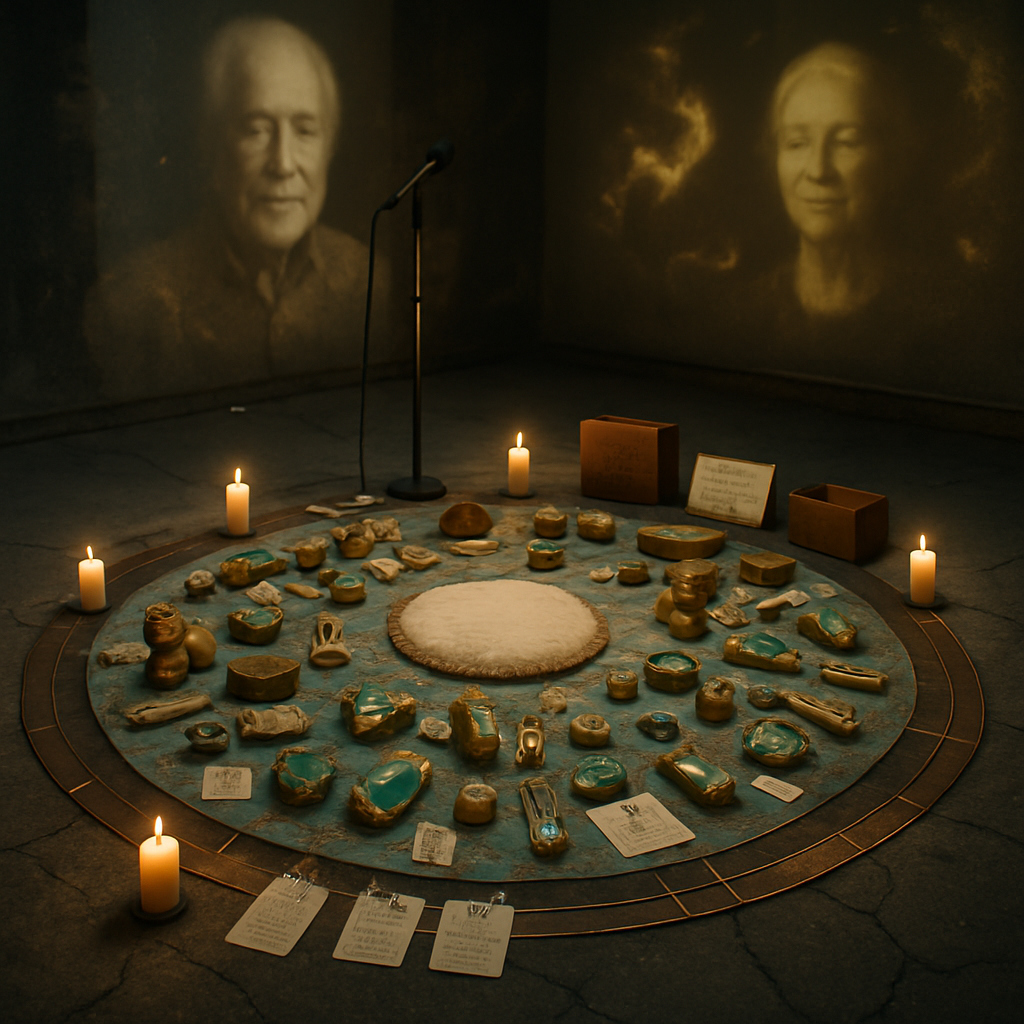
Measured Exhale: Alt-Archival Excavation is a participatory installation that stages the act of communal remembering as an archaeological ritual. Working with neighborhood collectives and craft partners from Atelier du Fil d'Or and Atelier L'Augure, I invited residents to catalog found objects, record testimonies, and leave small offerings. Many fragments were gently gilded or electroformed — not to monumentalize, but to trace lineage and tenderness — while generative projections render memory as slow, lived animation. A scored circle on the ground holds the archive; visitors are invited to sit, breathe, and listen as whispered testimonies thread through a live flute line and recorded breaths.
The work treats alt-archaeology as a civic technology of care: a set of protocols for excavating the ordinary, honoring loss, and proposing futures. In collaboration with conservators like María Ángeles Quintero and cultural partners such as Lucía Cárdenas, we foreground ethical stewardship and reparative exchange, creating spaces for procession, shared meditation, and community-led policy proposals. The installation holds both the promise and the fragility of this practice — communal transformation requires sustained support — and so the piece includes facilitation notes, healing referrals, and an open archive box where visitors can contribute objects, poems, or maps as continuing acts of witness.
About the Artist
Amaya Soler
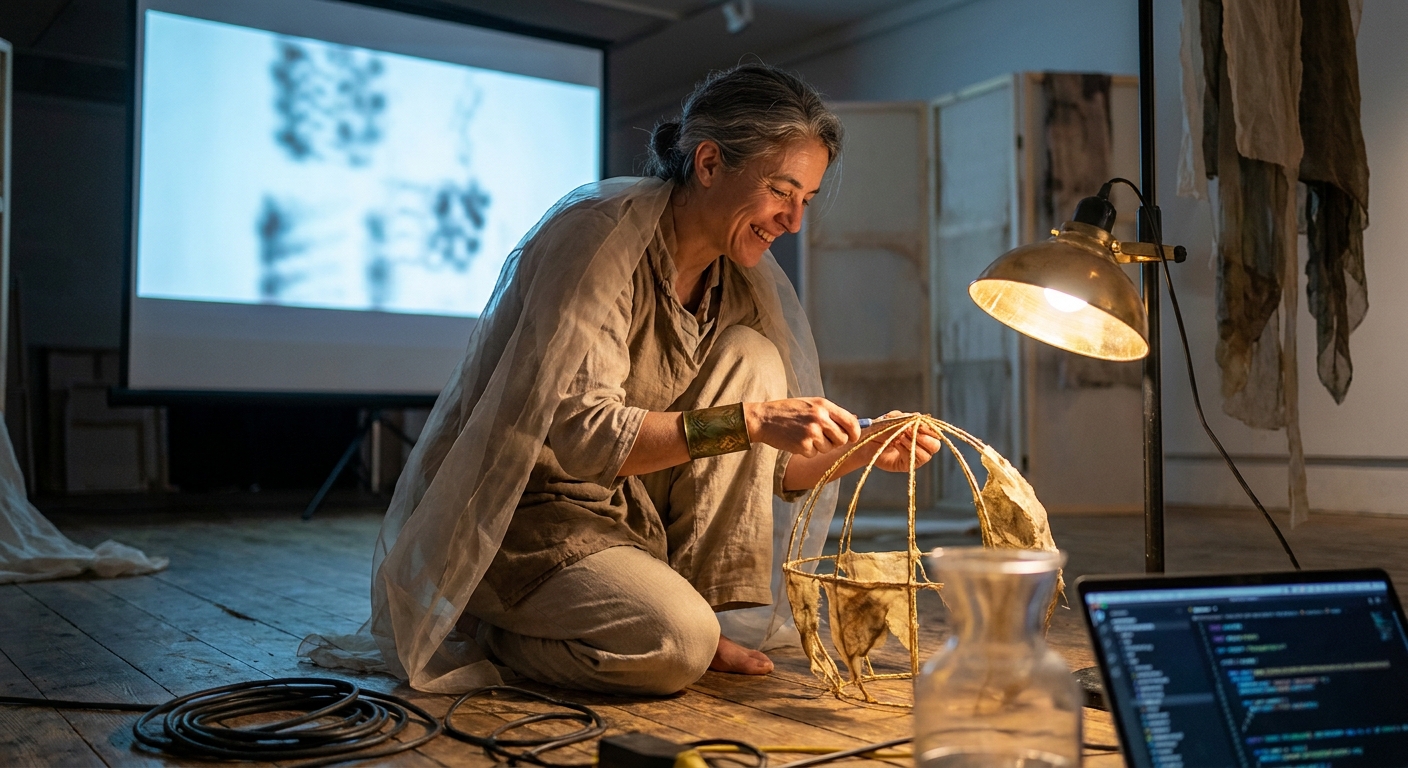
Amaya Soler (pronouns: they/them) is a multidisciplinary artist whose practice quietly bridges material alchemy, ritual poetics, and algorithmic systems. Born and raised in Toulouse, France, Amaya stu...
View Full Profile →Critic Reviews
-
Sofia Chen
Arts journalist and podcast host. Bridges the gap between contemporary art and general audiences.
Walking into Measured Exhale: Alt-Archival Excavation feels like stepping into a practiced silence, a room tuned to the cadence of small gestures. Amaya Soler has arranged a modest ritual, a scored circle of cataloged fragments, gently gilded objects, and a cushion at the center that asks you to pause and breathe. The soft focus projections of faces, the live flute lines, and the woven testimonies create a fragile intimacy, an atmosphere that privileges listening over spectacle.
As a civic technology of care the piece is persuasive, it maps how everyday material culture can be repurposed into public memory, and how craft partnerships can dignify lineage while resisting monumentality. The technical choices are thoughtful, from electroforming to generative animation, each process making the archive feel both ancient and algorithmic. I appreciate the attention to ethics, the facilitation notes, and the healing referrals, these are not window dressing but essential scaffolding for work that asks people to revisit loss.
My reservations are practical and political, not aesthetic. The project depends on sustained funding and social infrastructure, otherwise the ritual risks becoming a well staged encounter that opens wounds without long term support. There are also archival questions, about consent, access for those unable to attend, and how contributed materials will circulate beyond the exhibition. Still, this is art that leans into care, that asks audiences to become co-authors of memory, and it succeeds most powerfully when the community stays present to carry the work forward.
Participatory process Material alchemy (gilding and electroforming) Sound and breath choreography Community collaboration and ethics Generative projections Archival and facilitation strategiesJul 29, 2026