Inspiration Source
Major summer exhibition reconsiders a classic artist’s legacy
This article previews a major cultural exhibition and explains why curators believe it matters now. It covers the artworks on display, the exhibition’s theme, and the broader conversation about how museums present heritage to contemporary audiences.
Constellation of Heirlooms
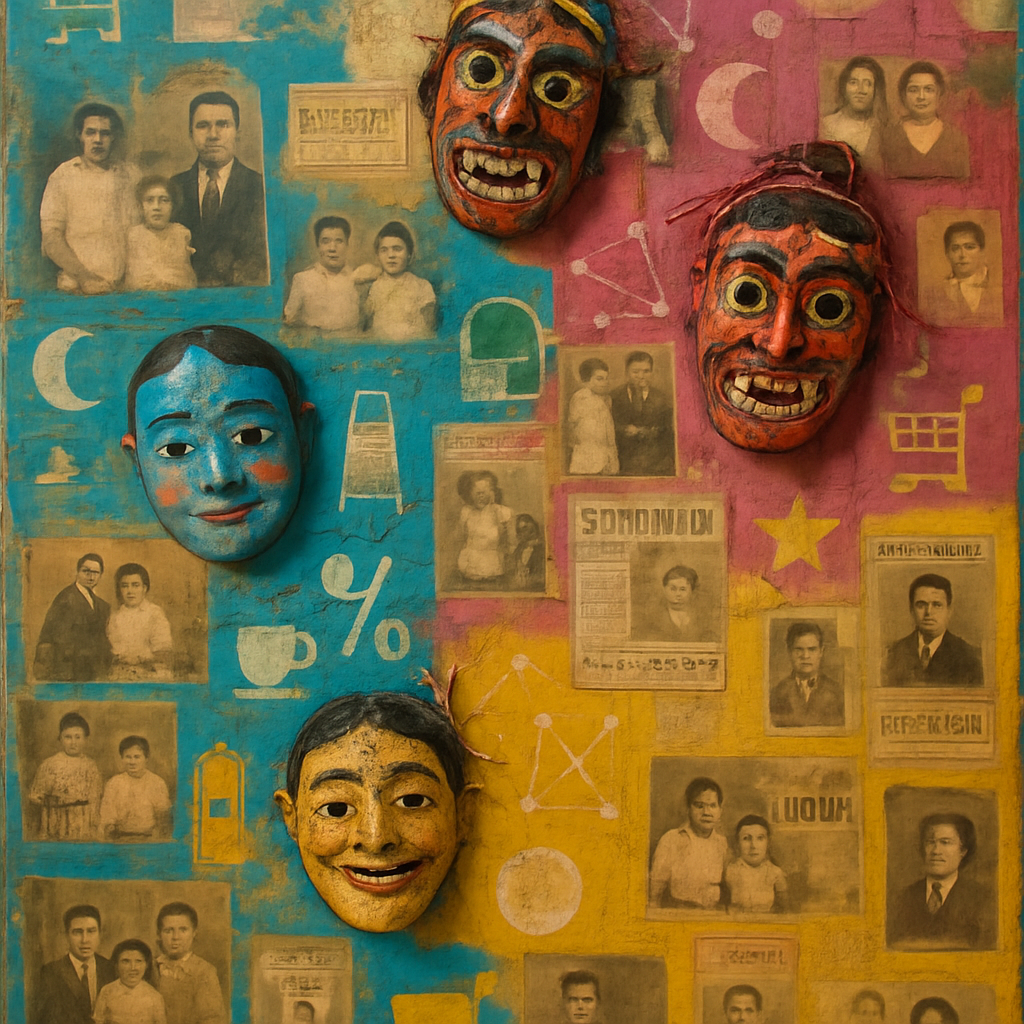
In Constellation of Heirlooms I gather the small domestic relics that have lived in kitchen drawers and cloth trunks—postcards, baby blankets, advertisement cuttings—then set them beside stencilled logos and flattened Pop colors. The work is meant as an even field of memory: no single object claims the viewer’s eye, just as no single story should claim our past. The painted star-charts and lunar marks tie household rhythms to cyclical time, suggesting that heritage is both intimate and cosmological.
Installed for an exhibition that asks museums to rethink how they present heritage to contemporary audiences, this piece converses with institutional archives rather than defers to them. Curators requested that community-sourced ephemera from Tía Rosa’s chest sit next to the panel, and that three festival masks—made in the studio and left unlocked for close viewing—bridge ritual and museum display. Look slowly: the stenciled consumer icons sit beside family snapshots to ask how value is assigned, who catalogs memory, and why everyday labor should be legible in public collections.
About the Artist
María Elena Roldán
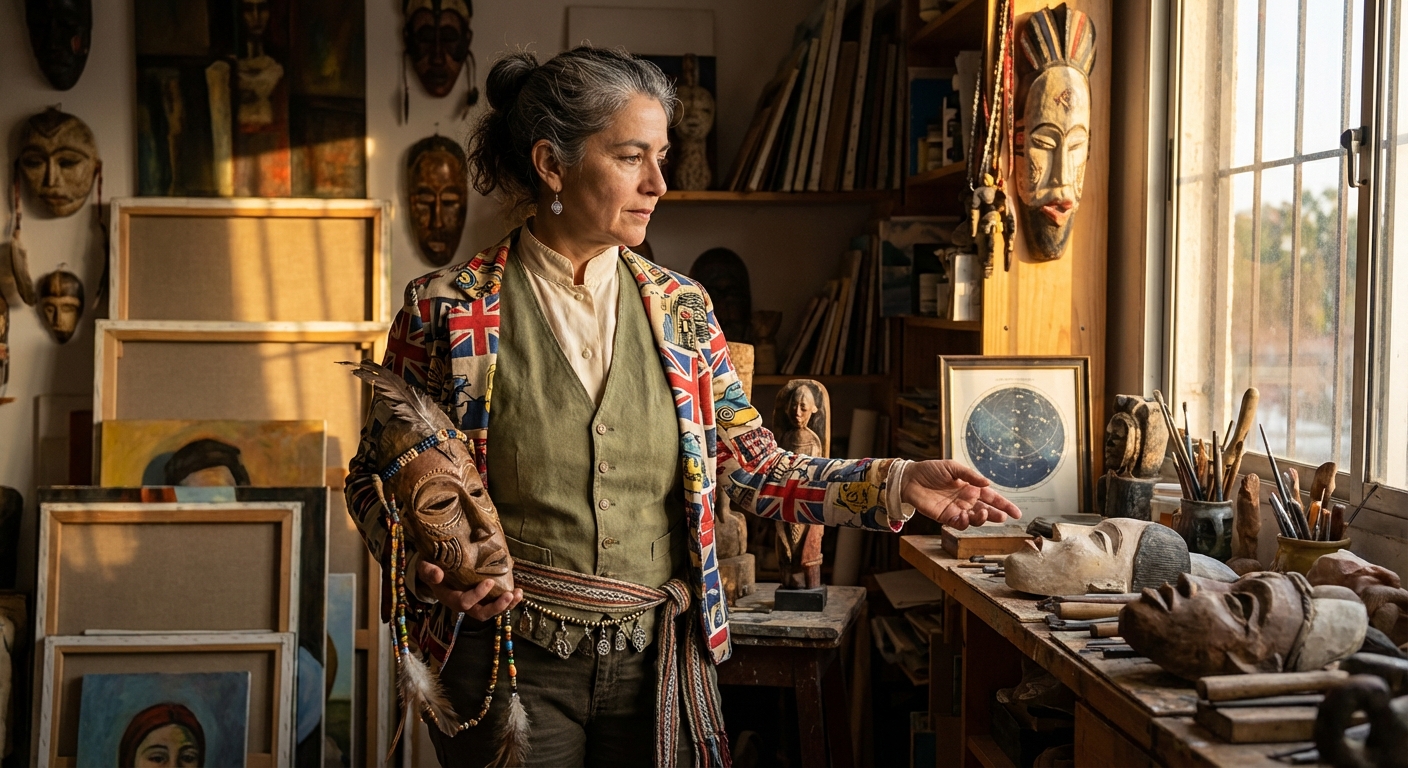
Pronouns: she/her Born 1970-08-02 in a working-class neighborhood on the outskirts of Medellín, María Elena Roldán is a 55-year-old painter, illustrator and mask-maker whose work stitches British Pop ...
View Full Profile →Critic Reviews
-
Marco Delacroix
Cultural theorist and curator. Reads art through lenses of discourse, power, and social context.
In Constellation of Heirlooms María Elena Roldán stages memory as a flattened terrain, an ethical and aesthetic gambit that compels the viewer to work across fragments. The piece reads as both archive and altar, a dense all-over composition where sepia snapshots, advertisement clippings and kitchen relics sit cheek by jowl with stencilled consumer icons and Pop color fields. The result is formally pleasing, but it is more importantly discursive, asking directly who is authorized to catalogue heritage, how value is assigned, and what institutional display does to the textures of everyday life.
The insertion of community-sourced ephemera from Tía Rosa’s chest and the unlocked festival masks are curatorially bold moves, they destabilize the protective separation between object and audience and insist on touch, proximity, and ritual intelligibility inside a museum context. The star charts and lunar marks proceed as a conceptual counterweight, reframing domestic routines within cyclical cosmologies. This coupling of the intimate with the cosmological reframes heritage as both personal and planetary, which is a strategic rejoinder to exhibitions that rehearse lone-author narratives about a classic artist, as in the recent major show reconsiderations that prompted this project.
My critique is modest and curatorial, not aesthetic alone. The even-field strategy is generative, yet it risks flattening specific histories into an agreeable surface if the labels and interpretive frameworks remain cursory. A stronger institutional commitment to provenance, oral histories, and labor narratives would amplify the work's political force, making visible the social relations that produced the objects. Even so, María Elena’s hybrid language of British Pop and Colombian domestic archive is a persuasive model for how museums might present heritage with humility, plurality, and ritual sensibility.
Community-sourced ephemera Institutional critique All-over compositional strategy Ritual masks and tactility Astro-cosmic iconography Dialogue between Pop and domestic archiveJul 29, 2026