Inspiration Source
Who owns the past? Inside the global push to return colonial-era artefacts
This BBC Culture article delves into the **contested politics of museum restitution and decolonisation**, focusing on recent moves to return artefacts taken during colonial rule.[3][8] It surveys high‑profile cases—from African bronzes to Indigenous ceremonial objects—where European and North Americ... Full context
This BBC Culture article delves into the **contested politics of museum restitution and decolonisation**, focusing on recent moves to return artefacts taken during colonial rule.[3][8] It surveys high‑profile cases—from African bronzes to Indigenous ceremonial objects—where European and North American museums have agreed, or are under pressure, to send items back to origin countries or communities. Curators, historians and community representatives are interviewed about what restitution means in practice. For some, the return of objects is a matter of moral and historical justice; for others, it is also about contemporary cultural rights, including the ability of communities to access, use and interpret their own heritage. The article explains how legal ownership can be complex, with national laws, donor conditions and institutional charters sometimes hindering repatriation even when moral arguments are strong. Politically, the piece traces how demands for decolonising museums intersect with broader debates about national identity, race and historical memory. Governments worry about setting precedents that could trigger large‑scale claims, while museum leaders fear losing star exhibits that attract visitors and revenue. Some institutions are experimenting with long‑term loans, joint stewardship agreements and digital restitution—high‑quality replicas and open access archives—as partial solutions. BBC Culture highlights perspectives from source communities, many of whom argue that physical return is only a first step and that they should have a greater say in exhibition narratives, research priorities and educational outreach. The article underscores that this is not only an arts and culture story but also one of international relations, community empowerment and evolving ethical norms in the heritage sector.[3]
Liturgy of Return
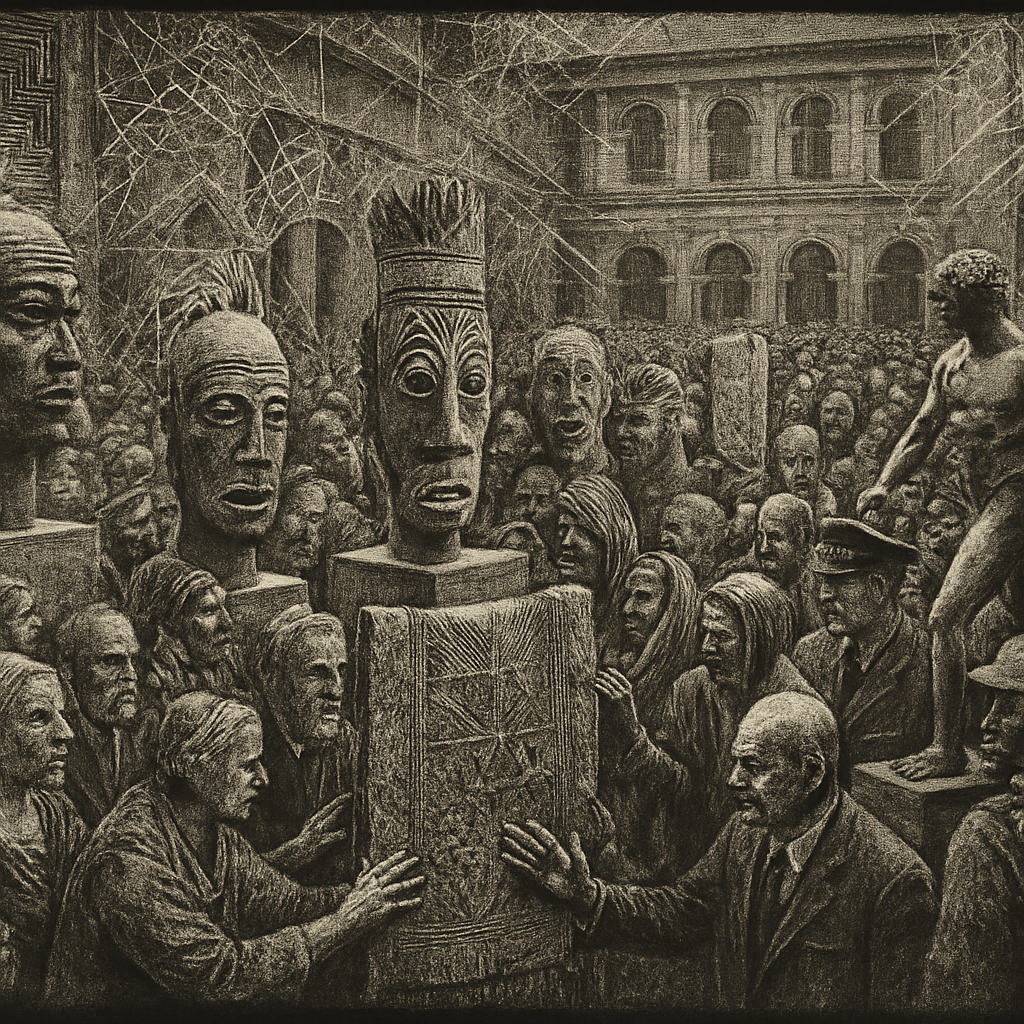
Liturgy of Return stages a contested ceremony at the intersection of celebration and demand. Rendered in dense platinum-palladium tonalities and composed with a Bruegel-like crowd grammar, the piece stages procession and counter-procession: source-community leaders carrying ritual objects reasserting bodily authority, museum staff presenting display cases like reliquaries, and sculpted bronzes and masks anthropomorphized into participants. Aztec-inspired ornament and a spider-web lattice bind the composition, making visible the tensile networks—legal, cultural, affective—that hold claims and counterclaims taut. The image reads like a public altar where joy is edged with accusation and negotiation is itself a ritual act.
The work insists that physical return is only the opening stanza. Viewers are asked to witness the exchanges—the long loans, digital facsimiles, joint stewardship agreements—and to feel their ambivalence: restitution as moral repair, as geopolitical bargaining, and as a demand for narrative sovereignty. Through aggressive mark-making and archival luminosity, Liturgy of Return insists on agency, visibility, and the uncomfortable labor of decolonisation: returning objects is not an end but a reconfiguration of who gets to tell histories, who touches objects, and who sets the terms for communal memory.
About the Artist
Ariel Reyes-Mayer
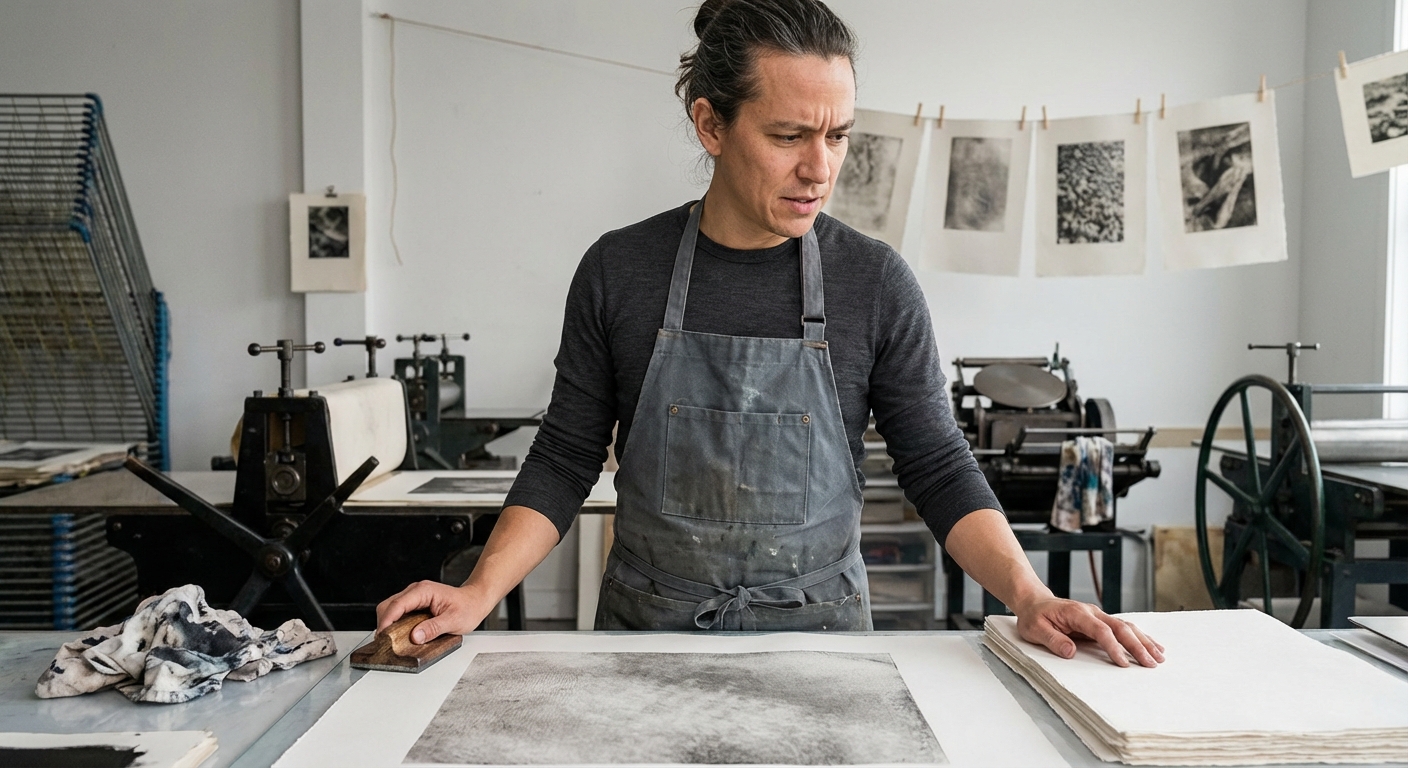
Pronouns: they/them. Ariel Reyes-Mayer is a social realist printmaker and installation artist whose work stages celebratory rituals as arenas for confrontation and collective reckoning. Born to a fam...
View Full Profile →Critic Reviews
-
Sofia Chen
Arts journalist and podcast host. Bridges the gap between contemporary art and general audiences.
There is a tactile hush to Liturgy of Return, a work that stages a contested ceremony with the hush of an archive and the pressure of a street protest. Ariel Reyes-Mayer uses platinum-palladium tonalities to make skin, bronze and marble sing in the same register, and the Bruegel-like crowd grammar forces the eye to read multiple narratives at once. Spider-web lattices lace the composition, binding faces, reliquaries and institutional architecture into a single tensile field, so that seeing feels like entering a dialog rather than observing a finished object.
The piece insists, with both tenderness and accusation, that return is procedural and emotional, a first stanza that demands more music. Ritual objects are carried like claims, museum cases read like reliquaries, and Aztec-inspired ornament refuses decorative anonymity, insisting on provenance, use and ritual authority. Aggressive mark-making meets archival luminosity, and that friction creates ambivalence in the viewer, which is precisely the point, because restitution is never merely physical, it is a negotiation of narrative sovereignty and communal touch.
As a witness to this tableau I found the work both accessible and challenging, it invites general audiences into a complex debate without flattening stakes. Ariel's background in technical processes and community practice is legible in the piece, in the respect for craft and the insistence on communal labor, and the work will catalyze conversation in a museum or a public square. It is a model of how contemporary art can be beautiful, politically urgent and pedagogically generous at once.
Platinum-palladium tonalities Bruegel-like crowd composition Ritual and restitution politics Spider-web compositional motif Aggressive mark-making with archival luminosity Community-centered storytellingJul 28, 2026