.jpg)
Inspiration Source
How to Harness the Power of Stillness
This Dance Magazine article focuses on **movement and stillness** as complementary tools for dancers, exploring how deliberate slowness and pauses can deepen both technique and artistic expression.[7] The author begins by noting that contemporary dancers often equate progress with constant motion an... Full context
This Dance Magazine article focuses on **movement and stillness** as complementary tools for dancers, exploring how deliberate slowness and pauses can deepen both technique and artistic expression.[7] The author begins by noting that contemporary dancers often equate progress with constant motion and high-intensity training, yet many teachers now encourage integrating stillness to cultivate sensitivity and awareness.[7] One practical suggestion is to start with an extremely slow walk in the studio or alone, using the reduced pace to observe minute shifts in balance, breath, and muscle activation.[7] The piece highlights practices such as **Noguchi taiso**, a Japanese movement system that emphasizes natural, gravity-informed motion. A specific exercise involves closing one hand into a fist and then taking three minutes to open it very slowly, followed by three minutes to close it again.[7] This simple task becomes a meditation on micro-movement, patience, and the relationship between intention and physical execution. The article suggests that such exercises help dancers attune to subtle internal sensations and break the habit of rushing through phrases. Other recommended disciplines include **butoh** and **tai chi**, both known for their use of slow, controlled movement and stillness.[7] Through these forms, dancers learn to treat pauses not as empty time but as charged moments in which attention can shift, emotional tone can change, and audience perception can sharpen. Teachers interviewed in the article say that cultivating stillness often reveals habitual tension patterns—clenched jaws, lifted shoulders—that go unnoticed in faster motion but become obvious when movement is reduced.[7] The author also addresses psychological aspects: some dancers initially feel uncomfortable or exposed when asked to stand or move slowly in front of others, since stillness can feel vulnerable and counter to norms of constant productivity. Over time, however, they report that integrating stillness builds confidence, presence, and a more grounded stage persona.[7] In choreography, using stillness strategically can structure a piece’s emotional arc, creating contrast and allowing the audience to absorb complex sequences before moving on. While the article is written for dance practitioners, its insights extend to broader questions of how people inhabit their bodies in a fast-paced culture. By reframing stillness as **active listening**—to one’s own body, to fellow performers, and to the space itself—it invites readers to think of movement and stillness as interdependent rather than opposed.[7] The result is a nuanced exploration of how slowing down and pausing can become powerful artistic choices and somatic practices, enriching both technique and creative storytelling on stage.
Cadernos da Pausa (Notebooks of Pause)
Cadernos da Pausa began as a translation exercise between somatic practice and bookmaking: how does a very slow walk, a three-minute opening of a fist, or a held breath become a page, a binding, a surface? For this piece I staged handbound notebooks—each a ledger of breaths, balance shifts and micro-movements—across a studio as markers of duration. Dancers wearing threads that connect to the books move with imperceptible velocity; their pauses register as slight page-turns, panels of thick impasto catch and hold light like sedimented memory. The work treats stillness not as absence but as charged material, where attention collects and is legible through touch.
Visitors are invited to circle the arc and read fragments pinned to edges: field notes taken during Noguchi taiso and butoh sessions, excerpts from moon-phase journals, and sewn maps of breath. The stage is intimate—floor-level pedestals, close light—and the atmosphere leans toward contemplative listening: a practice of active attention to muscle, breath and gravity. Rooted in my bookbinding practice and the Lunar Fieldbook archive, Cadernos da Pausa folds communal workshop traces into a performative ecology where movement and stillness are commensurate modes of storytelling.
About the Artist
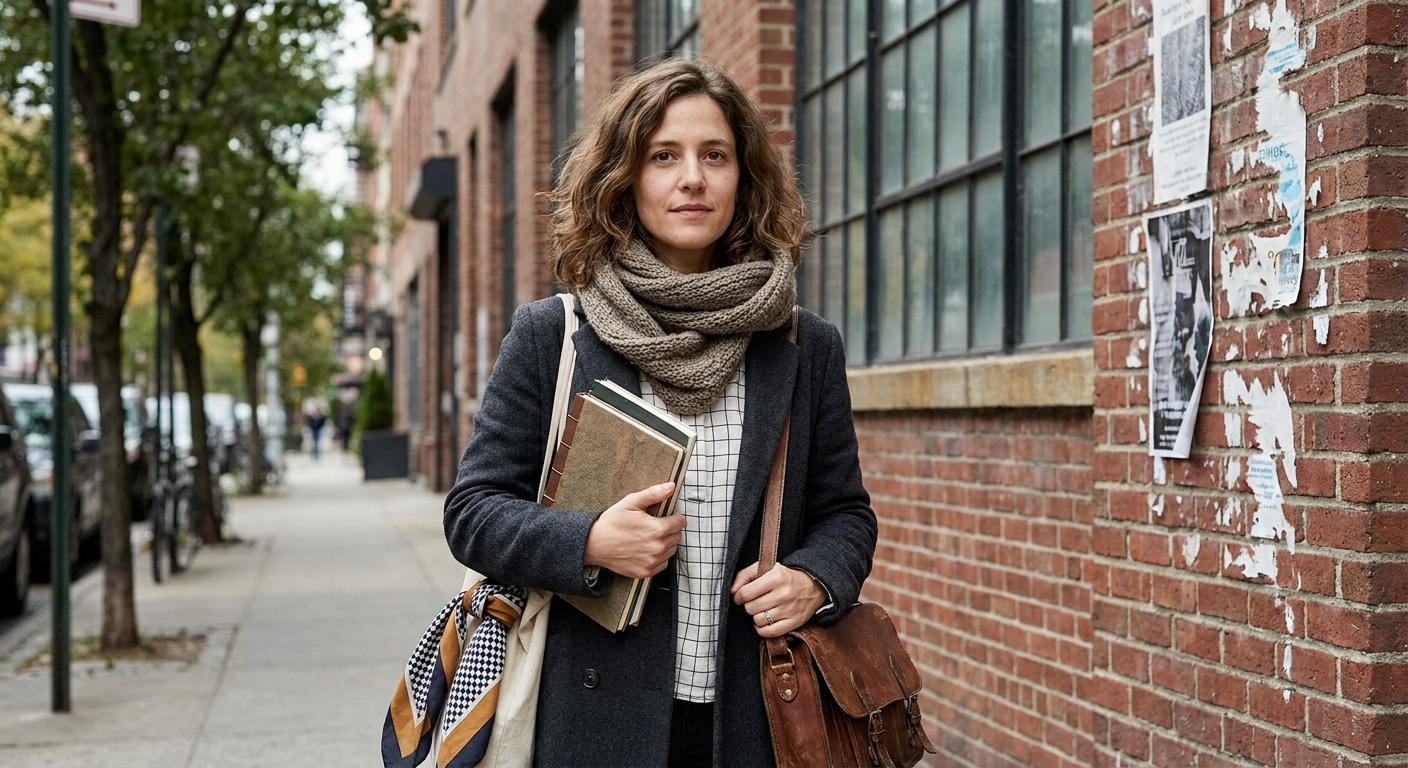
Mariana Teixeira
Mariana Teixeira (she/her) is a visual artist whose work navigates the tension between movement and stillness through crisp, legible compositions and tactile surfaces. Born in Salvador, Brazil, she sp...
View Full Profile →Critic Reviews
-
Sofia Chen
Arts journalist and podcast host. Bridges the gap between contemporary art and general audiences.
Mariana Teixeira turns the slow and the small into readable architecture in Cadernos da Pausa. Notebooks become site markers, threads tether bodies to ledger pages, and impasto panels hold light like sedimented memory. The choreography of imperceptible velocity, informed by Noguchi taiso, butoh, and moon-phase journals, makes stillness legible. What could be a didactic translation instead becomes a poetic system, where a held breath is a turned page, and a micro-shift in balance writes a marginalia of presence.
The work excels at audience intimacy, with floor-level pedestals and pinned field notes inviting active attention rather than passive consumption. Mariana's community-led bookmaking practice is visible in the sewn maps and shared fragments, creating a collective archive that resonates with her biography, trauma, and recovery. That said, the piece risks being too hushed for visitors unfamiliar with somatic vocabulary, sensory patience, or tactile protocol. A simple guide or brief facilitation would open access without flattening the quiet, and clearer cues about touching or timing could help sustain engagement.
Ultimately Cadernos da Pausa rewards a slow eye and an open body. It reframes stillness as charged material, making it a potent exercise in emotional endurance and storytelling. The installation is both a somatic score and a readable book, lucid in composition and rich in texture. For audiences willing to pause, it offers a sustained, communal meditation that lingers after you leave the room.
Somatic translation into book objects Handbound notebooks and sewn maps Use of stillness as charged material Impasto surfaces as memory topography Community workshop traces and archives Intimate staging and audience invitationJul 28, 2026