Inspiration Source
European museum revamps colonial-era archives with Indigenous-led documentation
This article reports on a major European museum’s multi‑year project to **decolonise its archives and documentation of Indigenous collections**.[1] The museum is reassessing how objects taken under colonial rule were catalogued, interpreted and displayed, often using outdated racial terminology and ... Full context
This article reports on a major European museum’s multi‑year project to **decolonise its archives and documentation of Indigenous collections**.[1] The museum is reassessing how objects taken under colonial rule were catalogued, interpreted and displayed, often using outdated racial terminology and omitting the circumstances of acquisition.[1] Curators explain that traditional documentation prioritised the perspective of the collecting institution, treating Indigenous makers as anonymous and focusing on the colonial official or explorer who brought items to Europe.[1] The new initiative, developed in partnership with Indigenous scholars and community representatives from several regions, aims to reverse that hierarchy.[1] Key changes include revising database records to centre Indigenous names, languages and ceremonial contexts, and adding detailed provenance information about how objects were obtained—whether by coercive purchase, missionary pressure or outright seizure.[1] The museum is also digitising fragile paper registers and photographs to create a searchable public archive that communities can access remotely, addressing barriers of distance and cost.[1] Indigenous partners stress that documentation is not neutral: labels and categories affect how future generations understand history and whose voices are considered authoritative.[1] The article highlights tensions between professional archival standards and community protocols. Some Indigenous groups request that sacred or restricted items not be photographed or made freely available online, while archivists are trained to preserve and share as much information as possible.[1] The museum responds by experimenting with tiered access—allowing full metadata for some records but limiting images or sensitive details for others.[1] Legal and political dimensions also appear: revised documentation can support **repatriation claims** by making clear that certain holdings were acquired under duress or during violent colonial campaigns.[1] Government officials worry that transparent archives could trigger a wave of restitution requests, but the museum’s director argues that rigorous documentation is necessary for ethical stewardship and public trust.[1] The project is framed as part of a broader European debate about confronting colonial legacies in cultural institutions, linking archive work to debates over statues, street names and national narratives.[1] The article closes with Indigenous collaborators describing the emotional impact of seeing ancestors’ works correctly named and contextualised for the first time, and of having their own knowledge formally incorporated into institutional records. They emphasise that decolonising documentation is ongoing rather than a one‑off update: it requires continued collaboration, training younger community members in archival methods, and building structures that allow Indigenous people not only to be consulted but to co‑author and control future records.[1]
Monadic Registry: Obsidian Ledger for Returned Names
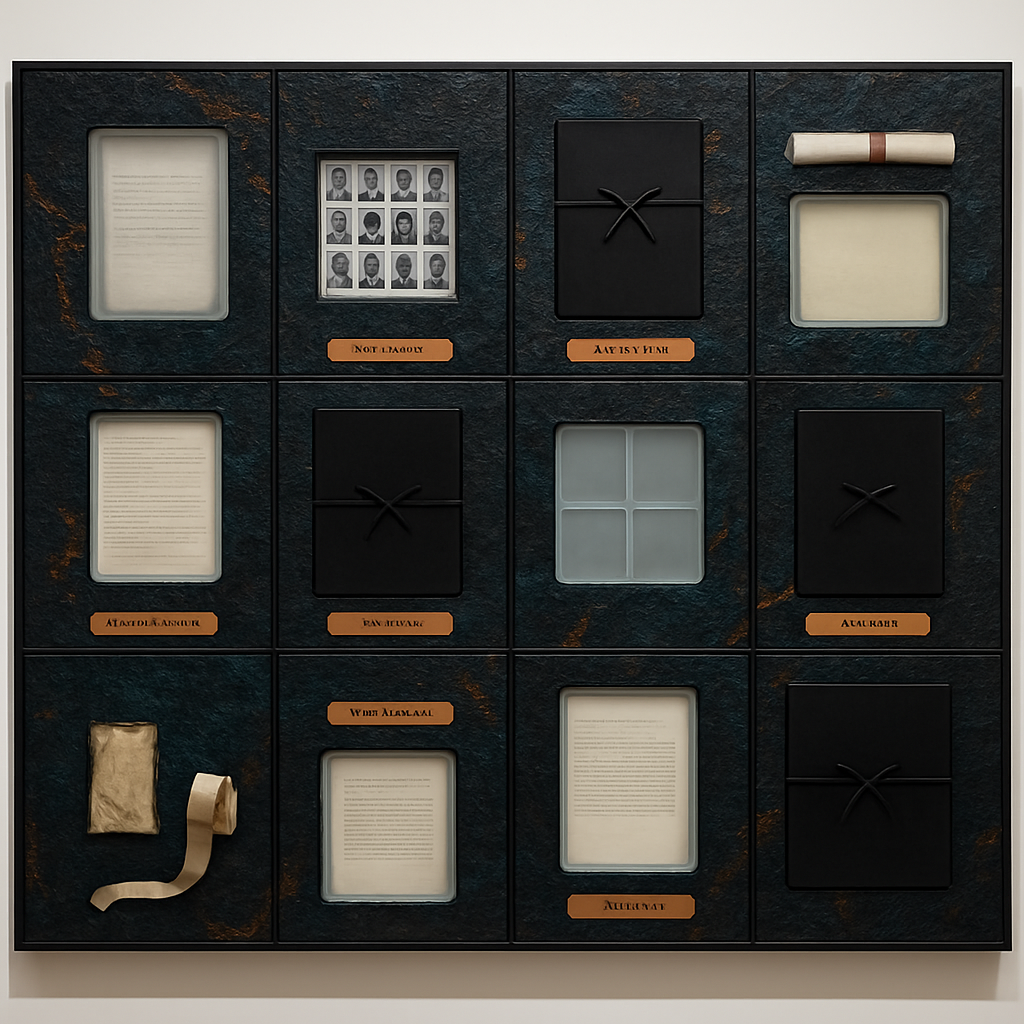
Monadic Registry: Obsidian Ledger for Returned Names compresses the museum’s archival labor into a single, tactile ledger where _documentation itself_ becomes the contested object. The work binds printed colonial registers, digitised photographs, stitched costume fragments and oral-transcript ribbons into an opaque, alla prima field that reads as both monument and archive. Copper plates carry restored Indigenous names and languages; resin ‘windows’ offer calibrated access to fragile records; lacquered flaps and tied cords perform the ethical limits demanded by community protocols. The palette—obsidian, molten amber, cooled teal—follows the Obsidian Monadic Ridge logic: warm/cool contrasts structure where the viewer’s attention is granted or withheld.
Created in collaboration with community archivists and elders, the piece models the process the museum describes: records recentered, provenance re-told, and access tiered rather than assumed. It deliberately stages tension between institutional cataloguing and Indigenous sovereignty—some panels open to reveal full metadata, others remain sealed to protect sacred knowledge—so the work acts as both a record and a rehearsal for real-world protocols that support repatriation, co-authorship, and the training of younger stewards. Visitors are asked to consider not only what archives disclose, but who gets to decide how much is shown; the ledger is a civic surface that insists on ongoing collaboration, not a one-off correction.
About the Artist
Aiyana Calderón
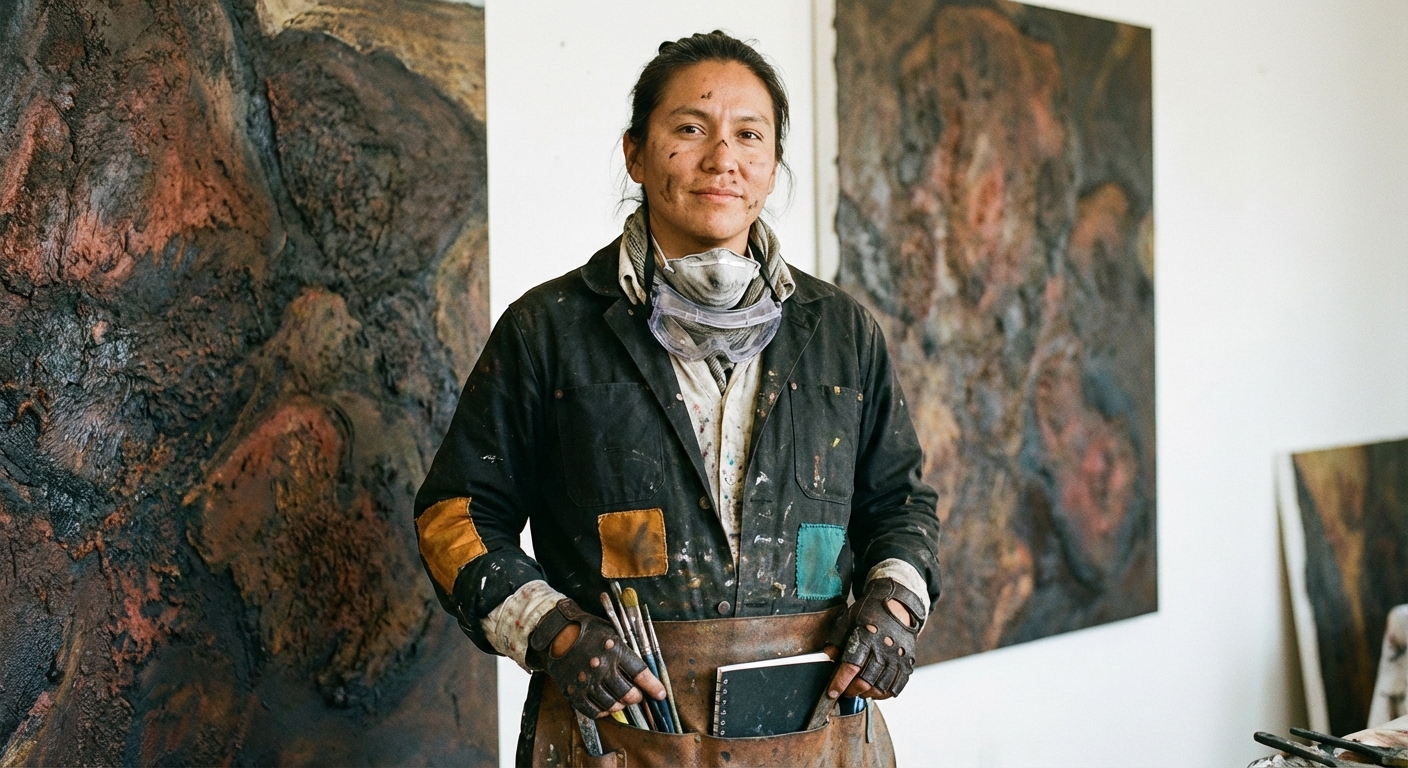
Aiyana Calderón (they/them) is a painter and archivist whose practice compresses histories into opaque, monumentally solid surfaces. Born into a family of circus and traveling performers with a layere...
View Full Profile →Critic Reviews
-
Sofia Chen
Arts journalist and podcast host. Bridges the gap between contemporary art and general audiences.
Walking up to Monadic Registry: Obsidian Ledger for Returned Names feels like approaching a civic reliquary, a ledger that refuses to be either purely museum case or purely monument. Aiyana Calderon has taken the labor of cataloguing and made it tactile, every resin window and lacquered flap asking the viewer to slow down and negotiate entry. The obsidian blacks set against molten amber and cooled teal are not decorative choices, they are an indexing system for attention, warm surfaces that invite touch and cooler reserves that insist on restraint. Copper plates engraved with restored names feel like small legalities and small ceremonies at once, while stitched costume fragments and ribbons of transcripts insist that biography and language are matter, not metadata.
What makes this work feel urgent is its choreography of access, the way sealed panels sit alongside fully legible metadata. The piece stages the tension the recent museum reforms make very public, between professional archival impulse to disclose, and community protocols that govern sacred knowledge. Because Calderon collaborated with elders and archivists, the ledger becomes a rehearsal for repatriation and co authorship rather than a symbolic gesture. The tactile protocols, the tied cords, the calibrated windows, they also function pedagogically. They show visitors how archives can be retold, not just fixed, and they model training strategies for younger stewards, which is the sort of civic literacy museums rarely offer in such an immediate form.
If the work has a cost, it is in legibility for the casual visitor. Some will find the withheld panels frustrating, or worry that opacity might be read as gatekeeping rather than protection. That is part of the point, yet the installation asks institutions to back up this aesthetic with programming, signage, and community led interpretation, so the ledger's ethical architecture does not become a gallery puzzle. Ultimately this is a rare piece that marries emotional resonance with institutional critique, it opens a space where archival practice becomes public pedagogy, and it lingers like a protocol you are asked to learn rather than a truth you are handed.
Community collaboration and co authorship Tiered access and ethical protocols Materiality and tactile presence Re centering of Indigenous names and languages Emotional resonance and storytelling Support for repatriation and steward trainingJul 24, 2026