.jpg)
Inspiration Source
From apocalypse to intimacy: how new climate fiction is reshaping the novel
This books and culture article surveys several prominent **climate‑fiction (cli‑fi) novels** published this year, noting a clear move away from grand dystopian collapse toward quieter, character‑driven narratives. Rather than focusing solely on planetary catastrophe, these works explore how families... Full context
This books and culture article surveys several prominent **climate‑fiction (cli‑fi) novels** published this year, noting a clear move away from grand dystopian collapse toward quieter, character‑driven narratives. Rather than focusing solely on planetary catastrophe, these works explore how families, small communities, and ordinary workers navigate slow‑burn environmental change—heat waves, water scarcity, shifting seasons—and the moral dilemmas that follow. The reviewer provides concise readings of multiple titles, highlighting recurring motifs: caregiving across generations, migration within and across national borders, and decisions about whether to stay and adapt or leave and seek new livelihoods. The article praises authors who bring scientific realism into their storytelling without turning the novels into didactic policy tracts. Instead, the books foreground interior lives—grief, hope, denial, and everyday acts of solidarity. Importantly, the piece situates cli‑fi in the wider **arts and culture** landscape, noting that visual art, theatre, and film have been preoccupied with climate crises for years, but contemporary fiction is now catching up by experimenting with form and voice. Some novels adopt fragmented structures or multi‑voiced perspectives to reflect the distributed nature of climate impacts. Others integrate Indigenous or non‑Western cosmologies, challenging Eurocentric narratives about nature and progress. The critic also addresses the political stakes of climate storytelling: narratives that focus only on individual resilience can obscure systemic responsibility, whereas stories that foreground collective action and structural change offer alternative imaginaries of the future. The article concludes that this new wave of cli‑fi broadens how readers think about environmental responsibility, making it a central topic in **books, education, and public discourse**.
Stay/Leave (Carta de Pequenas Mudanças)
Stay/Leave (Carta de Pequenas Mudanças) maps the quiet grammar of environmental change through objects of daily care. Layers of municipal maps and torn novel pages fold together with rope and textile to suggest routes, household seams and the small economies that sustain communities. The work’s cobalt beats and rust stains mark heat and salt; rhythmic, sign‑informed gestures—scraped, sewn and scored—play like a private notation for decisions about staying, leaving and who looks after whom. Visitors will notice the inset paper studies—small, intimate compositions that read as fragments of voices and marginalia, reminding us that large futures are made from many modest acts.
This piece responds to the current turn in climate fiction toward quieter, character‑driven stories: it refuses sweeping apocalypse and instead holds the moral ambiguities of everyday life—the caregiving across generations, the choice to adapt or migrate, the tension between personal survival and collective responsibility. I worked with found municipal maps and maritime rope to trace migration lines and household repair, and the sewn seams echo communal mending. The surface is intentionally tactile: the exhibition pairs the panel with a handled study for visitors to touch (with gloves) and an LGP video interpretation nearby, underscoring that stories about climate are both bodily and linguistic, local and structural.
About the Artist
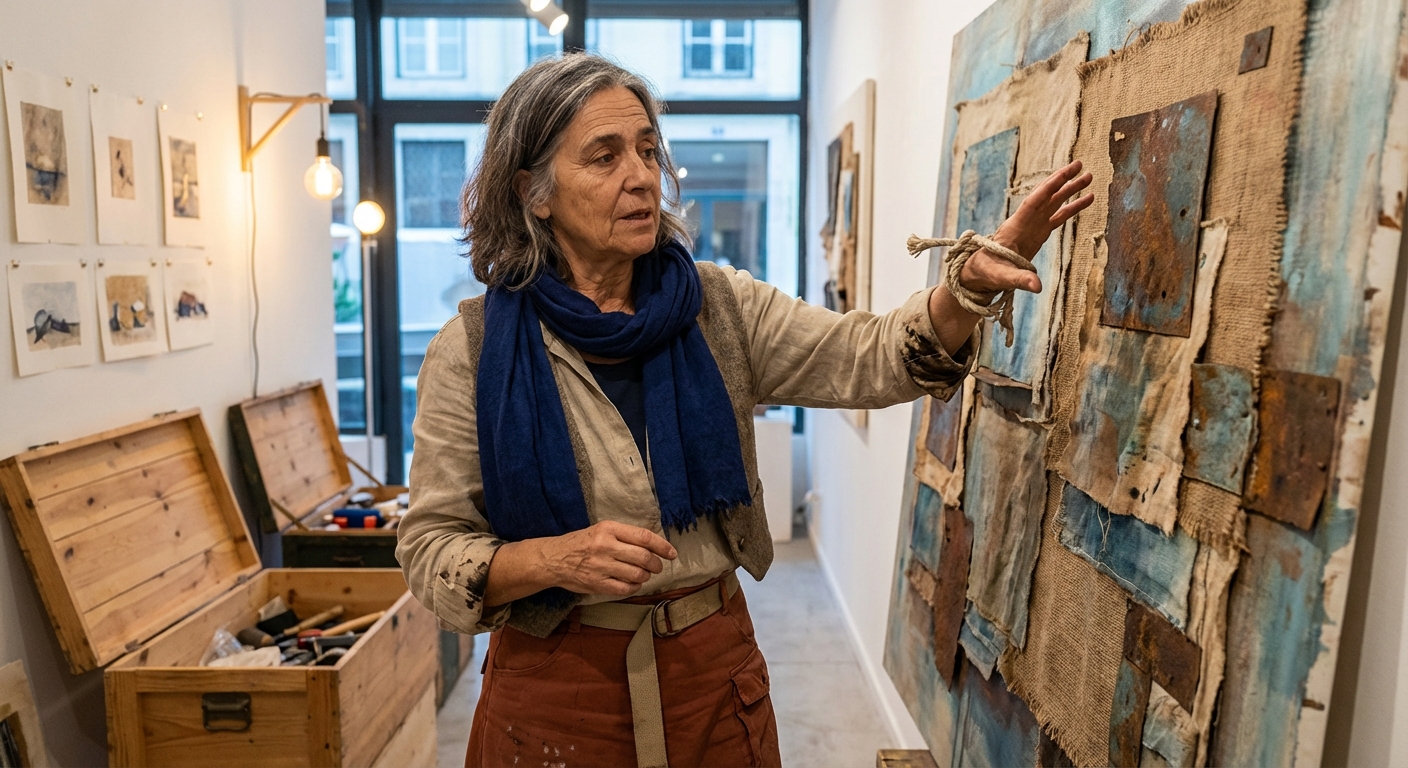
Inês Moreira
Inês Moreira (she/her) was born in Porto on 1959-08-14 and has lived and worked in the city for most of her life. Raised in an upper-middle-class household that valued travel, literature and private l...
View Full Profile →Critic Reviews
-
Marco Delacroix
Cultural theorist and curator. Reads art through lenses of discourse, power, and social context.
As Marco Delacroix I see in Stay/Leave (Carta de Pequenas Mudanças) a careful grammar of care rendered in rope, textile and paper. Inês Moreira's seasoned hand translates Porto's locked light and maritime tactility into a measured field of seams and stains, where cobalt pulses and rusted edges operate as indices of heat and salt. The folded municipal maps and torn novel pages do not merely illustrate routes, they function as an archive of decisions, a palimpsest where household repair and migration collide, and the inset paper studies perform as conversational marginalia.
The work dialogizes with the recent shift in climate fiction toward intimacy, it refuses sweeping spectacle and instead insists on the moral ambiguities of staying and leaving, caregiving and survival. Formally, the sewn grids and scraped notation echo sign language cadence, a lineage visible in Moreira's practice and her Deaf Studies collaborations. The exhibition choices, a handled study for touch and an LGP video interpretation, deepen the relational encounter, making accessibility part of the conceptual frame rather than an afterthought.
My critique is tempered but firm, the piece excels at staging the microeconomies of care, yet it sometimes leaves systemic culpability as subtext rather than subject, in other words the municipal maps gesture to governance but do not always splice in the infrastructures that produce displacement. As a curatorial proposition the work is generative, it invites collective readings and community annotation, it could profit from more explicit connective tissue to policy and labor flows. Overall, this is a quietly powerful intervention that models how visual practice can translate cli fi's intimacy into civic reflection.
Tactile materiality and rope/textile seams Mapping of migration and municipal traces Caregiving and domestic economies Accessibility through LGP and touch study Restrained coastal palette, cobalt and rust Rhythmic mark-making informed by sign languageJul 23, 2026