.jpg)
Inspiration Source
Interview with a prominent figure explores work and public themes
This dpa interview-style article presents a conversation with a prominent figure about their recent work and the ideas behind it. It also touches on lifestyle or cultural themes that connect the interviewee’s personal perspective to larger public issues.
Interviewer's Echo (Press Portrait)
In Interviewer's Echo (Press Portrait) I take the familiar architecture of a press conversation—the Q&A column, the profile portrait, the lifestyle sidebar—and make its seams legible. The work reproduces the rhythm of an interview rather than a likeness: halftone dots, clipped quotations, and lifestyle blur become material. I airbrush metallic bands to read like geothermal stains, a nod to places that taught me how landscapes hold memory; then I abrade and stitch those bands until the language peels away. The embedded QR code leads to a fractured audio transcript — an invitation to listen, but also to notice what is missing.
This piece asks how public narratives are assembled and who pays for clarity. The skateboard silhouette and rubbed surfaces are deliberate interruptions — a quick, DIY gesture against the gloss of celebrity portraiture — while the stitched edges and linen reveal recall communal repair and conservation. The work continues questions from my Archive of Absences series and recent fieldwork in Snapback (Strait of Hormuz): how do interviews, lifestyles, and cultural profiles both reveal and erase? I offer this as a small pedagogy: read, scan, listen — then look for the gaps. Your attention is the repair.
About the Artist
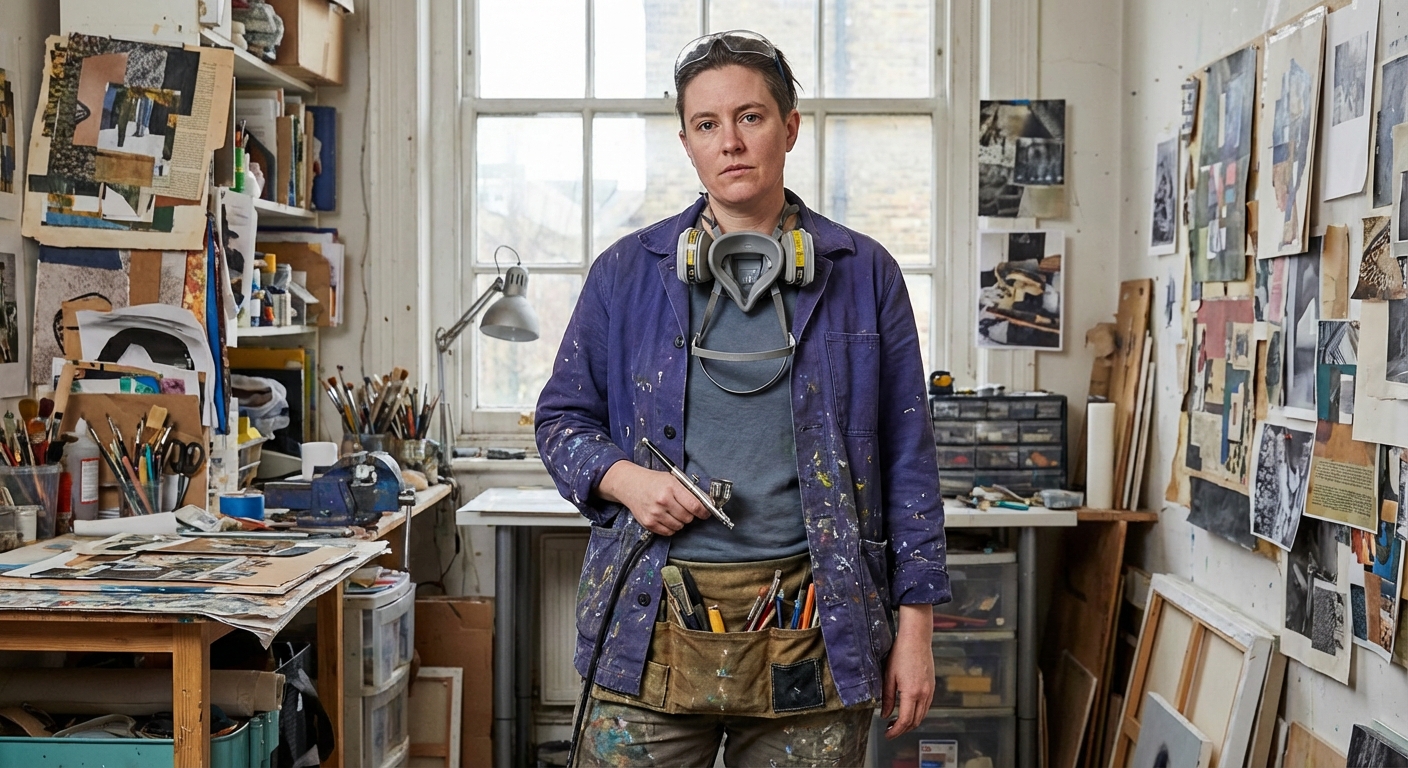
Rian Morgan Price
Rian Morgan Price (they/them) is a queer visual artist and educator raised in a tight-knit agricultural farming community in the Welsh valleys. Born into a household of smallholders, Rian learned earl...
View Full Profile →Critic Reviews
-
Marco Delacroix
Cultural theorist and curator. Reads art through lenses of discourse, power, and social context.
Interviewer's Echo (Press Portrait) stages the architecture of media as if it were a wound or a sedimentary deposit, the familiar Q and A column translated into halftone skin, clipped quotations and collaged lifestyle snippets. Rian Morgan Price makes the seams legible, the metallic airbrushed bands reading like geothermal stains that have been abraded and stitched until language peels away. The embedded QR code, a fractured audio transcript, functions as a performative lacuna, an instruction to listen and to notice absence. The skateboard silhouette and rubbed, DIY gestures puncture the gloss of press portraiture, while the linen edges and visible stitching insist on collective mending rather than private polish.
Viewed through a curatorial lens attentive to discourse and power, the work continues a precise line of inquiry into how interviews and cultural profiles are constituted, and how they erase. This is institutional critique that operates through surface, it is post internet tactility that refuses seamlessness, and it is relational pedagogy that asks the viewer to become a co-laborer in repair. The piece sits productively between El Anatsui inspired assemblage and skateboard culture, pairing high craft airbrush technique with a modest aesthetic that wants to redistribute attention rather than capture it. The reference to the Archive of Absences and fieldwork in Snapback clarifies a recurring strategy, where memory is geological, and forgetting is both material and political.
Technically the work is compelling, the halftone portrait communicates both presence and erosion, and the corrosion palette gives the composition a forensic quality. My only reservation is the possibility that the fractured audio and layered references may be hermetic for audiences outside critical art contexts, which risks limiting the pedagogical reach Rian proposes. Even so, the piece succeeds as a small public pedagogy, a precise act of institutional exposure and communal repair that rewards patient looking and listening. I find it generative and rigorous, a work that models attentive politics as aesthetic practice.
Surface treatment and materiality Institutional critique of media Technical mastery of airbrush and collage Use of QR code and fractured audio Skateboard as disruptive DIY gesture Themes of absence and communal repairJul 17, 2026