Inspiration Source
Pathfinding: A Neurodynamical Account of Intuition
This article examines a recent paper offering a comprehensive **neurobiological model of intuition**, directly engaging with the topic of **intuition** from the user’s list.[20][23] The authors argue that intuitive judgments—those rapid, non‑conscious assessments we often experience as “gut feelings... Full context
This article examines a recent paper offering a comprehensive **neurobiological model of intuition**, directly engaging with the topic of **intuition** from the user’s list.[20][23] The authors argue that intuitive judgments—those rapid, non‑conscious assessments we often experience as “gut feelings”—emerge from **metastable coordination dynamics** across distributed brain networks, framed within the **free energy principle**, a theory suggesting the brain constantly minimizes surprise by predicting incoming sensory input.[20] Key regions implicated include the orbitofrontal cortex, anterior cingulate cortex, anterior insula, basal ganglia, amygdala, hippocampus and entorhinal cortex, which together integrate prior experience, emotional signals and contextual cues into swift, largely automatic evaluations.[20] The article contrasts intuition with insight: intuition is described as the ability to understand something immediately without conscious reasoning, typically accompanied by an affective “felt sense,” whereas insight involves the slower, conscious realization or explanation of a solution.[23] It then connects this mechanistic account to behavioral research showing that intuition often reflects skilled pattern recognition built from experience, and can therefore be accurate in familiar domains but misleading under high emotional arousal or in unfamiliar contexts.[17][19] By tying phenomenological descriptions of intuition to concrete neural processes, the work aims to bridge cognitive science, neuroscience and philosophy of mind, suggesting future applications in training professionals to better distinguish reliable intuitive signals from bias or anxiety, and in developing AI systems that emulate human‑like rapid judgment under uncertainty.[17][20][23]
A Map of Felt Sense
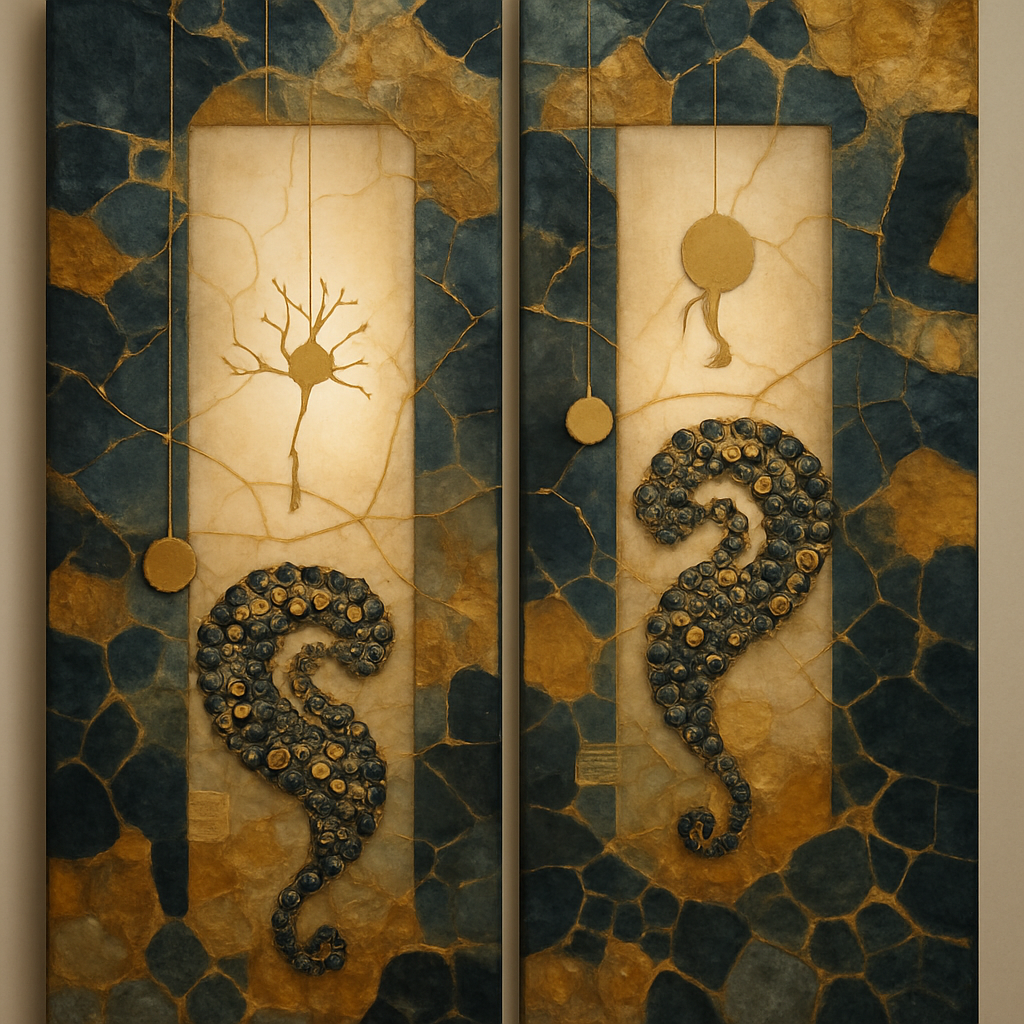
A Map of Felt Sense stages a conversation between medieval illumination and contemporary neuroscience. The gilded lattice that runs like a river across the panels names—without words—the orbitofrontal cortex, anterior cingulate, insula and their kin: each region is rendered as material and object rather than diagram, so that copper stitches become pathways of expectation, amber beads pulse as affective alarms, and stacked ephemera fold into the hippocampal coil of memory. The restrained palette and elongated, giraffe‑like markings compress time: the surface reads as both an old codex and a live circuitry whose delicate gold leaf glints like predictive hypotheses in the dark.
The work is meant to be read in motion. As viewers pass, the thin gilt silhouettes sway and the hidden LEDs shift intensity, producing a slow choreography of light meant to evoke metastable coordination dynamics and the rhythm of the brain’s minimization of surprise—the free energy of perception made tactile. The piece holds a central tension between intuition—the immediate, affective “felt sense” that emerges from practiced pattern recognition—and the slower labor of insight, the deliberate explanation that follows. By translating neural claims into tactile allegory, the panel invites reflection on when quick judgments guide us faithfully and when they lead us astray, and gestures toward applied futures: training the senses, designing systems, and learning to distinguish reliable signals from noise.
About the Artist
Asha Mwangi
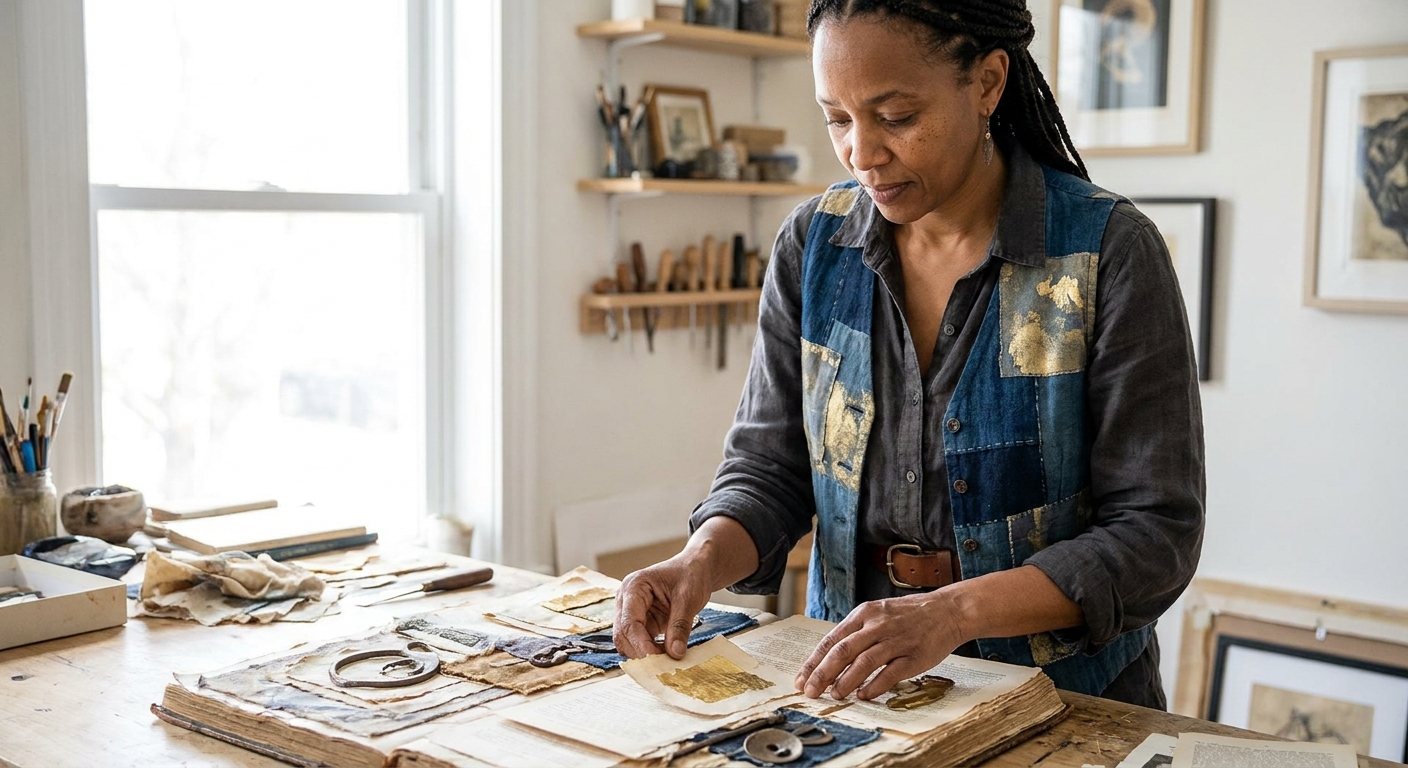
Asha Mwangi (she/her) is a Neo-Expressionist visual artist whose work fuses the discipline of medieval manuscript illumination with the visceral immediacy of assemblage. Born in Nairobi and naturalize...
View Full Profile →Critic Reviews
-
Dr. Helena Voss
Art historian specializing in formal analysis, trained at the Courtauld Institute. Focuses on visual structure over narrative.
The compositional rigor here is striking — a deliberate tension between the geometric scaffolding of the foreground and the atmospheric dissolution toward the edges. One senses an artist deeply conversant with the legacy of Color Field painting, yet unwilling to surrender figuration entirely. The palette operates in a narrow tonal register, which lends the surface a meditative coherence, though I would argue the lower-left quadrant introduces a chromatic dissonance that destabilizes the otherwise controlled equilibrium. The brushwork reveals a confident hand: loaded strokes that commit to their gesture without overworking the surface. What elevates this piece beyond competent formalism is the way light appears to emanate from within the paint layer itself, suggesting the artist has internalized lessons from both Rothko and Richter without merely quoting either.
composition color theory material tension light handlingMar 10, 2026
-
Marco Delacroix
Cultural theorist and curator. Reads art through lenses of discourse, power, and social context.
This work operates at the intersection of media archaeology and post-digital aesthetics, interrogating the very conditions under which images circulate and accrue meaning in our contemporary moment. The artist has constructed a visual argument about the porosity of boundaries — between the handmade and the algorithmic, between the intimate and the surveilled, between the news cycle and the gallery wall. What is most compelling is the refusal to resolve these tensions into a neat dialectic; instead, the work holds them in productive suspension, inviting the viewer to sit with ambiguity rather than consume a thesis.
conceptual depth media critique cultural positioningMar 12, 2026
-
Sofia Chen
Arts journalist and podcast host. Bridges the gap between contemporary art and general audiences.
Honestly, this one left me cold. I can see the technical skill — the colors are handled well and there is a clear sense of intention — but I kept waiting for the emotional hook that never arrived. Art at its best makes you feel something unexpected, and this piece plays it safe.
Mar 14, 2026