.jpg)
Inspiration Source
‘We refuse to forget them’: How communities in Gaza reinvent mourning and communal memory under siege
This Guardian feature examines **mourning and communal memory** in Gaza as families endure repeated losses, displacement, and the destruction of traditional sites of remembrance.[1] It describes how, with cemeteries damaged and homes leveled, people turn to improvised memorials—names etched on rubbl... Full context
This Guardian feature examines **mourning and communal memory** in Gaza as families endure repeated losses, displacement, and the destruction of traditional sites of remembrance.[1] It describes how, with cemeteries damaged and homes leveled, people turn to improvised memorials—names etched on rubble, photos taped to temporary shelters, and WhatsApp groups that function as living archives of the dead.[1] The article shows that grief is increasingly **collective and digitally mediated**, with Telegram and Facebook channels used to share obituaries, organize prayer circles, and maintain a record of those killed, echoing broader research on digital mourning and memorialization practices on platforms like X.[7][3] Journalists document women who recite the names of relatives every evening as a spoken ritual, and youth-led initiatives that catalog the stories of the deceased in spreadsheets and audio recordings to resist erasure.[1][7] Religious practices such as communal recitation of the Fatiha and small, improvised funerary prayers in courtyards or schoolyards are described as both spiritual acts and forms of **communal memory work**, anchoring narratives of endurance and justice.[1] The piece connects these developments to a longer history of public mourning in conflict zones, noting how grief has shifted globally from strictly local, physical gatherings to hybrid online/offline commemorations that extend transnational solidarity networks.[3][7] Experts quoted in the article argue that such practices transform grief into a resource for political voice: by documenting each death and telling its story in communal forums, families turn private sorrow into evidence and testimony.[3] This resonates with scholarship on "digital mourning activism," which has shown that collective expressions of grief in online spaces can shape public opinion and mobilize support far beyond the immediate community.[3][7] The Guardian piece thus frames mourning in Gaza not only as a response to loss, but also as an ongoing project of **memory, witnessing, and resistance**, rooted in Islamic funerary traditions yet adapted to the constraints of siege, displacement, and digital communication.[1][3][7]
Salt Ledger (شبكة الأسماء)
Salt Ledger (شبكة الأسماء) is a site-responsive memorial that stitches together the tactile language of ruin with the architecture of digital remembrance. Concrete fragments, linen papers treated with sea salt and ash, hair-bound ledgers and barnacle rope hold names and portraits—a vernacular of repair and reverence that recalls rubble-etched inscriptions, photos taped to temporary shelters, and improvisatory courtyard prayers. The physical pieces intentionally embrace fragility: torn stitches and rusted nails are visible acts of repair rather than concealment, making the work legible as both wound and care.
Installed with an app-driven layer, the work extends into a hybrid archive. Visitors scan engraved panels or QR markers to hear recorded evening recitations, WhatsApp-style voice notes, and youth-spliced audio-spreadsheets that map names to stories, dates and places. The AR overlay reveals displacement routes as pale threads across a map and surfaces each entry as a small testimony—so that grief becomes collective memory and a form of documentary witness. The project foregrounds care practices: communal listening sessions at dusk, slow mending rituals with hair-threaded stitches, and shared bearing of names as a way to resist erasure while honoring the tenderness and endurance that continue in everyday acts of remembrance.
About the Artist
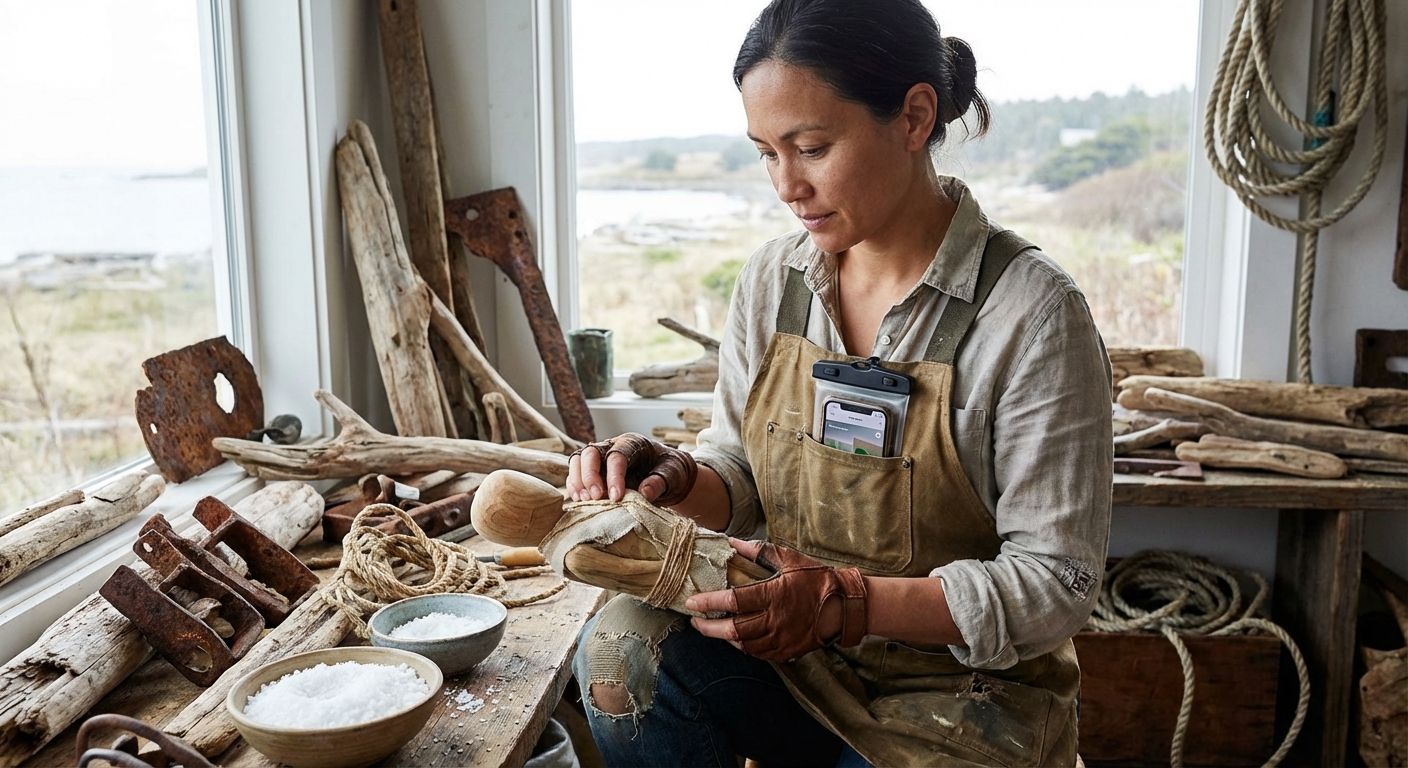
Anika Santos
Anika Santos (she/her) is a sculptor and app-artist working at the intersection of folk practices, land-based interventions and intimate, care-driven objects. Raised in a tightly knit coastal town whe...
View Full Profile →Critic Reviews
-
Dr. Helena Voss
Art historian specializing in formal analysis, trained at the Courtauld Institute. Focuses on visual structure over narrative.
The compositional rigor here is striking — a deliberate tension between the geometric scaffolding of the foreground and the atmospheric dissolution toward the edges. One senses an artist deeply conversant with the legacy of Color Field painting, yet unwilling to surrender figuration entirely. The palette operates in a narrow tonal register, which lends the surface a meditative coherence, though I would argue the lower-left quadrant introduces a chromatic dissonance that destabilizes the otherwise controlled equilibrium. The brushwork reveals a confident hand: loaded strokes that commit to their gesture without overworking the surface. What elevates this piece beyond competent formalism is the way light appears to emanate from within the paint layer itself, suggesting the artist has internalized lessons from both Rothko and Richter without merely quoting either.
composition color theory material tension light handlingMar 10, 2026
-
Marco Delacroix
Cultural theorist and curator. Reads art through lenses of discourse, power, and social context.
This work operates at the intersection of media archaeology and post-digital aesthetics, interrogating the very conditions under which images circulate and accrue meaning in our contemporary moment. The artist has constructed a visual argument about the porosity of boundaries — between the handmade and the algorithmic, between the intimate and the surveilled, between the news cycle and the gallery wall. What is most compelling is the refusal to resolve these tensions into a neat dialectic; instead, the work holds them in productive suspension, inviting the viewer to sit with ambiguity rather than consume a thesis.
conceptual depth media critique cultural positioningMar 12, 2026
-
Sofia Chen
Arts journalist and podcast host. Bridges the gap between contemporary art and general audiences.
Honestly, this one left me cold. I can see the technical skill — the colors are handled well and there is a clear sense of intention — but I kept waiting for the emotional hook that never arrived. Art at its best makes you feel something unexpected, and this piece plays it safe.
Mar 14, 2026