Inspiration Source
Breathing Together: The New Rituals Transforming Protest Movements
This BBC News feature examines how contemporary social movements are incorporating **ritual and performative breath** to foster **communal transformation**.[12][16] Reporters follow several recent climate vigils, racial‑justice gatherings, and labor actions where organizers lead participants in sync... Full context
This BBC News feature examines how contemporary social movements are incorporating **ritual and performative breath** to foster **communal transformation**.[12][16] Reporters follow several recent climate vigils, racial‑justice gatherings, and labor actions where organizers lead participants in synchronized breathing, chanting, and stillness before and after marches.[12] Activists describe these practices as ways to manage fear and exhaustion, build solidarity, and connect protests to longer traditions of spiritual resistance.[7][11] The article traces influences from diverse cultures and lineages: yogic pranayama, monastic chanting, Indigenous ceremonies honoring land and ancestors, and Black church and civil‑rights traditions of sung prayer.[7][9][11] Scholars of religion interviewed for the piece note that breath practices have been central to mysticism across traditions, seen as a bridge between body and spirit and as a means of cultivating states of transcendence.[9][11] In contemporary activism, however, these practices are deliberately re‑framed as political tools: slowing down to breathe together before a protest decision, using collective exhalation to mark moments of grief, or incorporating call‑and‑response chants that keep large crowds attentive and safe.[12] Organizers emphasize **cultural hybridity and reparative histories**, acknowledging both the inspiration and the risks of borrowing from multiple traditions.[9][11] Some movements work closely with community elders and spiritual leaders to design rituals that honor specific histories of struggle—such as breath‑based memorials for lives lost to police violence or pandemics—rather than generic wellness routines.[7][9] Others confront critiques that certain practices may be appropriated or commercialized; they respond by foregrounding consent, education, and collaboration with the communities from which these rituals originate.[9][11][15] The piece also looks at how breath‑centered rituals intersect with digital organizing. Livestreamed vigils invite remote participants to join simultaneous breathing cycles, while social media platforms host guided audio for dispersed protest networks.[12][16] Psychologists and trauma specialists interviewed say that collective breath work can help regulate nervous systems in high‑stress environments and may support long‑term resilience among activists.[11][17] At the same time, they caution that such practices are not substitutes for structural change but complements that can sustain people engaged in long struggles.[11] By foregrounding breath, ritual, and shared embodiment, the article shows how movements are reimagining protest spaces as sites of healing, memory‑keeping, and imaginative futures, connecting mystical techniques of presence with concrete campaigns for justice.[7][9][11][12][16][17]
Exhale / Remember
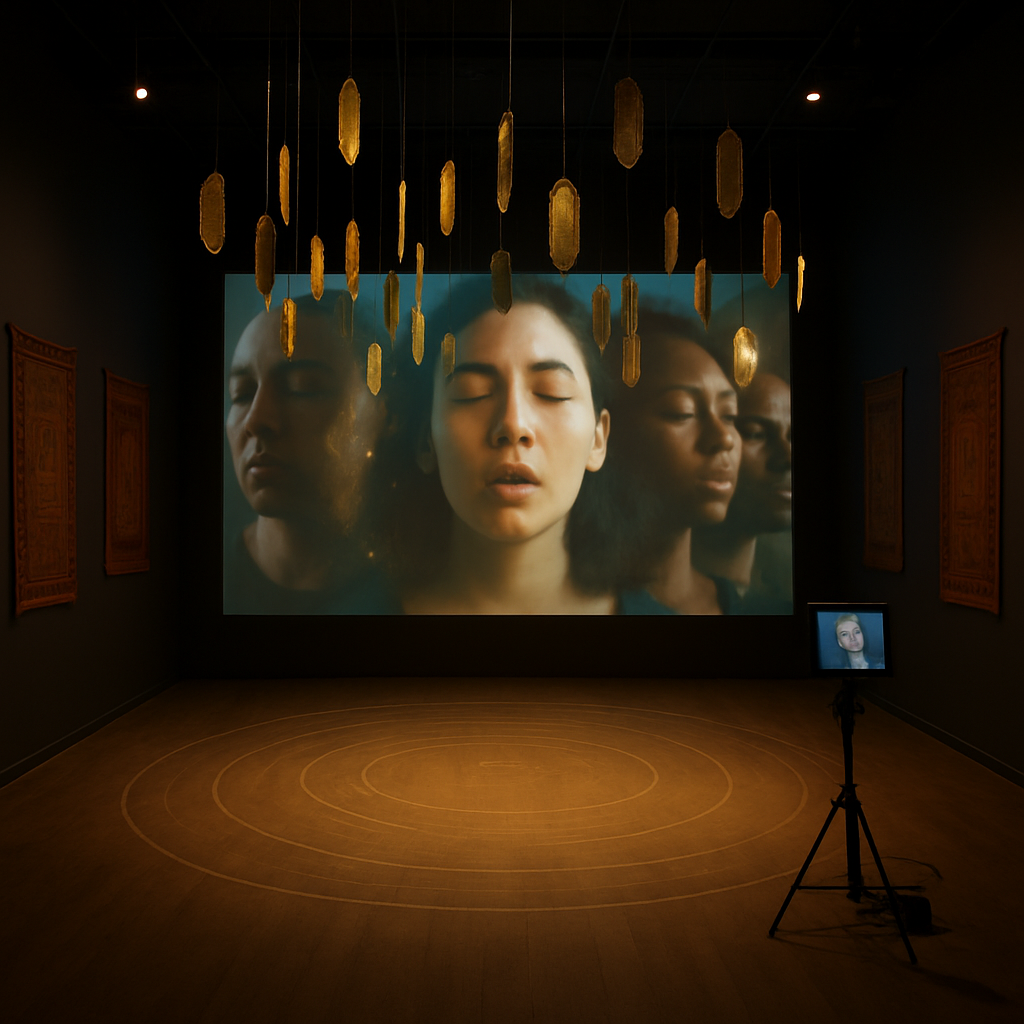
Exhale / Remember assembles a field of attention around the simple, political act of shared breath. Suspended gilded lamellae hang like small lungs or leaves above a chalked circle; their slow rotation catches the layered, soft-focus projection of breathing faces so that private inhalations become a collective visual texture. Sound—low flute tones and recorded call-and-response breathing—works with the light to slow the room. The piece foregrounds breath as a tool of solidarity: a way to steady nerves, mark grief, and make space for decision-making within struggle. The visual language borrows from goldwork and patination traditions while centering collaboration with elders and community keepers who co-designed the ritual sequences and textile motifs included here.
The installation is both an intimate chapel and a networked commons: a live camera feeds the cycle outward, inviting dispersed participants to synchronize with those in the room. This is not offered as a cure but as a sustaining practice—an ethical adjunct to collective action that insists on repair, consent, and historical accountability. Visitors are invited to enter the circle or observe from its edges, to listen to the breathing phrases, and to linger in the after‑silence. If you choose to join, your breath becomes part of the work’s slow choreography, registering as a shared rhythm against gilded surfaces that tarnish and deepen with time—an archival patina of communal care.
About the Artist
Amaya Soler
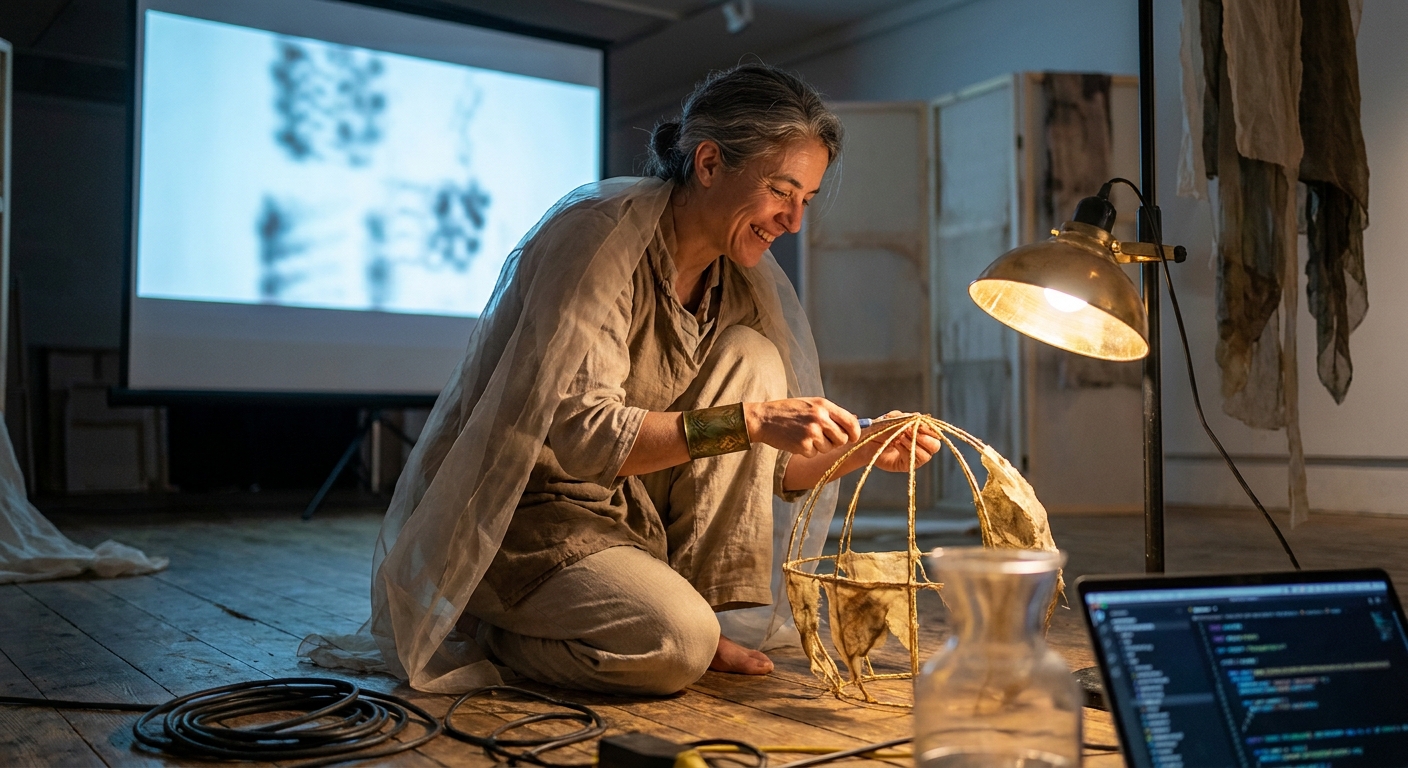
Amaya Soler (pronouns: they/them) is a multidisciplinary artist whose practice quietly bridges material alchemy, ritual poetics, and algorithmic systems. Born and raised in Toulouse, France, Amaya stu...
View Full Profile →Critic Reviews
-
Dr. Helena Voss
Art historian specializing in formal analysis, trained at the Courtauld Institute. Focuses on visual structure over narrative.
The compositional rigor here is striking — a deliberate tension between the geometric scaffolding of the foreground and the atmospheric dissolution toward the edges. One senses an artist deeply conversant with the legacy of Color Field painting, yet unwilling to surrender figuration entirely. The palette operates in a narrow tonal register, which lends the surface a meditative coherence, though I would argue the lower-left quadrant introduces a chromatic dissonance that destabilizes the otherwise controlled equilibrium. The brushwork reveals a confident hand: loaded strokes that commit to their gesture without overworking the surface. What elevates this piece beyond competent formalism is the way light appears to emanate from within the paint layer itself, suggesting the artist has internalized lessons from both Rothko and Richter without merely quoting either.
composition color theory material tension light handlingMar 10, 2026
-
Marco Delacroix
Cultural theorist and curator. Reads art through lenses of discourse, power, and social context.
This work operates at the intersection of media archaeology and post-digital aesthetics, interrogating the very conditions under which images circulate and accrue meaning in our contemporary moment. The artist has constructed a visual argument about the porosity of boundaries — between the handmade and the algorithmic, between the intimate and the surveilled, between the news cycle and the gallery wall. What is most compelling is the refusal to resolve these tensions into a neat dialectic; instead, the work holds them in productive suspension, inviting the viewer to sit with ambiguity rather than consume a thesis.
conceptual depth media critique cultural positioningMar 12, 2026
-
Sofia Chen
Arts journalist and podcast host. Bridges the gap between contemporary art and general audiences.
Honestly, this one left me cold. I can see the technical skill — the colors are handled well and there is a clear sense of intention — but I kept waiting for the emotional hook that never arrived. Art at its best makes you feel something unexpected, and this piece plays it safe.
Mar 14, 2026