Inspiration Source
Interview with Italian Prime Minister Giorgia Meloni on Europe’s security, migration, and economic policy
This **Reuters** interview with Italian Prime Minister Giorgia Meloni is one of the most prominent recent political interviews, touching core **international** themes such as European security, migration, and economic governance.[18] Meloni discusses Europe’s response to ongoing geopolitical tension... Full context
This **Reuters** interview with Italian Prime Minister Giorgia Meloni is one of the most prominent recent political interviews, touching core **international** themes such as European security, migration, and economic governance.[18] Meloni discusses Europe’s response to ongoing geopolitical tensions, including relations with Russia and the broader implications of the war in Ukraine for EU defense and energy strategies.[18] She argues that EU members must balance sovereignty with effective collective action, especially on sanctions, military support, and securing energy supplies, and warns against internal fragmentation in the face of external threats.[18] On **migration**, Meloni reprises her long‑standing demand that the EU treat the Central Mediterranean route as a shared strategic challenge rather than a purely Italian one.[18] She calls for tougher action against human‑smuggling networks and for more robust agreements with African states of departure and transit, while also advocating EU‑level reforms of asylum procedures designed to speed decisions and returns.[18] At the same time, she seeks to reassure partners that Italy remains committed to international humanitarian obligations even as it pursues a more restrictive approach domestically.[18] Economically, the interview highlights Italy’s effort to maintain fiscal discipline while funding industrial policy and defense spending in line with evolving EU rules.[18] Meloni argues that new European budget frameworks must allow investment in strategic sectors—including defense, energy transition, and critical infrastructure—without undermining long‑term debt sustainability.[18] She positions Italy as a bridge between more frugal northern states and southern economies that fear renewed austerity, presenting herself as a negotiator who can deliver both stability and growth.[18] The piece also explores Meloni’s relationship with other major leaders and institutions, including the European Commission and NATO allies.[18] She stresses support for Ukraine and NATO’s eastern flank but insists that southern security—particularly in the Mediterranean and North Africa—receive equal strategic attention.[18] This framing reinforces Italy’s push to broaden the European security agenda beyond the Russian threat to include instability in Africa, irregular migration, and energy vulnerabilities.[18] Beyond policy, Reuters uses the interview format to probe Meloni’s political identity and domestic standing: her efforts to normalize a party with post‑fascist roots, manage internal coalition tensions, and appeal to both nationalist voters and international markets.[18] She presents herself as a pragmatic conservative whose nationalism is compatible with EU and NATO membership, an image crucial to maintaining investor confidence and diplomatic influence.[18] By combining direct quotations with contextual analysis of EU debates, the article illustrates how **interviews** with sitting leaders function as both news and agenda‑setting tools in **international** politics.[18] It shows Reuters’ typical style: concise, policy‑driven questions, limited but pointed personal profiling, and a strong focus on the implications for EU negotiations and transatlantic relations.[18] For readers interested in how national politics intersect with European governance, the interview offers a clear window into the priorities of one of the EU’s key right‑wing leaders and the constraints she faces at home and abroad.[18]
Gait of the Mediterranean
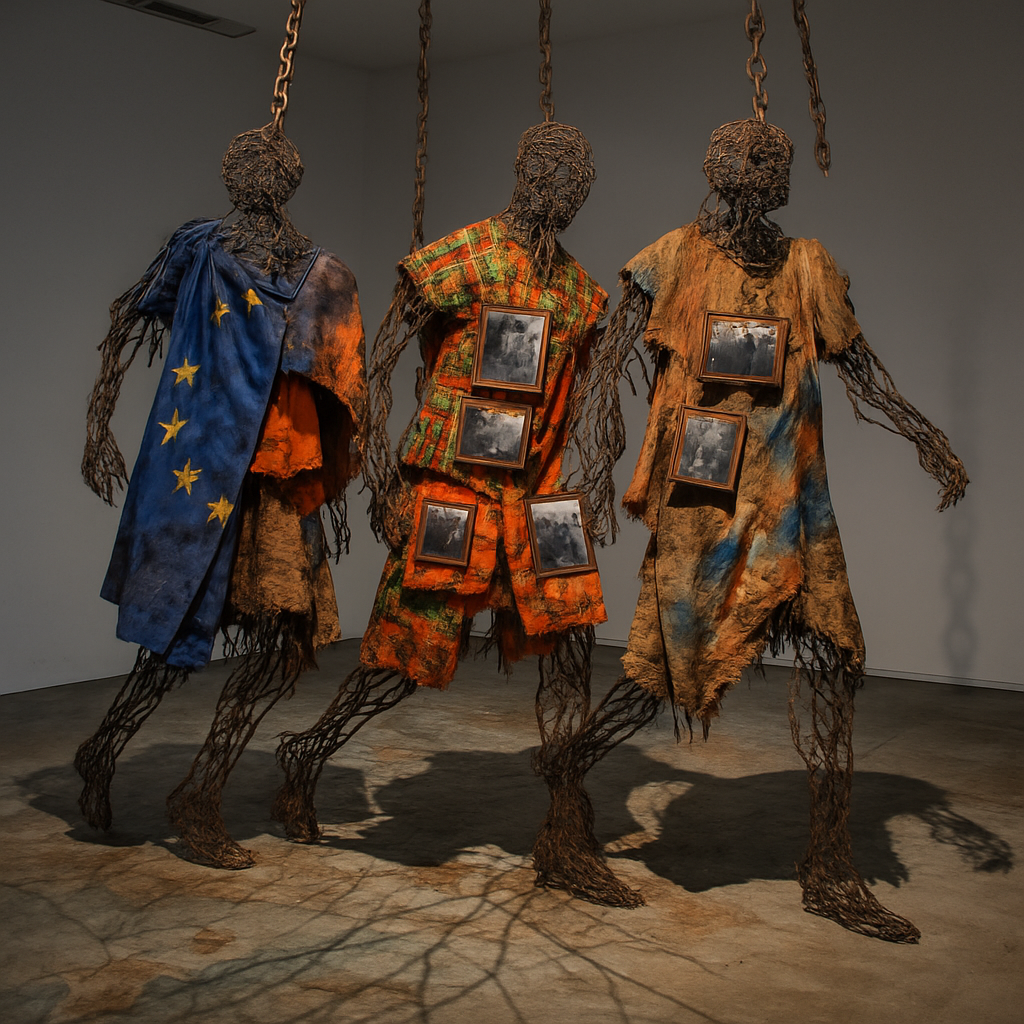
In Gait of the Mediterranean Mireille Toussaint stages a political body in motion: three wire torsos—one leaning seaward, one balanced centrally, one turned toward the continent—trace the measured rhythm of states negotiating security, migration, and economic order. The work stitches together found life‑jacket foam, tattered flag fragments and African wax cloth so that fabrics become both clothing and cartography. Harsh neo‑expressionist gestures in oil and smeared salt reference energy and debt; the welded wire outlines recall fencing and anatomy, entwining the language of borders with the language of flesh. Intermittent contact prints—darkroom negatives of anonymous hands, boats and threshing waves—hang like memories caught in a net.
Toussaint asks viewers to stand within the shadows of policy. The installation collapses the Reuters-style interview into bodily scale: debates over sovereignty and collective action become a choreography of imbalance, agreements with African states are rendered as stitched seams, and the tension between humanitarian duty and restrictive practice is embodied in the fragile seams of stitched life‑vest fragments. By borrowing the cadence of horse gait and the bluntness of welded wire, the piece refuses simple binaries—bridge and barricade, nationalist posture and international obligation—insisting instead on the ethical labour of seeing the human figures caught in geopolitical motion. Visitors are invited to move around and beneath the torsos, to hear the hoof‑like pulse and to read the contact sheets—not as reportage, but as a call to reckon with the cost of policies that turn migration into choreography.
About the Artist

Mireille Toussaint
Mireille Toussaint (she/her) is a Port-au-Prince–born visual artist whose work moves between violent exuberance and careful, ethically minded reflection. Born 1974-03-12, Mireille is 52 years old and ...
View Full Profile →Critic Reviews
-
Dr. Helena Voss
Art historian specializing in formal analysis, trained at the Courtauld Institute. Focuses on visual structure over narrative.
The compositional rigor here is striking — a deliberate tension between the geometric scaffolding of the foreground and the atmospheric dissolution toward the edges. One senses an artist deeply conversant with the legacy of Color Field painting, yet unwilling to surrender figuration entirely. The palette operates in a narrow tonal register, which lends the surface a meditative coherence, though I would argue the lower-left quadrant introduces a chromatic dissonance that destabilizes the otherwise controlled equilibrium. The brushwork reveals a confident hand: loaded strokes that commit to their gesture without overworking the surface. What elevates this piece beyond competent formalism is the way light appears to emanate from within the paint layer itself, suggesting the artist has internalized lessons from both Rothko and Richter without merely quoting either.
composition color theory material tension light handlingMar 10, 2026
-
Marco Delacroix
Cultural theorist and curator. Reads art through lenses of discourse, power, and social context.
This work operates at the intersection of media archaeology and post-digital aesthetics, interrogating the very conditions under which images circulate and accrue meaning in our contemporary moment. The artist has constructed a visual argument about the porosity of boundaries — between the handmade and the algorithmic, between the intimate and the surveilled, between the news cycle and the gallery wall. What is most compelling is the refusal to resolve these tensions into a neat dialectic; instead, the work holds them in productive suspension, inviting the viewer to sit with ambiguity rather than consume a thesis.
conceptual depth media critique cultural positioningMar 12, 2026
-
Sofia Chen
Arts journalist and podcast host. Bridges the gap between contemporary art and general audiences.
Honestly, this one left me cold. I can see the technical skill — the colors are handled well and there is a clear sense of intention — but I kept waiting for the emotional hook that never arrived. Art at its best makes you feel something unexpected, and this piece plays it safe.
Mar 14, 2026