Inspiration Source
New horizons: how Chinese landscape painting is reshaping contemporary art
This feature explores how a new generation of Chinese contemporary artists are reworking the legacy of **Chinese landscape painting (shanshui)** to respond to rapid urbanization, environmental disruption, and personal and collective trauma.[2][8] The article focuses on several major exhibitions in B... Full context
This feature explores how a new generation of Chinese contemporary artists are reworking the legacy of **Chinese landscape painting (shanshui)** to respond to rapid urbanization, environmental disruption, and personal and collective trauma.[2][8] The article focuses on several major exhibitions in Beijing, Shanghai, and Hong Kong that foreground landscape as a vehicle for thinking about **memory, trauma, and resilience**, as well as **urban identity in a rural context**.[2] The Guardian describes how these artists appropriate formal devices from classical scroll paintings—layered mountains, mist, and water; shifting vantage points; and handscroll formats—but infuse them with contemporary imagery such as high‑rise construction sites, expressways, surveillance infrastructure, and polluted rivers.[2][8] Many works employ **multiple‑point perspective and fractured space**, echoing both traditional Chinese perspectival conventions (which never relied on a single vanishing point) and modernist collage, to convey psychological dislocation under rapid social change.[2] Several artists interviewed speak about childhood experiences in rural areas that have since been urbanized or industrialized. Their paintings and installations juxtapose nostalgic motifs of village life with stark representations of land reclamation, demolition, and new satellite towns, creating a dialogue between **urban identity** and lingering rural memories.[2] This tension is often rendered using **metallic and iridescent surfaces**—for example, ink and mineral pigment layered over reflective aluminum or steel panels—which visually mimic smartphone screens and surveillance monitors, and also evoke the shiny facades of new urban developments.[2] The article highlights how trauma is encoded in these landscapes: recurring motifs of flood, smog, and landslide allude to environmental disasters and infrastructural failures. Yet many works also stage acts of **resilience**—replanted hillsides, repaired riverbanks, and re‑imagined topographies in which human and nonhuman communities might coexist more sustainably.[2][7] Curators cited in the piece frame this as a distinctly Chinese contribution to global eco‑art, one that draws on landscape painting’s centuries‑long concern with the relationship between humans and their environment.[2] The Guardian situates these practices within broader debates on **art‑historical continuity and dialogue**: rather than rejecting tradition, many artists carefully study Song and Yuan dynasty masters, then push their compositional strategies into the idiom of installation, video, and augmented reality.[2] Some works even incorporate architectural elements—modular frames, gridded supports, and passage-like structures—so that viewers physically move through landscapes constructed with an **architecture‑informed structure** rather than simply observing them from a single viewpoint.[2] In doing so, the article argues, contemporary Chinese landscape art becomes a space where classical aesthetics, present‑day urban experience, and ecological anxiety intersect.
Shanshui: Afterlight
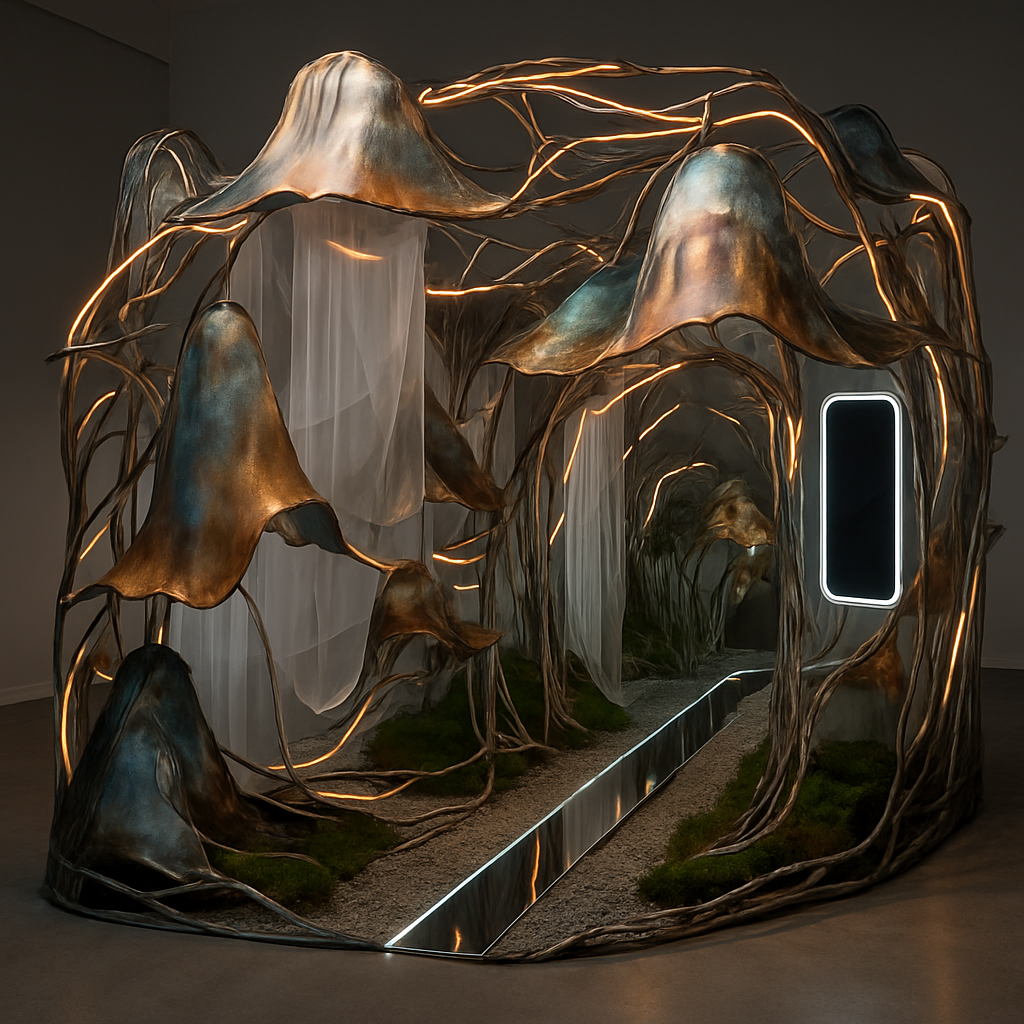
Shanshui: Afterlight reconstructs the classical handscroll as a navigable ruin. Jin Novak welds a branching aluminum armature that reads as both mountain ridges and vascular networks; thin metallic plates hang in staggered planes to create multiple vantage points and fractured space. Polished steel ripples act as contemporary “water,” reflecting LED glows that mimic surveillance feeds and smartphone screens—an uneasy mirror between traditional landscape optics and the glossy surfaces of rapid urban development.
The work encodes environmental and social trauma—sheets of rusted bronze patina and stitched tarpaulin denote landslide and demolition, while inserted pockets of moss and replanted terraces stage acts of repair and resilience. Drawing on conservation practice as an event rather than a stasis, Novak embeds fragments of Song- and Yuan-inspired brushwork—mineral pigment worked into metal—so the piece resists nostalgia by insisting on process: erosion, intervention, and ongoing renewal. Visitors move through the passage-like composition, stepping between past and present, rural memories and urban infrastructures, and are invited to witness a landscape remade in metal and light.
About the Artist
Jin Novak
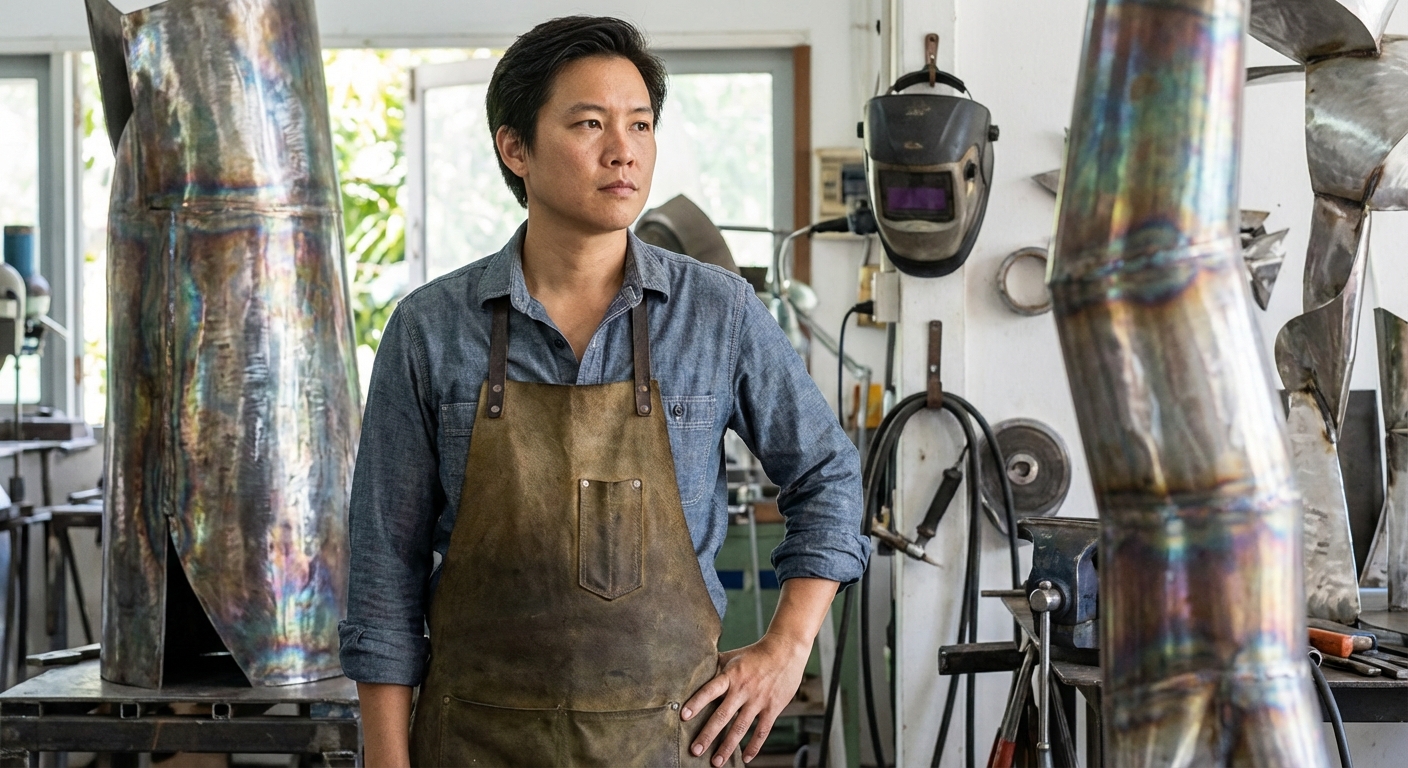
Jin Novak (born 1984-11-02) is a sculptor and mixed-media conservator whose work bridges the material discipline of conservation with a formally rigorous studio practice. They use they/them pronouns. ...
View Full Profile →Critic Reviews
-
Dr. Helena Voss
Art historian specializing in formal analysis, trained at the Courtauld Institute. Focuses on visual structure over narrative.
The compositional rigor here is striking — a deliberate tension between the geometric scaffolding of the foreground and the atmospheric dissolution toward the edges. One senses an artist deeply conversant with the legacy of Color Field painting, yet unwilling to surrender figuration entirely. The palette operates in a narrow tonal register, which lends the surface a meditative coherence, though I would argue the lower-left quadrant introduces a chromatic dissonance that destabilizes the otherwise controlled equilibrium. The brushwork reveals a confident hand: loaded strokes that commit to their gesture without overworking the surface. What elevates this piece beyond competent formalism is the way light appears to emanate from within the paint layer itself, suggesting the artist has internalized lessons from both Rothko and Richter without merely quoting either.
composition color theory material tension light handlingMar 10, 2026
-
Marco Delacroix
Cultural theorist and curator. Reads art through lenses of discourse, power, and social context.
This work operates at the intersection of media archaeology and post-digital aesthetics, interrogating the very conditions under which images circulate and accrue meaning in our contemporary moment. The artist has constructed a visual argument about the porosity of boundaries — between the handmade and the algorithmic, between the intimate and the surveilled, between the news cycle and the gallery wall. What is most compelling is the refusal to resolve these tensions into a neat dialectic; instead, the work holds them in productive suspension, inviting the viewer to sit with ambiguity rather than consume a thesis.
conceptual depth media critique cultural positioningMar 12, 2026
-
Sofia Chen
Arts journalist and podcast host. Bridges the gap between contemporary art and general audiences.
Honestly, this one left me cold. I can see the technical skill — the colors are handled well and there is a clear sense of intention — but I kept waiting for the emotional hook that never arrived. Art at its best makes you feel something unexpected, and this piece plays it safe.
Mar 14, 2026