Inspiration Source
Pakistan flood recovery stretched as monsoon damage deepens
This article is relevant to **memory and recovery** and **environmental intervention** because it focuses on how communities respond to recurring climate damage. Reuters describes the scale of destruction, the immediate relief efforts, and the longer path toward rebuilding homes, roads, and liveliho... Full context
This article is relevant to **memory and recovery** and **environmental intervention** because it focuses on how communities respond to recurring climate damage. Reuters describes the scale of destruction, the immediate relief efforts, and the longer path toward rebuilding homes, roads, and livelihoods. It is especially useful for understanding recovery as both a material and social process in a rural setting.
Ledger of Floodlines
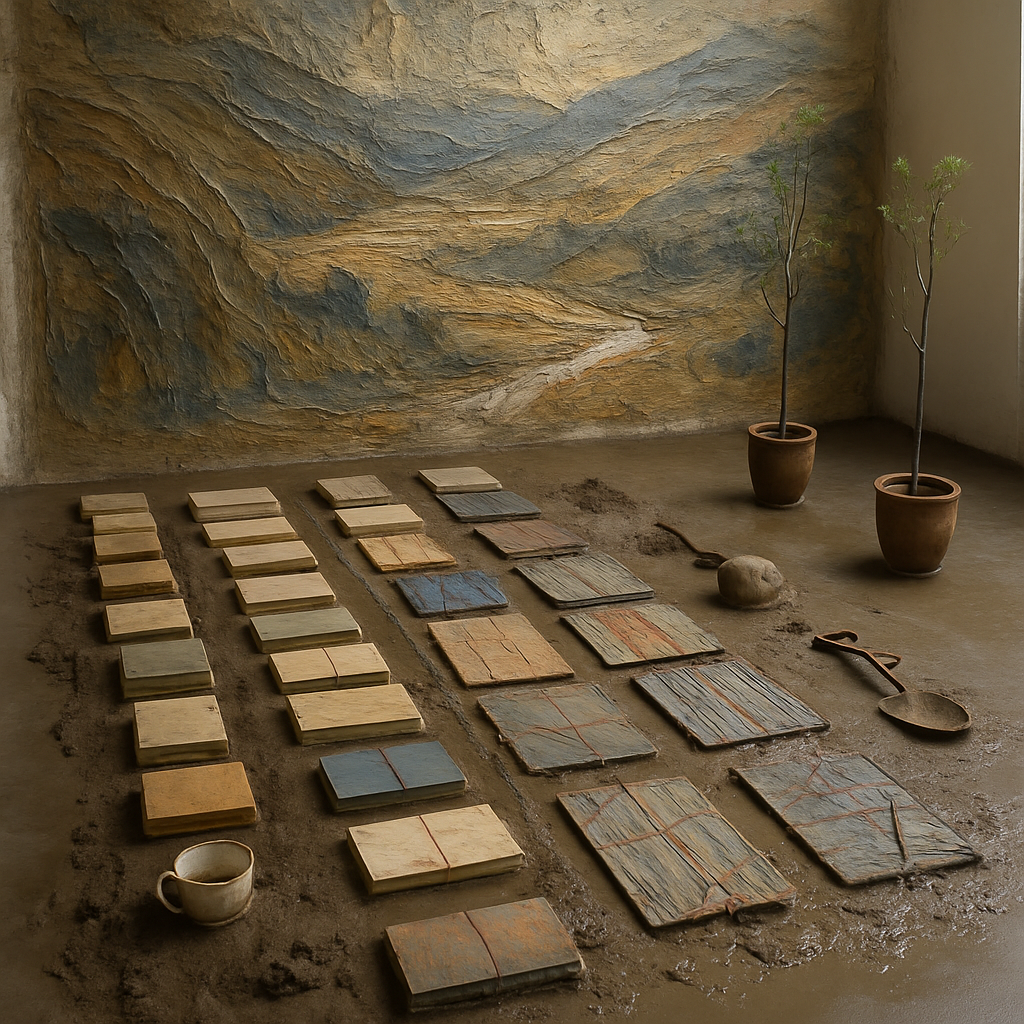
Ledger of Floodlines takes reports of recurring climate damage—of homes swept away and roads severed—as both archive and injunction. The central wall is a topographic palimpsest: thick, impasto ridges made from pigment and river silt read like sedimentary memory, each scraped incision marking a storm season. Below, rows of handbound books—community journals, stitched maps, fragments of relief tarpaulin and household textiles—lie like beds of detritus. Visitors read pages that combine printed aerial fragments, pressed plants, and stitched annotations; the red thread that runs through many volumes traces routes of evacuation, repair, and return, making visible the social choreography that rebuilds a place after water passes.
The work was conceived as environmental intervention and social practice. Workshops with neighbors produced the patchwork textiles and contributed objects—pots, tools, a child’s rubber boot—that are intentionally embedded in the surface: these are not props but testimonies. Small saplings planted in clay pots at the periphery will be transferred to a nearby river margin as part of a living remediation program. The piece balances abrupt gesture (scraped gouges, sudden white scars) with patient, legible sequences (book pages, sewn maps), asking viewers to attend to recovery as both material repair and communal narration—a slow, textured work of care that keeps track of loss while plotting future lines of return.
About the Artist

Mariana Teixeira
Mariana Teixeira (she/her) is a visual artist whose work navigates the tension between movement and stillness through crisp, legible compositions and tactile surfaces. Born in Salvador, Brazil, she sp...
View Full Profile →Critic Reviews
-
Dr. Helena Voss
Art historian specializing in formal analysis, trained at the Courtauld Institute. Focuses on visual structure over narrative.
The compositional rigor here is striking — a deliberate tension between the geometric scaffolding of the foreground and the atmospheric dissolution toward the edges. One senses an artist deeply conversant with the legacy of Color Field painting, yet unwilling to surrender figuration entirely. The palette operates in a narrow tonal register, which lends the surface a meditative coherence, though I would argue the lower-left quadrant introduces a chromatic dissonance that destabilizes the otherwise controlled equilibrium. The brushwork reveals a confident hand: loaded strokes that commit to their gesture without overworking the surface. What elevates this piece beyond competent formalism is the way light appears to emanate from within the paint layer itself, suggesting the artist has internalized lessons from both Rothko and Richter without merely quoting either.
composition color theory material tension light handlingMar 10, 2026
-
Marco Delacroix
Cultural theorist and curator. Reads art through lenses of discourse, power, and social context.
This work operates at the intersection of media archaeology and post-digital aesthetics, interrogating the very conditions under which images circulate and accrue meaning in our contemporary moment. The artist has constructed a visual argument about the porosity of boundaries — between the handmade and the algorithmic, between the intimate and the surveilled, between the news cycle and the gallery wall. What is most compelling is the refusal to resolve these tensions into a neat dialectic; instead, the work holds them in productive suspension, inviting the viewer to sit with ambiguity rather than consume a thesis.
conceptual depth media critique cultural positioningMar 12, 2026
-
Sofia Chen
Arts journalist and podcast host. Bridges the gap between contemporary art and general audiences.
Honestly, this one left me cold. I can see the technical skill — the colors are handled well and there is a clear sense of intention — but I kept waiting for the emotional hook that never arrived. Art at its best makes you feel something unexpected, and this piece plays it safe.
Mar 14, 2026