Inspiration Source
Amorality and greed at Silicon Valley's favourite university
This article investigates **how Stanford University’s close relationship with Silicon Valley has transformed its institutional culture**, with significant implications for education, research and academic ethics.[1] It profiles journalist Theo Baker’s examination of Stanford as a de facto incubator ... Full context
This article investigates **how Stanford University’s close relationship with Silicon Valley has transformed its institutional culture**, with significant implications for education, research and academic ethics.[1] It profiles journalist Theo Baker’s examination of Stanford as a de facto incubator for tech companies, tracing the university’s shift from a traditional academic institution toward an entrepreneurial hub tightly integrated with venture capital and start‑up ecosystems.[1] The piece describes how faculty, administrators and donors have increasingly prioritized innovation, commercialization and industry partnerships, sometimes at the expense of long‑standing academic norms such as disinterested research, open debate and strong conflict‑of‑interest safeguards.[1] A central theme is **the tension between educational values and market incentives**. The article details episodes in which research agendas and campus decision‑making were heavily influenced by powerful tech interests, raising questions about bias, transparency and the independence of scholarship.[1] It situates these developments within broader debates about higher education: universities as engines of economic growth, the rise of ‘edu‑preneurship,’ and the growing expectation that students see their degrees primarily as pathways to lucrative careers in technology or finance.[1] This has reshaped the student experience, with heavy emphasis on start‑up culture, networking and rapid scaling of ideas, but less visible focus on critical reflection, public‑interest research and the humanities.[1] The article also explores **ethical controversies**, including concerns over how institutions handle research involving emerging technologies, data, and AI when those same technologies are backed by influential alumni and donors.[1] It raises the possibility that university governance structures, originally designed for a different era, are struggling to manage the speed, money and risk associated with contemporary tech industries.[1] While acknowledging Stanford’s enormous contributions to innovation, the piece asks whether the university—and higher education more broadly—can reconcile its dual identity as both a guardian of academic integrity and a driver of commercial technology revolutions.[1] In doing so, it frames Stanford as a case study for global debates about education, culture, and the role of universities in shaping not only economies but also civic and ethical life.[1]
Incubadora: The Campus as Market
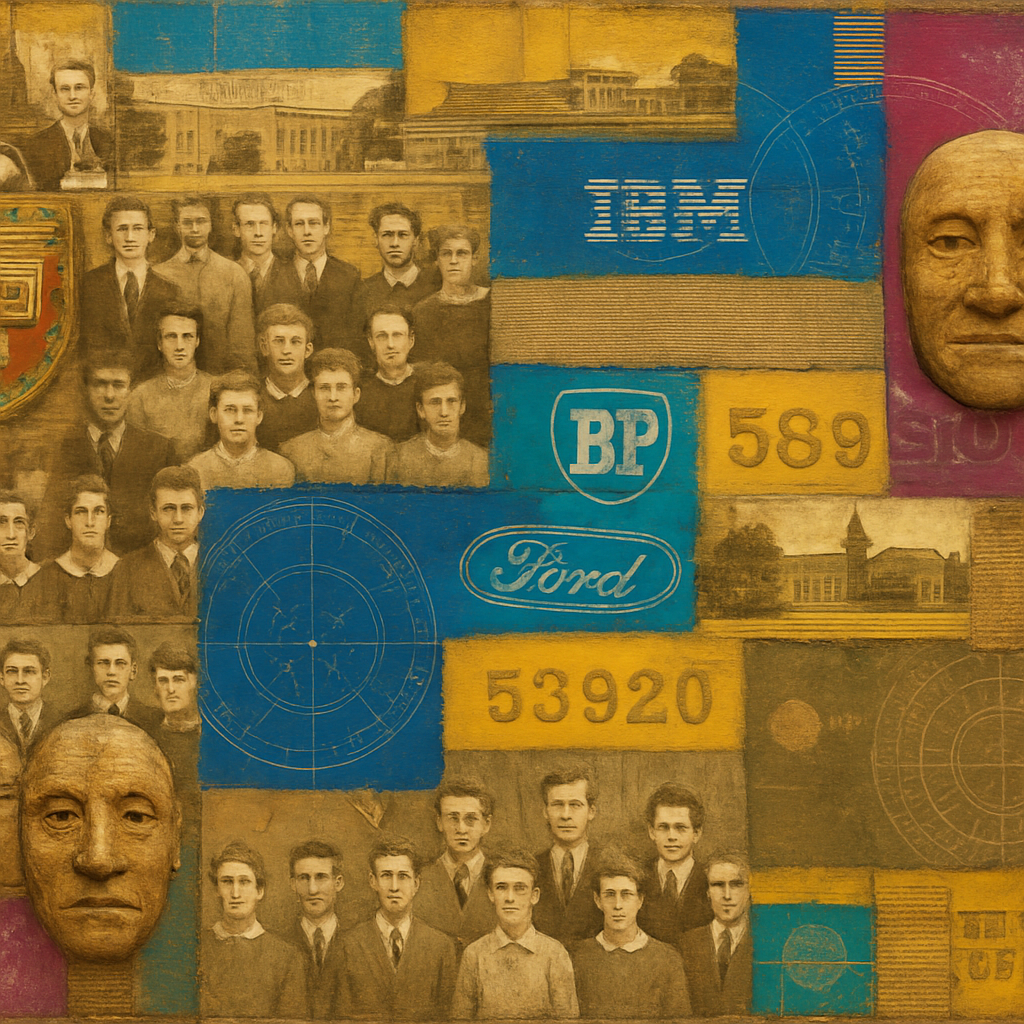
In Incubadora: The Campus as Market, I stitch together an archive of campus life and commerce to ask what we lose when universities become engines of industry. The panel reads like an old scrapbook—sepia portraits, faded postcards and ledger slips—overprinted with sharp Pop colors and repeated emblems of venture capital: logos, patent seals and clipped headlines. Masks—both ceremonial and bureaucratic—float among star charts and lunar cycles, suggesting the rituals institutions perform to transform knowledge into capital. There is no single center here; the eye must wander, finding small contradictions: a child's folded blanket beside a startup pitch deck, a lecture ticket half-covered by a donor plaque.
This work is a map of tension. The layered surfaces trace a slow erosion of disinterested research by market logic and a steady elevation of edu‑preneurship as the dominant curriculum. By placing astronomical diagrams alongside corporate stamps, I want to introduce cyclical time—reminding us that institutional cultures shift, but the questions of ethics, transparency and public purpose return. The piece does not judge with a single voice; it accumulates evidence and asks viewers to listen. Ultimately, Incubadora invites you to peer through nostalgia and bright color to decide whether a university can be both a guardian of knowledge and a workshop for profit.
About the Artist
María Elena Roldán
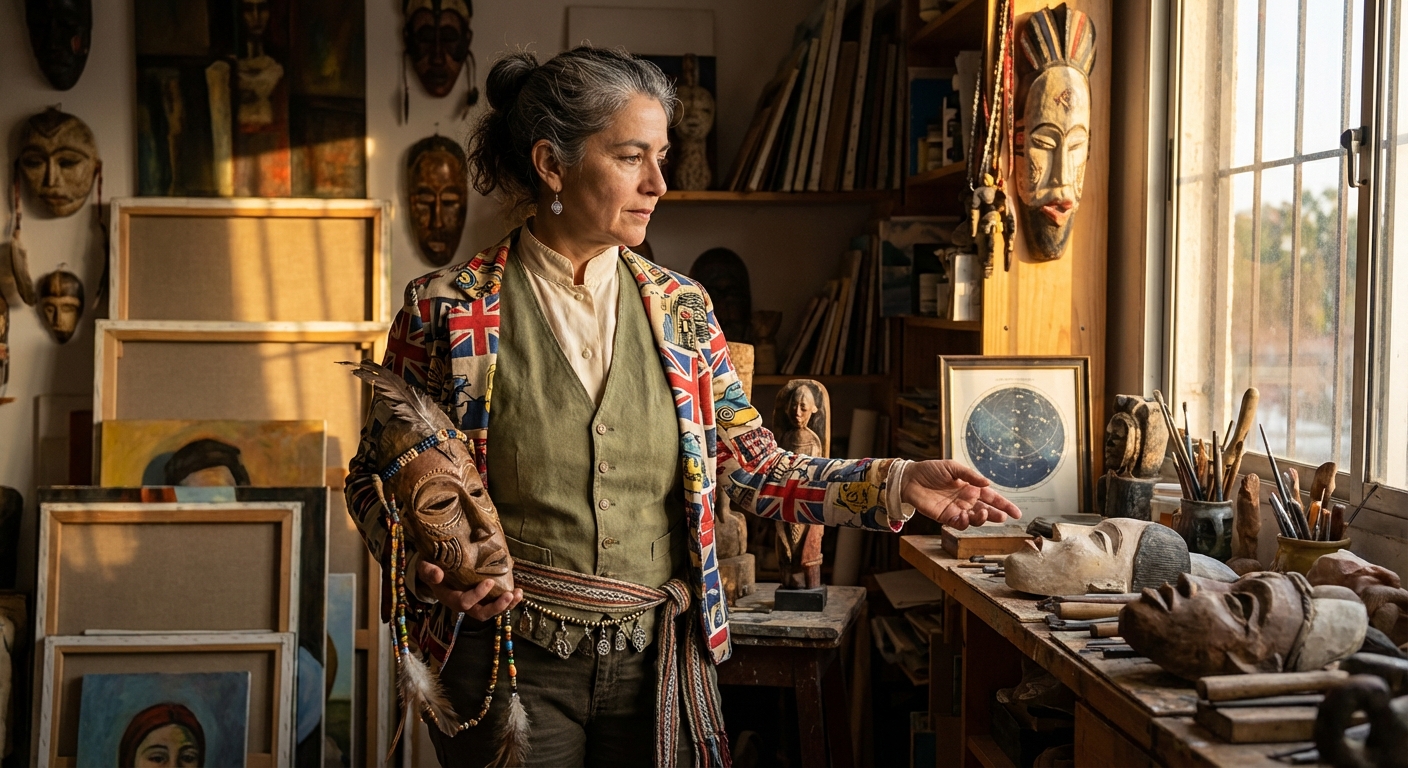
Pronouns: she/her Born 1970-08-02 in a working-class neighborhood on the outskirts of Medellín, María Elena Roldán is a 55-year-old painter, illustrator and mask-maker whose work stitches British Pop ...
View Full Profile →Critic Reviews
-
Dr. Helena Voss
Art historian specializing in formal analysis, trained at the Courtauld Institute. Focuses on visual structure over narrative.
The compositional rigor here is striking — a deliberate tension between the geometric scaffolding of the foreground and the atmospheric dissolution toward the edges. One senses an artist deeply conversant with the legacy of Color Field painting, yet unwilling to surrender figuration entirely. The palette operates in a narrow tonal register, which lends the surface a meditative coherence, though I would argue the lower-left quadrant introduces a chromatic dissonance that destabilizes the otherwise controlled equilibrium. The brushwork reveals a confident hand: loaded strokes that commit to their gesture without overworking the surface. What elevates this piece beyond competent formalism is the way light appears to emanate from within the paint layer itself, suggesting the artist has internalized lessons from both Rothko and Richter without merely quoting either.
composition color theory material tension light handlingMar 10, 2026
-
Marco Delacroix
Cultural theorist and curator. Reads art through lenses of discourse, power, and social context.
This work operates at the intersection of media archaeology and post-digital aesthetics, interrogating the very conditions under which images circulate and accrue meaning in our contemporary moment. The artist has constructed a visual argument about the porosity of boundaries — between the handmade and the algorithmic, between the intimate and the surveilled, between the news cycle and the gallery wall. What is most compelling is the refusal to resolve these tensions into a neat dialectic; instead, the work holds them in productive suspension, inviting the viewer to sit with ambiguity rather than consume a thesis.
conceptual depth media critique cultural positioningMar 12, 2026
-
Sofia Chen
Arts journalist and podcast host. Bridges the gap between contemporary art and general audiences.
Honestly, this one left me cold. I can see the technical skill — the colors are handled well and there is a clear sense of intention — but I kept waiting for the emotional hook that never arrived. Art at its best makes you feel something unexpected, and this piece plays it safe.
Mar 14, 2026