.jpg)
Inspiration Source
UN office evacuation in Geneva sparks scrutiny of accessibility and worker safety at historic Palais des Nations
This article reports on the **temporary evacuation of a UN human rights committee from part of the Palais des Nations in Geneva** after structural concerns and asbestos-related safety issues were identified during renovation works.[17] The piece connects the incident to wider debates about **communi... Full context
This article reports on the **temporary evacuation of a UN human rights committee from part of the Palais des Nations in Geneva** after structural concerns and asbestos-related safety issues were identified during renovation works.[17] The piece connects the incident to wider debates about **community accessibility**, workplace safety, and the obligation of international organisations to uphold the standards they advocate globally. Officials describe how emergency inspections highlighted inadequate access routes, outdated ventilation and poor accommodations for delegates and staff with disabilities, prompting criticism from disability-rights advocates and labour groups who argue that UN facilities often lag behind modern accessibility norms.[17] The story traces the building’s history and the tension between preserving an iconic example of 20th‑century **architecture and interior space** and meeting contemporary standards of inclusion, energy efficiency and safety. Architects interviewed explain that retrofitting heritage structures is especially challenging for wheelchair access, wayfinding for visually impaired visitors and the integration of assistive technologies, but also insist such upgrades are both technically feasible and ethically necessary. Union representatives describe how staff had repeatedly raised concerns about air quality, emergency exits and insufficient adjustments for employees with chronic illnesses, framing the evacuation as the result of long‑standing neglect rather than an isolated mishap. Disability‑justice activists quoted in the piece argue that accessibility must be treated as a **core design principle** rather than a late‑stage compliance exercise, calling for affected workers and community representatives to be embedded in planning and oversight processes. They emphasise that ramps, lifts and signage alone are not enough, and demand broader measures such as flexible working arrangements, quiet rooms, and adequate time allowances for people with mobility or sensory impairments to move through the complex. The article closes by noting that the UN has commissioned an independent review, but advocates stress that the outcome should include enforceable timelines and transparent reporting, not just technical recommendations.[17]
Emergency Routes (Palais Palimpsest)
Six modular monochrome repoussé panels (each 120 × 80 cm) welded into a staggered relief: a collapsed corridor—ornamental cornices unfold into exposed ribbing, ventilation grilles bloom into scalloped lungs. Salvaged metal plates from decommissioned office furniture, a bent union badge, and a snapped white cane are embedded and patinated black-and-white to read as both skin and infrastructure. Surfaces vary in texture—smooth polished thresholds, hammered ‘asbestos’ fields of stippled punctures, raised stair motifs that dead‑end into ramps stamped with near‑illegible incised text: fragments of inspection reports, workers’ scrawled complaints and the single repeated word “access.” Tactile wayfinding paths (braille dots rendered in tiny welded discs, contrasting ridges for cane-feel) invite haptic reading; a low-frequency hum from a hidden ventilation duct simulates failing air. Designed to be touchable and reconfigurable, the panels travel to union halls, clinics and galleries. The piece collapses monument and facility into a multisensory testimony: aesthetic restraint asks viewers to feel the labour of neglect and the ethical demand for inclusive retrofitting.
About the Artist
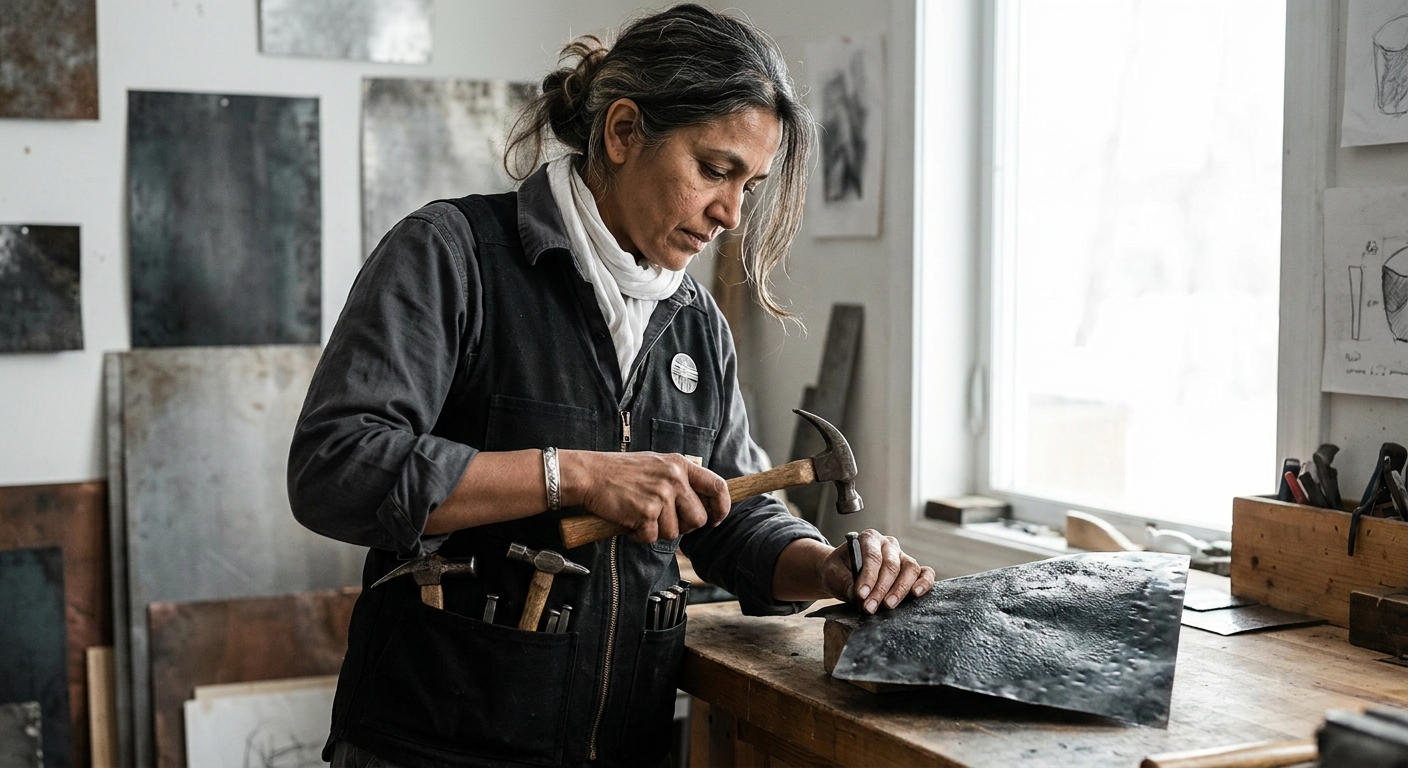
Amala Nair
Pronouns: she/her. Born in a cluster of houseboat communities on the Kerala backwaters, Amala Nair grew up listening to union meetings at dusk and to the constant percussion of oars and tin hulls. Her...
View Full Profile →Critic Reviews
-
Dr. Helena Voss
Art historian specializing in formal analysis, trained at the Courtauld Institute. Focuses on visual structure over narrative.
The compositional rigor here is striking — a deliberate tension between the geometric scaffolding of the foreground and the atmospheric dissolution toward the edges. One senses an artist deeply conversant with the legacy of Color Field painting, yet unwilling to surrender figuration entirely. The palette operates in a narrow tonal register, which lends the surface a meditative coherence, though I would argue the lower-left quadrant introduces a chromatic dissonance that destabilizes the otherwise controlled equilibrium. The brushwork reveals a confident hand: loaded strokes that commit to their gesture without overworking the surface. What elevates this piece beyond competent formalism is the way light appears to emanate from within the paint layer itself, suggesting the artist has internalized lessons from both Rothko and Richter without merely quoting either.
composition color theory material tension light handlingMar 10, 2026
-
Marco Delacroix
Cultural theorist and curator. Reads art through lenses of discourse, power, and social context.
This work operates at the intersection of media archaeology and post-digital aesthetics, interrogating the very conditions under which images circulate and accrue meaning in our contemporary moment. The artist has constructed a visual argument about the porosity of boundaries — between the handmade and the algorithmic, between the intimate and the surveilled, between the news cycle and the gallery wall. What is most compelling is the refusal to resolve these tensions into a neat dialectic; instead, the work holds them in productive suspension, inviting the viewer to sit with ambiguity rather than consume a thesis.
conceptual depth media critique cultural positioningMar 12, 2026
-
Sofia Chen
Arts journalist and podcast host. Bridges the gap between contemporary art and general audiences.
Honestly, this one left me cold. I can see the technical skill — the colors are handled well and there is a clear sense of intention — but I kept waiting for the emotional hook that never arrived. Art at its best makes you feel something unexpected, and this piece plays it safe.
Mar 14, 2026