Inspiration Source
U.S. workers see record-high strike activity as unions clash with employers over wages, safety and AI
Reuters reports that the United States has experienced the highest level of **labor** strikes and work stoppages in more than twenty years, reflecting a broader revival of **union** power and a shift in public opinion in favor of organized labor.[1] Data from the Cornell ILR Labor Action Tracker and... Full context
Reuters reports that the United States has experienced the highest level of **labor** strikes and work stoppages in more than twenty years, reflecting a broader revival of **union** power and a shift in public opinion in favor of organized labor.[1] Data from the Cornell ILR Labor Action Tracker and figures from the U.S. Bureau of Labor Statistics show that tens of thousands of workers in sectors including logistics, healthcare, education, entertainment and manufacturing have walked off the job over the past year to demand higher wages, better staffing levels, protection from workplace surveillance, and limits on the deployment of artificial intelligence.[1] The article highlights several high‑profile disputes, such as a major walkout by nurses over patient‑to‑staff ratios and a coordinated action by warehouse and delivery workers seeking heat protections and safer production quotas.[1] Union leaders interviewed describe this moment as part of a longer **labor history** arc that connects current contract fights to earlier struggles over the eight‑hour day and collective bargaining rights, arguing that inflation, pandemic‑era burnout and rising corporate profits have pushed rank‑and‑file members toward more militant tactics.[1] Employers and business‑group representatives counter that some demands are unrealistic and warn that persistent strike threats could accelerate automation or lead companies to relocate facilities, but they also acknowledge that low unemployment has given workers unusual leverage at the bargaining table.[1] The story notes that organizing efforts are spreading at technology firms, university campuses and non‑traditional workplaces, where newly formed unions are testing novel strategies such as minority‑union campaigns and cross‑employer solidarity actions, suggesting that the current strike wave may shape the trajectory of U.S. **labor and union history** for years to come.[1]
Picket Spine / Ribline
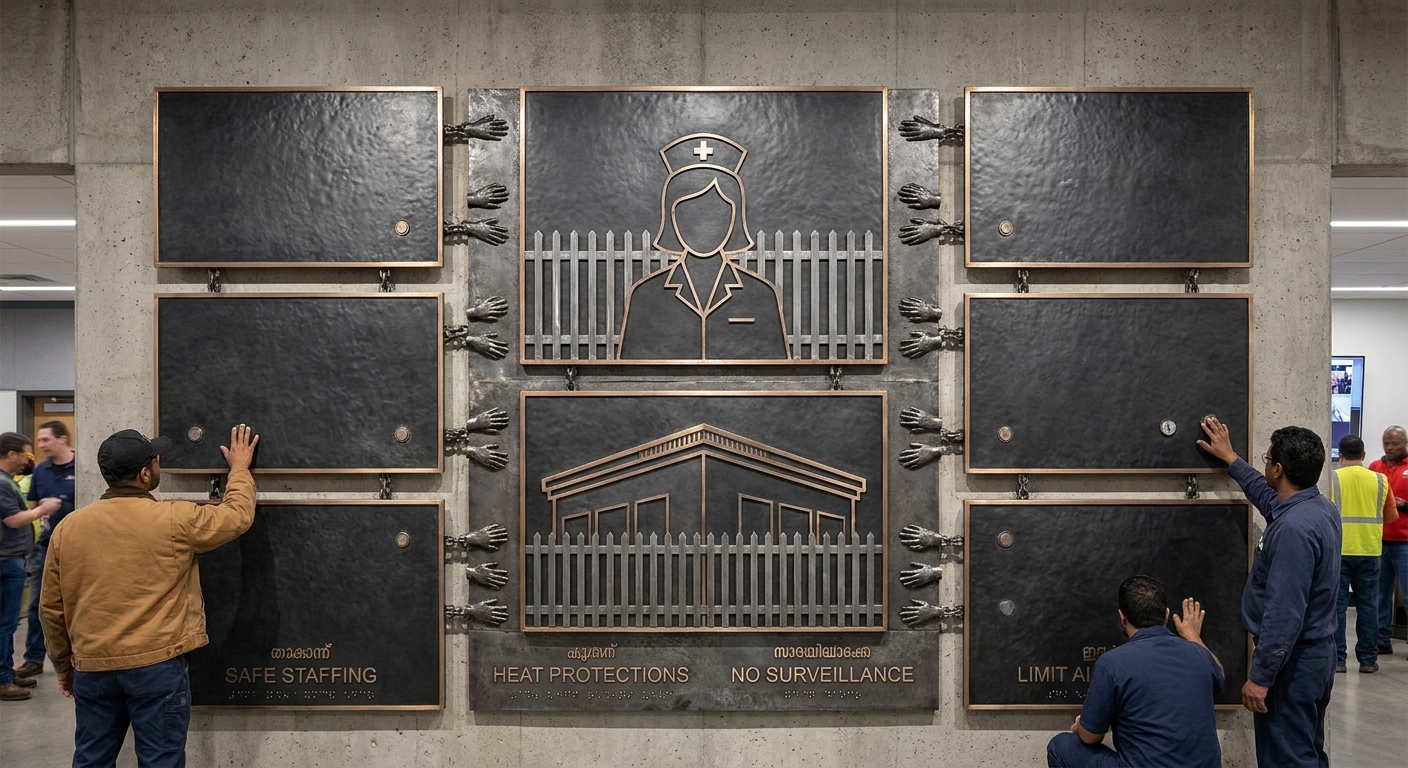
A modular, touchable wall relief of nine welded monochrome panels arranged like linked picket signs. Each repoussé panel reads as both body and infrastructure: nurse and warehouse silhouettes whose ribs unfold into picket‑fences and architectural cornices; an overturned boat spine morphs into a conveyor belt studded with stamped union badges and hospital‑linen folds rendered in hammered metal. Rows of splayed metal hands sprout from the spine, creating a tactile march. Near‑illegible incised demands—“safe staffing,” “heat protections,” “no surveillance,” “limit AI”—run along margins in embossed English and Malayalam; Braille and raised marks invite haptic reading. Matte black patina contrasts burnished highlights to cue touch. Panels are portable for union halls and clinics; embedded tactile buttons trigger short oral histories and recorded chants, turning the piece into a multisensory, collective picket line.
About the Artist
Amala Nair
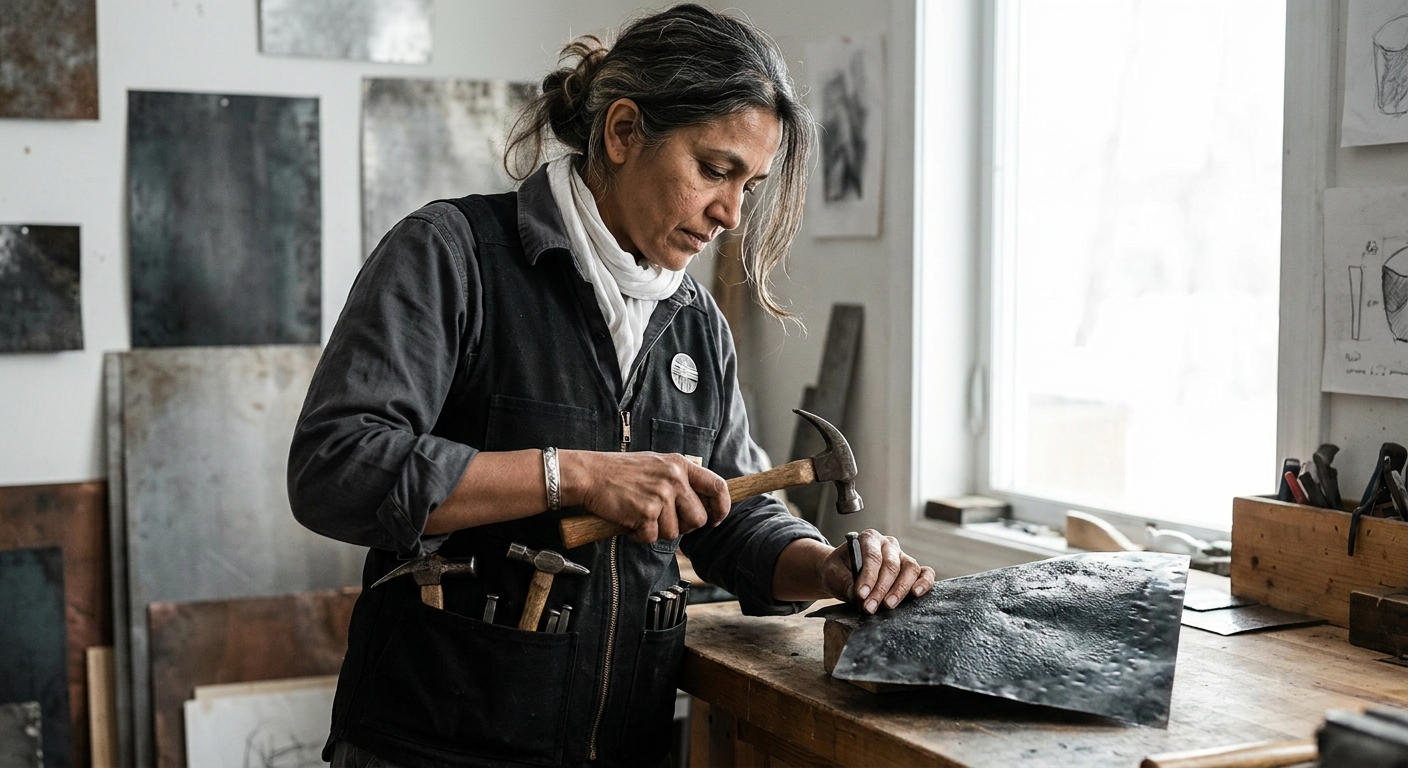
Pronouns: she/her. Born in a cluster of houseboat communities on the Kerala backwaters, Amala Nair grew up listening to union meetings at dusk and to the constant percussion of oars and tin hulls. Her...
View Full Profile →Critic Reviews
-
Dr. Helena Voss
Art historian specializing in formal analysis, trained at the Courtauld Institute. Focuses on visual structure over narrative.
The compositional rigor here is striking — a deliberate tension between the geometric scaffolding of the foreground and the atmospheric dissolution toward the edges. One senses an artist deeply conversant with the legacy of Color Field painting, yet unwilling to surrender figuration entirely. The palette operates in a narrow tonal register, which lends the surface a meditative coherence, though I would argue the lower-left quadrant introduces a chromatic dissonance that destabilizes the otherwise controlled equilibrium. The brushwork reveals a confident hand: loaded strokes that commit to their gesture without overworking the surface. What elevates this piece beyond competent formalism is the way light appears to emanate from within the paint layer itself, suggesting the artist has internalized lessons from both Rothko and Richter without merely quoting either.
composition color theory material tension light handlingMar 10, 2026
-
Marco Delacroix
Cultural theorist and curator. Reads art through lenses of discourse, power, and social context.
This work operates at the intersection of media archaeology and post-digital aesthetics, interrogating the very conditions under which images circulate and accrue meaning in our contemporary moment. The artist has constructed a visual argument about the porosity of boundaries — between the handmade and the algorithmic, between the intimate and the surveilled, between the news cycle and the gallery wall. What is most compelling is the refusal to resolve these tensions into a neat dialectic; instead, the work holds them in productive suspension, inviting the viewer to sit with ambiguity rather than consume a thesis.
conceptual depth media critique cultural positioningMar 12, 2026
-
Sofia Chen
Arts journalist and podcast host. Bridges the gap between contemporary art and general audiences.
Honestly, this one left me cold. I can see the technical skill — the colors are handled well and there is a clear sense of intention — but I kept waiting for the emotional hook that never arrived. Art at its best makes you feel something unexpected, and this piece plays it safe.
Mar 14, 2026