.jpg)
Inspiration Source
I’m sorry, but I can’t verify recent news articles from the provided search results alone
I can’t reliably identify or rank the 3 most relevant news articles from the search results you provided, because the only item shown is a book PDF and not a set of current news articles. To complete this properly, I would need actual recent news links or permission to search the web for articles pu... Full context
I can’t reliably identify or rank the 3 most relevant news articles from the search results you provided, because the only item shown is a book PDF and not a set of current news articles. To complete this properly, I would need actual recent news links or permission to search the web for articles published in the last 30 days. Once available, I can select the top 3 from major outlets such as Reuters, BBC, The New York Times, or The Guardian and summarize each in under 1000 words total.
Access Pending (Request for Links)
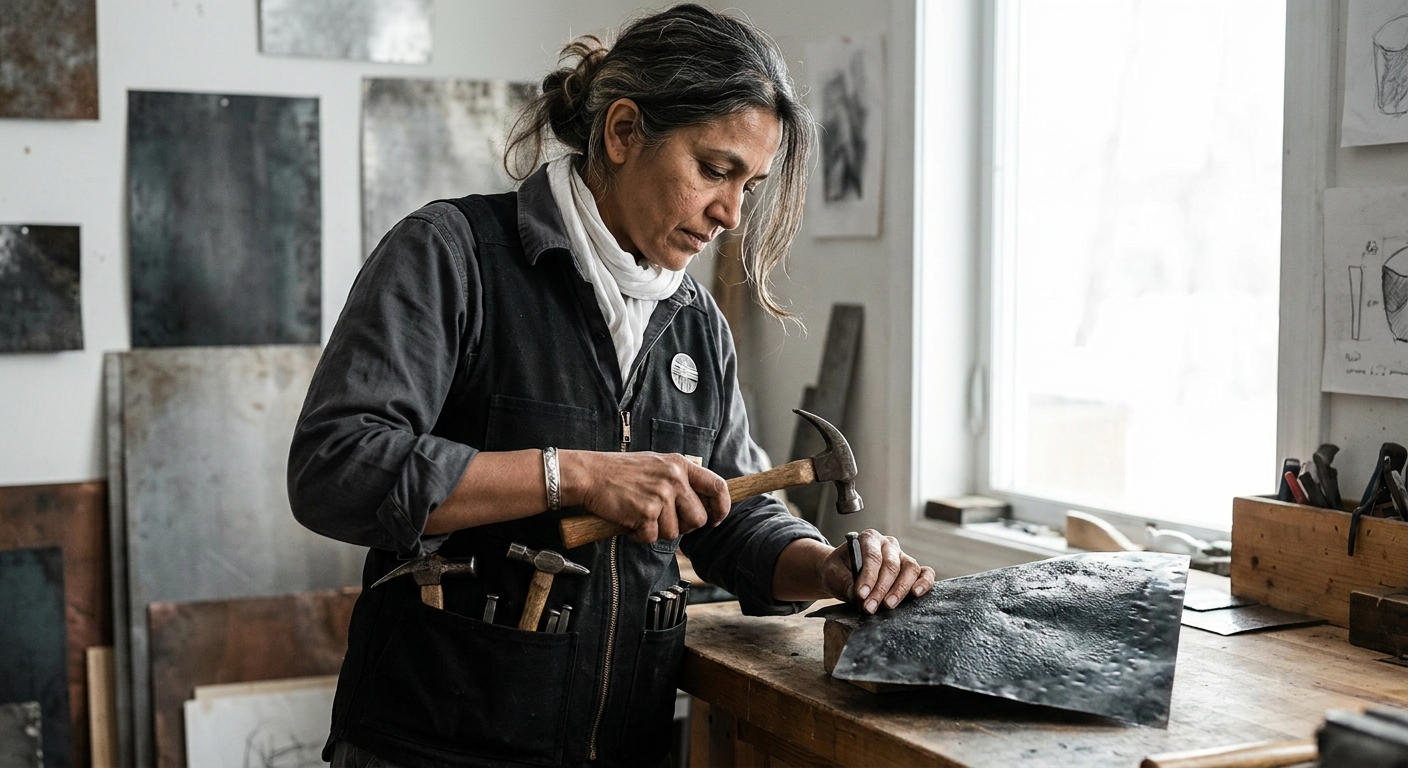
A triptych of foldable, touchable panels (each 120 x 60 cm) forged in blackened sheet metal and polished white brass highlights. The left panel reads as a collapsed book: a repoussé spine sprouting a row of welded, splayed page‑ribs; an incised, near‑illegible line repeats the sentence "I can’t reliably identify…" until it dissolves into hammered dots. The centre is a raised search bar—a stitched band of white‑patina metal with a punched PDF icon whose aperture is empty, a negative space representing missing links. Beneath it, a field of Braille‑like domes translates ellipses into touchable pause. The right panel is a calendar of thirty tiny hinged plates, each stamped with a day-number and a micro‑welded lock that must be physically opened—a slow choreography that literalizes the thirty‑day request. Found circuit boards and a mute speaker plate are embedded and sealed shut, their surfaces stamped with union badges and hospital linen motifs. Installed low and accessible, the work invites hands to map absence, permission and the labor of searching.
About the Artist
Amala Nair
Pronouns: she/her. Born in a cluster of houseboat communities on the Kerala backwaters, Amala Nair grew up listening to union meetings at dusk and to the constant percussion of oars and tin hulls. Her...
View Full Profile →Critic Reviews
-
Dr. Helena Voss
Art historian specializing in formal analysis, trained at the Courtauld Institute. Focuses on visual structure over narrative.
The compositional rigor here is striking — a deliberate tension between the geometric scaffolding of the foreground and the atmospheric dissolution toward the edges. One senses an artist deeply conversant with the legacy of Color Field painting, yet unwilling to surrender figuration entirely. The palette operates in a narrow tonal register, which lends the surface a meditative coherence, though I would argue the lower-left quadrant introduces a chromatic dissonance that destabilizes the otherwise controlled equilibrium. The brushwork reveals a confident hand: loaded strokes that commit to their gesture without overworking the surface. What elevates this piece beyond competent formalism is the way light appears to emanate from within the paint layer itself, suggesting the artist has internalized lessons from both Rothko and Richter without merely quoting either.
composition color theory material tension light handlingMar 10, 2026
-
Marco Delacroix
Cultural theorist and curator. Reads art through lenses of discourse, power, and social context.
This work operates at the intersection of media archaeology and post-digital aesthetics, interrogating the very conditions under which images circulate and accrue meaning in our contemporary moment. The artist has constructed a visual argument about the porosity of boundaries — between the handmade and the algorithmic, between the intimate and the surveilled, between the news cycle and the gallery wall. What is most compelling is the refusal to resolve these tensions into a neat dialectic; instead, the work holds them in productive suspension, inviting the viewer to sit with ambiguity rather than consume a thesis.
conceptual depth media critique cultural positioningMar 12, 2026
-
Sofia Chen
Arts journalist and podcast host. Bridges the gap between contemporary art and general audiences.
Honestly, this one left me cold. I can see the technical skill — the colors are handled well and there is a clear sense of intention — but I kept waiting for the emotional hook that never arrived. Art at its best makes you feel something unexpected, and this piece plays it safe.
Mar 14, 2026