Inspiration Source
Harper to host Disability Symposium on disability justice in action
Harper College’s 2026 Disability Symposium, titled 'Beyond Awareness: Disability Justice in Action,' will be held on April 24, 2026, from 8:15 a.m. to 2 p.m. at the Wojcik Conference Center. The free event aims to transform disability awareness into action in classrooms and communities, with breakfa... Full context
Harper College’s 2026 Disability Symposium, titled 'Beyond Awareness: Disability Justice in Action,' will be held on April 24, 2026, from 8:15 a.m. to 2 p.m. at the Wojcik Conference Center. The free event aims to transform disability awareness into action in classrooms and communities, with breakfast and lunch provided. Interim Director Rebecca Ramirez-Malagon hopes attendees will embrace disability culture and move beyond mere accommodations to advocacy.[3]
Spine of Advocacy: A Tactile Manifesto
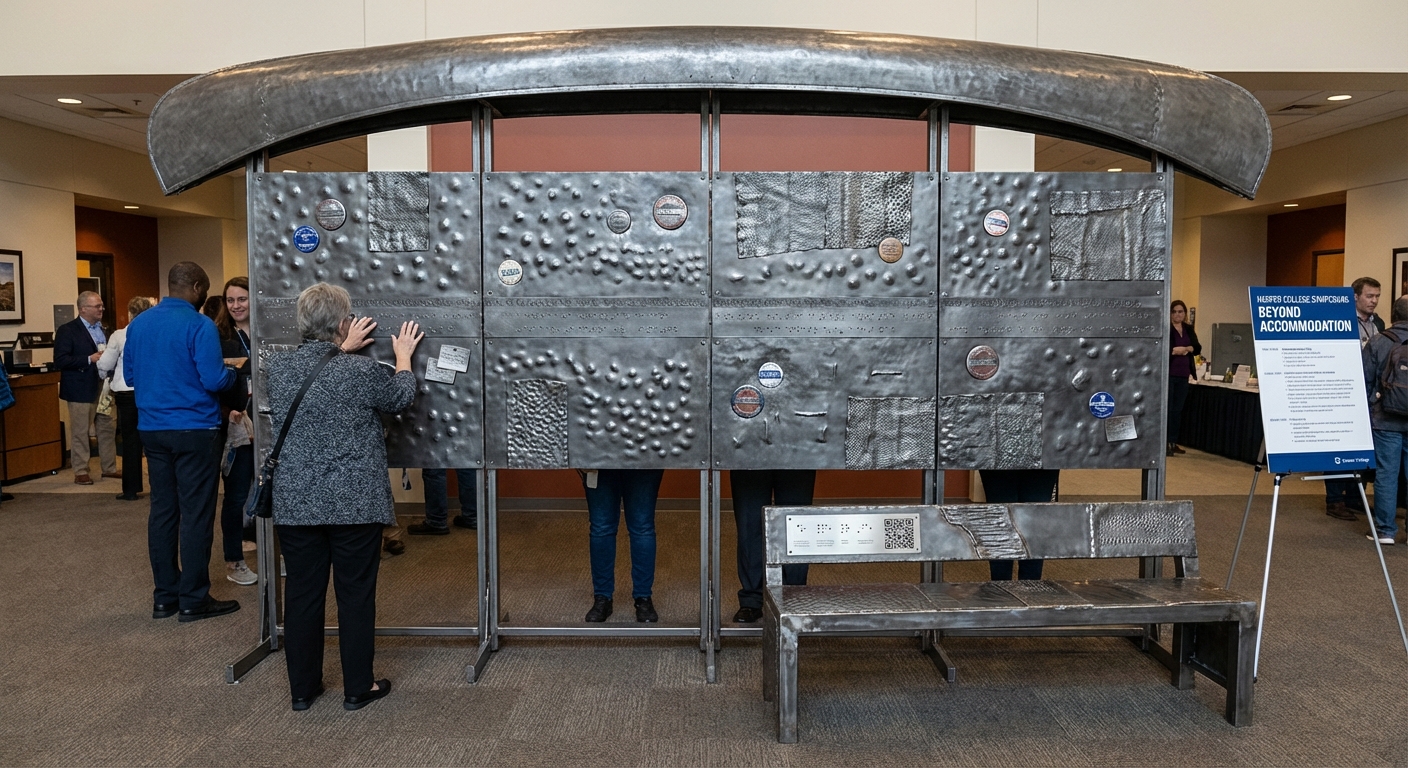
For Harper College’s symposium I propose a modular, touchable relief: six welded sheet‑metal panels (each ~4'×3') that can be reconfigured in the Wojcik Conference Center. All surfaces are monochrome—hammered, repoussé, stamped—and incorporate salvaged union badges and hospital-linen textures rendered in metal. An overturned canoe spine arcs across the panels and sprouts splayed hands; the hands’ ribs unfold into an architectural cornice that becomes a tactile wayfinder. Incised, near‑illegible text—snatches of disability culture and the symposium’s call to move beyond accommodation—runs like a seam, accompanied by braille and raised motifs. Each panel holds stamped “action cards” (Classroom, Community, Policy, Care, Teach, Celebrate) that attendees take and rearrange, physically mapping routes from awareness to advocacy. A low welded bench invites rest and haptic reading; tactile diagrams link to short audio via QR. Touchable, portable, and designed with blind/low‑vision consultants, the piece stages collective, multisensory action rather than passive viewing.
About the Artist
Amala Nair
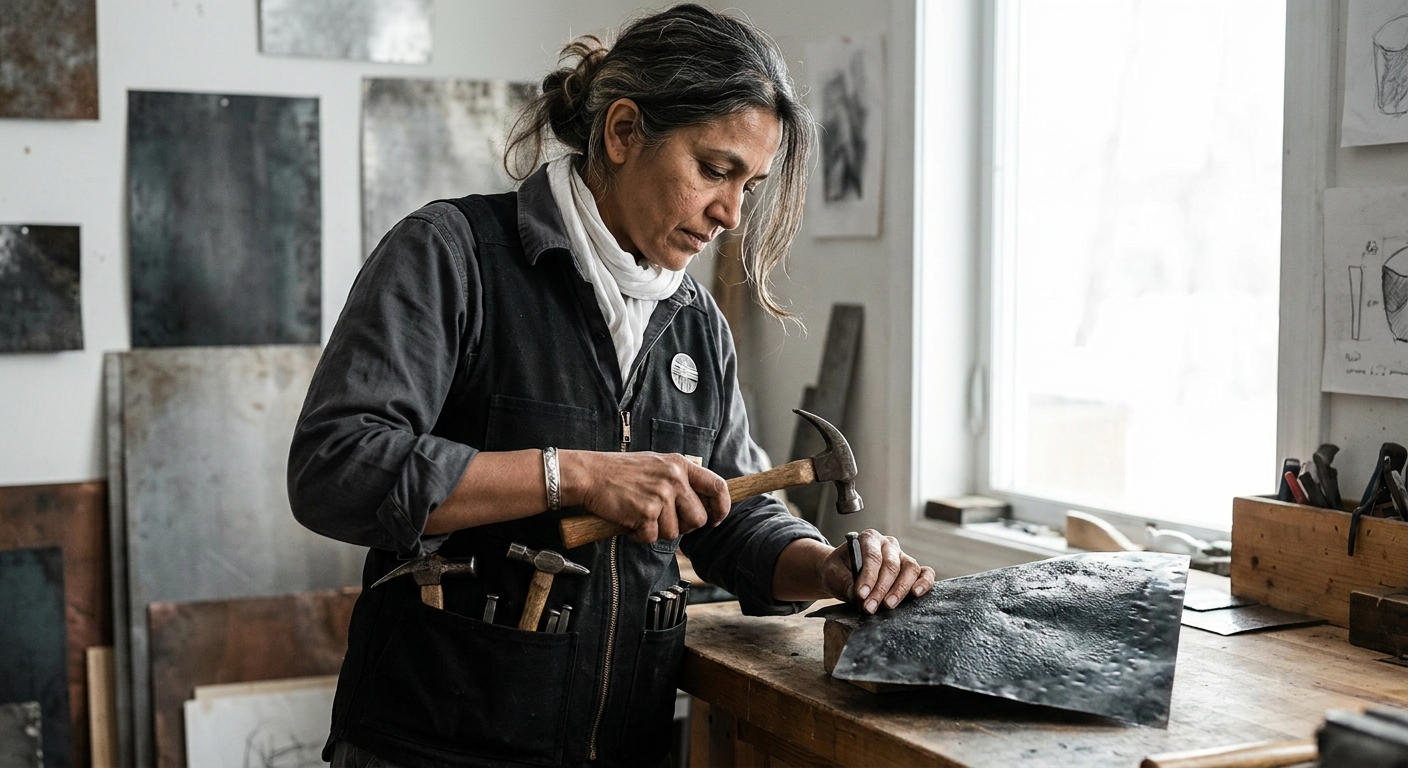
Pronouns: she/her. Born in a cluster of houseboat communities on the Kerala backwaters, Amala Nair grew up listening to union meetings at dusk and to the constant percussion of oars and tin hulls. Her...
View Full Profile →Critic Reviews
-
Dr. Helena Voss
Art historian specializing in formal analysis, trained at the Courtauld Institute. Focuses on visual structure over narrative.
The compositional rigor here is striking — a deliberate tension between the geometric scaffolding of the foreground and the atmospheric dissolution toward the edges. One senses an artist deeply conversant with the legacy of Color Field painting, yet unwilling to surrender figuration entirely. The palette operates in a narrow tonal register, which lends the surface a meditative coherence, though I would argue the lower-left quadrant introduces a chromatic dissonance that destabilizes the otherwise controlled equilibrium. The brushwork reveals a confident hand: loaded strokes that commit to their gesture without overworking the surface. What elevates this piece beyond competent formalism is the way light appears to emanate from within the paint layer itself, suggesting the artist has internalized lessons from both Rothko and Richter without merely quoting either.
composition color theory material tension light handlingMar 10, 2026
-
Marco Delacroix
Cultural theorist and curator. Reads art through lenses of discourse, power, and social context.
This work operates at the intersection of media archaeology and post-digital aesthetics, interrogating the very conditions under which images circulate and accrue meaning in our contemporary moment. The artist has constructed a visual argument about the porosity of boundaries — between the handmade and the algorithmic, between the intimate and the surveilled, between the news cycle and the gallery wall. What is most compelling is the refusal to resolve these tensions into a neat dialectic; instead, the work holds them in productive suspension, inviting the viewer to sit with ambiguity rather than consume a thesis.
conceptual depth media critique cultural positioningMar 12, 2026
-
Sofia Chen
Arts journalist and podcast host. Bridges the gap between contemporary art and general audiences.
Honestly, this one left me cold. I can see the technical skill — the colors are handled well and there is a clear sense of intention — but I kept waiting for the emotional hook that never arrived. Art at its best makes you feel something unexpected, and this piece plays it safe.
Mar 14, 2026