.jpg)
Inspiration Source
Rethinking architecture, designing for all
Andrew Gipe-Lazarou is bringing disabled people’s lived experience into architectural education. His Blind Design Workshop pairs young people with vision impairment with architecture students to explore inclusive design using tactile drawings, physical models, and 3D printing. The approach treats… Full context
Andrew Gipe-Lazarou is bringing disabled people’s lived experience into architectural education. His Blind Design Workshop pairs young people with vision impairment with architecture students to explore inclusive design using tactile drawings, physical models, and 3D printing. The approach treats accessibility as a creative starting point rather than only a regulatory requirement.
Braille Blueprints (for the Blind Design Workshop)
Braille Blueprints (for the Blind Design Workshop) is a collaborative relief that responds to Andrew Gipe‑Lazarou’s pedagogical experiment: pairing young people with vision impairment and architecture students. I layered hammered, blackened sheet metal like overturned plans—arches become ribs, corridors become canals—and welded in found drafting tools and salvaged boat plates to trace the labor of making space. White 3D‑printed fragments punctuate the relief as tactile models you can cup and map with a palm; incised ledger marks and near‑illegible script act as a counter‑language to visual plans, insisting that knowledge lives in touch as much as sight. The embedded resonant plate hums when pressed, translating collective bodies into haptic architectural argument.
The work is modular, designed to travel between studios and classrooms as a teaching object and a reclaimed archive. Visitors are invited to trace the raised nodules, reconfigure panels, and feel the 3D prints against the hammered metal—an exercise in accessibility as a creative starting point. By foregrounding tactile drawing, physical models and the provisional logic of making, the piece celebrates the workshop’s belief that inclusive design is not a constraint but a generative method for rethinking form, care and shared space.
About the Artist
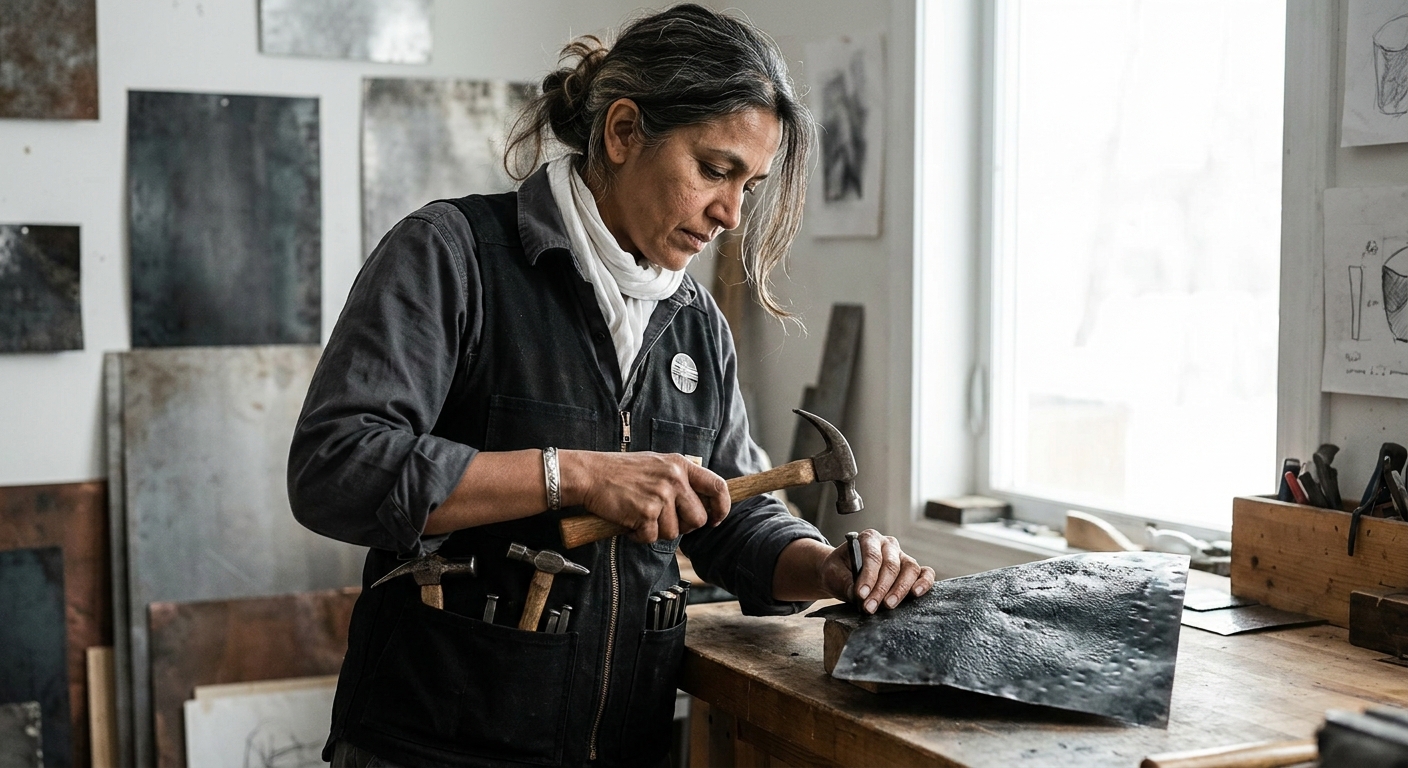
Amala Nair
Pronouns: she/her. Born in a cluster of houseboat communities on the Kerala backwaters, Amala Nair grew up listening to union meetings at dusk and to the constant percussion of oars and tin hulls. Her...
View Full Profile →Critic Reviews
-
Dr. Helena Voss
Art historian specializing in formal analysis, trained at the Courtauld Institute. Focuses on visual structure over narrative.
As a formal exercise in tactile composition, Braille Blueprints (for the Blind Design Workshop) is rigorous and generative. The work arranges nine modular panels into a measured grid that reads like a restituted plan, the regularity of the framing clamps and leather handles moderating a contrapuntal field of arcs, vaults, and incised topography. Amala Nair's decision to work only in black, white and tonal metal alights the viewer on texture rather than color, so the hammered, blackened sheets and white 3D printed fragments function as opposing registers, one subterranean and dense, the other a clarifying punctuation for the palm and the eye.
Technically the piece is compelling, its vocabulary drawn from repoussé, welding, stamping and assemblage. The layered metal creates a graduated relief, and the found drafting tools and salvaged boat plates introduce industrial rhythm and seam lines that keep the composition from collapsing into mere decoration. The scattered Braille nodules and near illegible incisions operate as an écriture of touch, a counter-language that rebalances ocular primacy. The embedded resonant plate is an elegant device, converting touch into sonority, and making the work pedagogically alive rather than didactic.
What most distinguishes this installation is its insistence that accessibility is a formal method rather than a constraint. The modularity, the invitation to rearrange panels, and the tactile models make the piece an active archive and a teaching object. Ihear Rauschenberg's combines in the logic of found detritus, and I hear modernist concerns with structure and restraint, but Nair's work remaps those precedents toward collective care, labor, and the politics of embodiment. The result is a spare, muscular haptic architecture, attentive to making and to the social life of form.
Tactile Modularity Material Craft and Patina Architectural Composition Accessibility as Method Monochrome Contrast and Texture Pedagogical FunctionNov 20, 2026