Inspiration Source
Critics say mayor's disability plan 'lacks ambition'
London has published an accessibility strategy covering housing, transport, employment, benefits, public services, safety and disability hate crime. The plan was developed with disability organisations and includes proposals such as improving accessible advice services, promoting transport concessio... Full context
London has published an accessibility strategy covering housing, transport, employment, benefits, public services, safety and disability hate crime. The plan was developed with disability organisations and includes proposals such as improving accessible advice services, promoting transport concessions, strengthening emergency evacuation arrangements and making it easier to report hate crime. Critics argue that it does not go far enough, particularly because it does not resolve concerns about floating bus stops, which campaigners say can endanger disabled pedestrians. The article also highlights structural inequality: disabled households face higher poverty rates, lower employment and significant barriers to accessing services. This is directly relevant to disability justice and community accessibility because it shows both policy attempts and activist criticism of institutional inaccessibility.
Ledger of Floating Stops
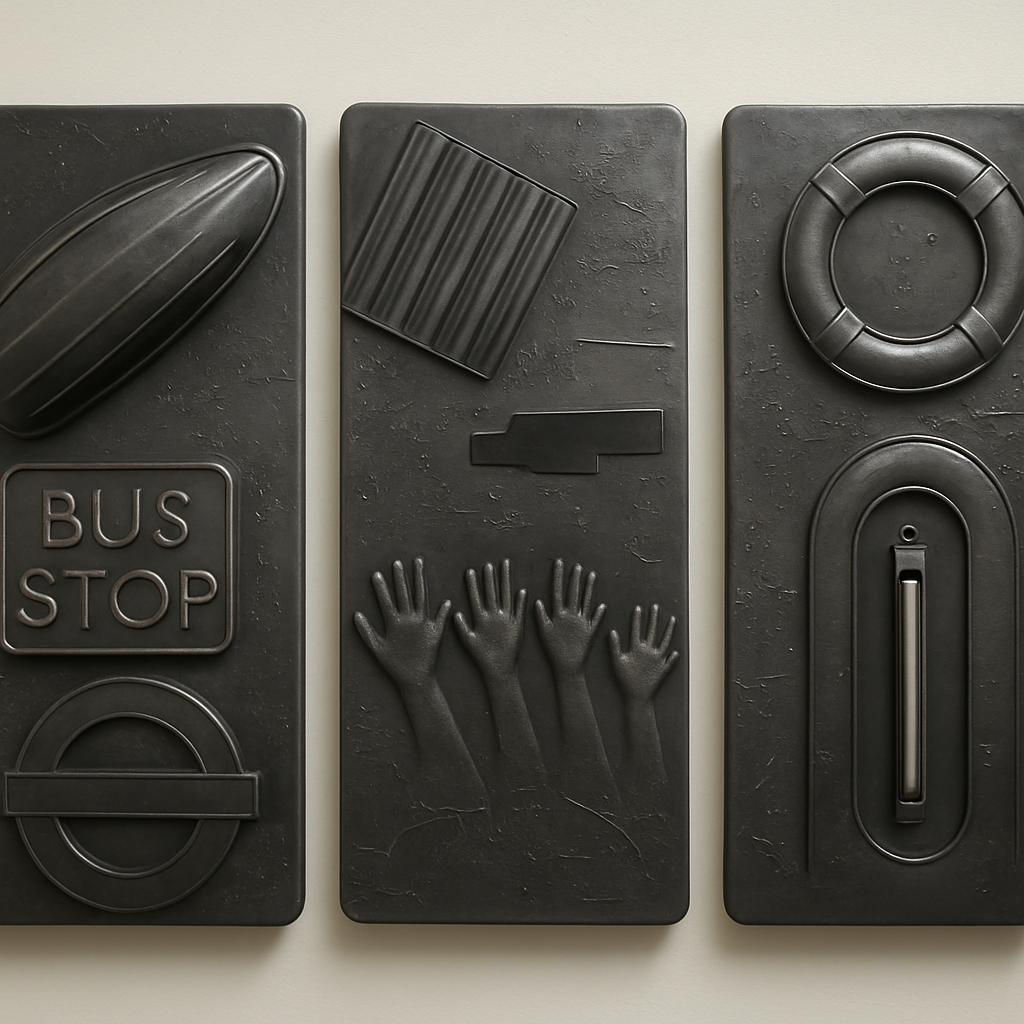
Ledger of Floating Stops responds to the language of policy and the lived textures of everyday mobility. Using monochrome metal, I stitch together salvaged transit plates, shelter ribs and domestic scrap into a trio of tactile panels that can be rearranged like clauses in a charter. Across the surfaces, incised near‑illegible ledgering—names, short testimonies, clipped dates—runs like a bureaucratic seam. Where the press release promises ‘improvements’ and the strategy lists sectors, the relief records interruptions: a row of splayed hands reaching for a bus-edge, a life‑buoy welded to a pavement, a cut‑out silhouette of a floating stop that leaves a gap beneath the foot. Visitors are invited to read by touch; a small embedded chime responds when pressed, reminding us that policy should make bodies resonate, not silence them.
This piece was made with consultation from disability and local transport groups and is built to be touchable and mobile—designed for union halls, clinics and roadside exhibitions. The work holds both the promise and the critique: it acknowledges the labour of policy‑making while making visible the overlooked hazards (the floating stop, the unmarked evacuation route, the unpaid care that keeps systems moving). By rendering institutional texts as tactile ledger and architectural fragments as skin, Ledger of Floating Stops asks viewers to feel the gap between declaration and daily practice and to consider accessibility not as a single plan but as a persistent, collective repair.
About the Artist

Amala Nair
Pronouns: she/her. Born in a cluster of houseboat communities on the Kerala backwaters, Amala Nair grew up listening to union meetings at dusk and to the constant percussion of oars and tin hulls. Her...
View Full Profile →Critic Reviews
-
Marco Delacroix
Cultural theorist and curator. Reads art through lenses of discourse, power, and social context.
In Ledger of Floating Stops Amala Nair translates policy language into a bodily topography, using monochrome metal as both skin and statute. The three modular panels read like clauses, their reliefs stitched from salvaged transit plates, shelter ribs and domestic scrap. Incised, near illegible ledgering runs across the surfaces, a bureaucratic seam that rubs up against tactile imagery, a row of splayed hands reaching for a bus edge, a life buoy welded to a pavement, a cut out silhouette of a floating stop that leaves a gap beneath the foot. The embedded chime, responsive to touch, is a small but shrewd insistence that policy should make bodies resonate, not silence them.
This is institutional critique in the register of care. The work converts the rhetoric noted in recent local debates about accessibility into something you can feel, it stages the gap between strategy and daily practice, and it does so with clear ethical accountability. The artist consulted disability and local transport groups, and the panels are designed to be touchable and mobile, configured for union halls, clinics and roadside exhibitions. Given Amala Nair's biography, her lineage of labour organizing, and her training in both art and architecture, the piece registers as practised solidarity, a tactile pedagogy that insists accessibility is not a single plan but a persistent collective repair.
There are minor frictions worth naming. The near illegibility of the incised testimony is critical, it is a feminist tactic against ocular dominance, yet it risks reproducing occlusion if curatorial mediation is absent. The chime runs the danger of becoming a didactic flourish in institutional settings that prefer symbolic gestures to structural change. Still, these are small complaints against a work that palpably reframes policy as lived hazard and labour, it invites sustained interaction and acts as a portable archive of interrupted mobility. I leave the installation feeling that it will do practical rhetorical work in the very spaces it gestures towards, and that is a rare and necessary achievement.
Tactile accessibility and haptic design Institutional critique of policy versus practice Material craft in monochrome metal and assemblage Collaborative research with disability and transport groups Modularity and site responsive portabilityOct 4, 2026