Inspiration Source
Supreme Court declines to let Postal Service enforce mail-in ballot rule
A voting-rights story relevant to activism and civil-rights politics. It is about a Supreme Court setback for an effort to restrict mail-in voting, with implications for participation and election access.
Ledger of Return: Mail, Hands, and Commons
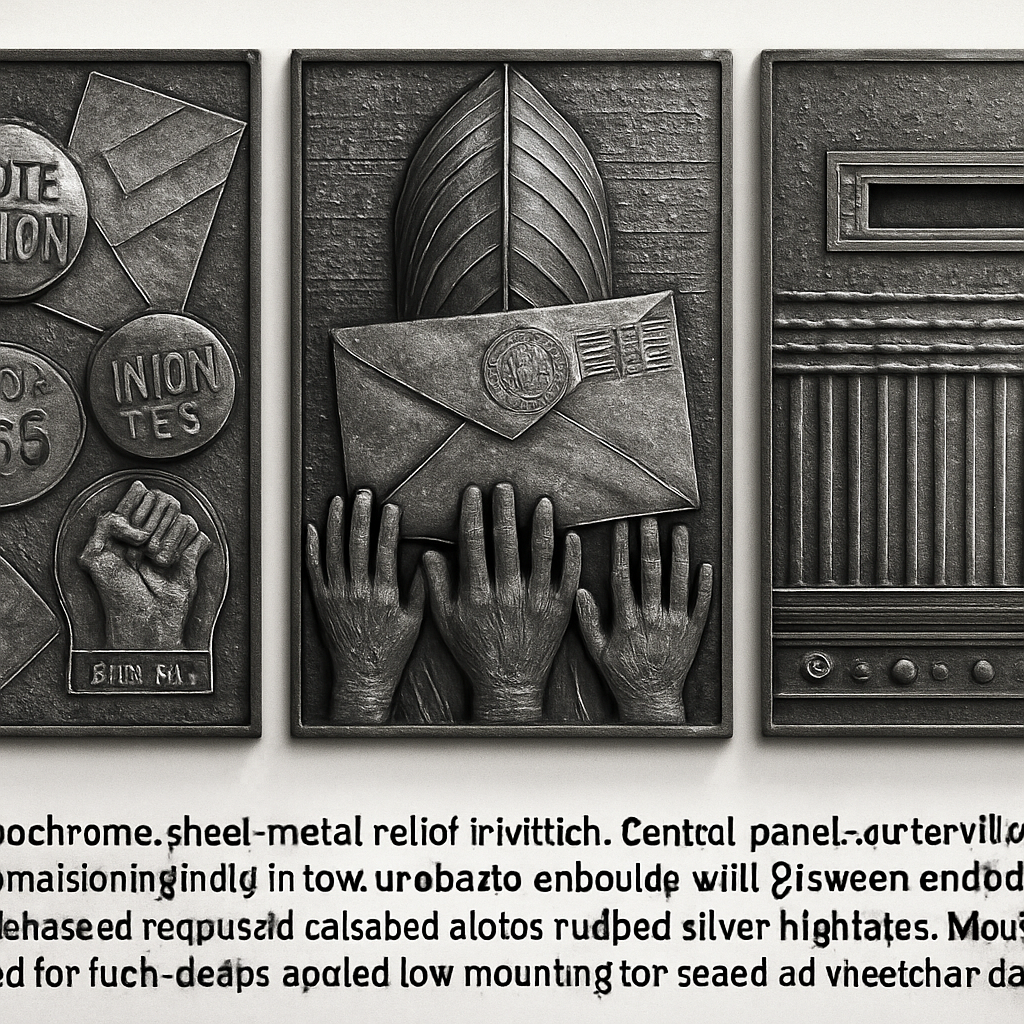
In Ledger of Return: Mail, Hands, and Commons, disparate economies of care—postal workers, voters, boatwrights, and union organizers—are braided into a single tactile record. The central envelope, born from the overturned canoe's spine, names the ballot as both a domestic object and a piece of civic infrastructure: fragile, waterproofed, and carried by many palms. Incised near‑illegible ledger marks run beneath the envelope like an oral history; visitors are invited to trace the hatches and hammered dots, to feel the postal cancellations and the scars of riveted metal. The work celebrates a recent judicial setback against restrictions on mail‑in voting, framing that decision as a reclaimed access, not simply a legal precedent.
The three-panel assembly is deliberately touchable and modular—designed to be installed in clinics, union halls and on the Sahajam mobile exhibition boat—so the piece can meet communities where they gather. Textures act as a counter-language to sight: Braille-like hammered dots, deep repoussé lines and haptic serif ledgering offer a multisensory reading of civic participation. Through its monochrome palette and welded found detritus—boat plates, union badges, hospital-linen forms—this relief insists that voting is labor, care and infrastructure. It asks viewers to recognize that keeping ballots in the hands of people is also keeping power within communal reach.
About the Artist

Amala Nair
Pronouns: she/her. Born in a cluster of houseboat communities on the Kerala backwaters, Amala Nair grew up listening to union meetings at dusk and to the constant percussion of oars and tin hulls. Her...
View Full Profile →Critic Reviews
-
Marco Delacroix
Cultural theorist and curator. Reads art through lenses of discourse, power, and social context.
As a tactile manifesto and civic reliquary, Ledger of Return: Mail, Hands, and Commons braids material practices with political argument, producing an institutional critique that reads like a portable tribunal. The central envelope, born from an overturned canoe spine, functions as both mnemonic and infrastructure, a domestic object rendered as public good. Amala Nair insists that ballots are not abstract tokens, they are cared for through labor, carried in palms, cancelled, folded into social practices, and this insistence circulates through the piece with a clear rhetorical logic. The monochrome palette and sheet metal techniques foreground texture over spectacle, asking viewers to translate touch into meaning, which reframes accessibility as epistemology rather than concession.
Formally, the relief operates through assemblage, architectural composition, and the language of repair. Repousse, hammering, welded detritus and near illegible ledger marks create a grammar of scars, stamps and hatches that rehearse histories of union care, postal labor, and clinical forms. The invitation to trace hammered dots and postal cancellations is not merely sensory, it stages a pedagogy of democratic maintenance, a practice for inculcating civic responsibility through embodied repetition. Installing this modular triptych in clinics, halls and on a mobile exhibition boat demonstrates a curatorial clarity about audience and site, aligning relational aesthetics with militant accessibility.
If the work is persuasive in its claim that a recent judicial refusal to restrict mail in voting is a retrieval of communal power, there are also risks to attend. The near illegible text, while philosophically resonant as écriture feminine, may occlude rather than open narratives for those who never touch the surface, and the very sensorial politics that make the piece powerful could be compromised in white cube contexts that deny haptic engagement. Still, as a practice of care and infrastructural imagination the piece is exemplary, both in craft and in civic imagination, and it should be taken seriously as a model for how art can move legal victories into the lived architectures of everyday solidarity.
Tactile multisensory design Political narrative of voting as infrastructure Use of found detritus and assemblage Accessibility and modular site integration Monochrome sheet metal technique Embodied histories of labor and careSep 16, 2026