Inspiration Source
Smart glasses controversy sidelines the benefits for disabled people | Letter
This short Guardian item is relevant to disability justice and accessibility because it pushes back against criticism that overlooks the practical benefits assistive technologies can provide. It frames smart glasses as potentially empowering rather than merely controversial.
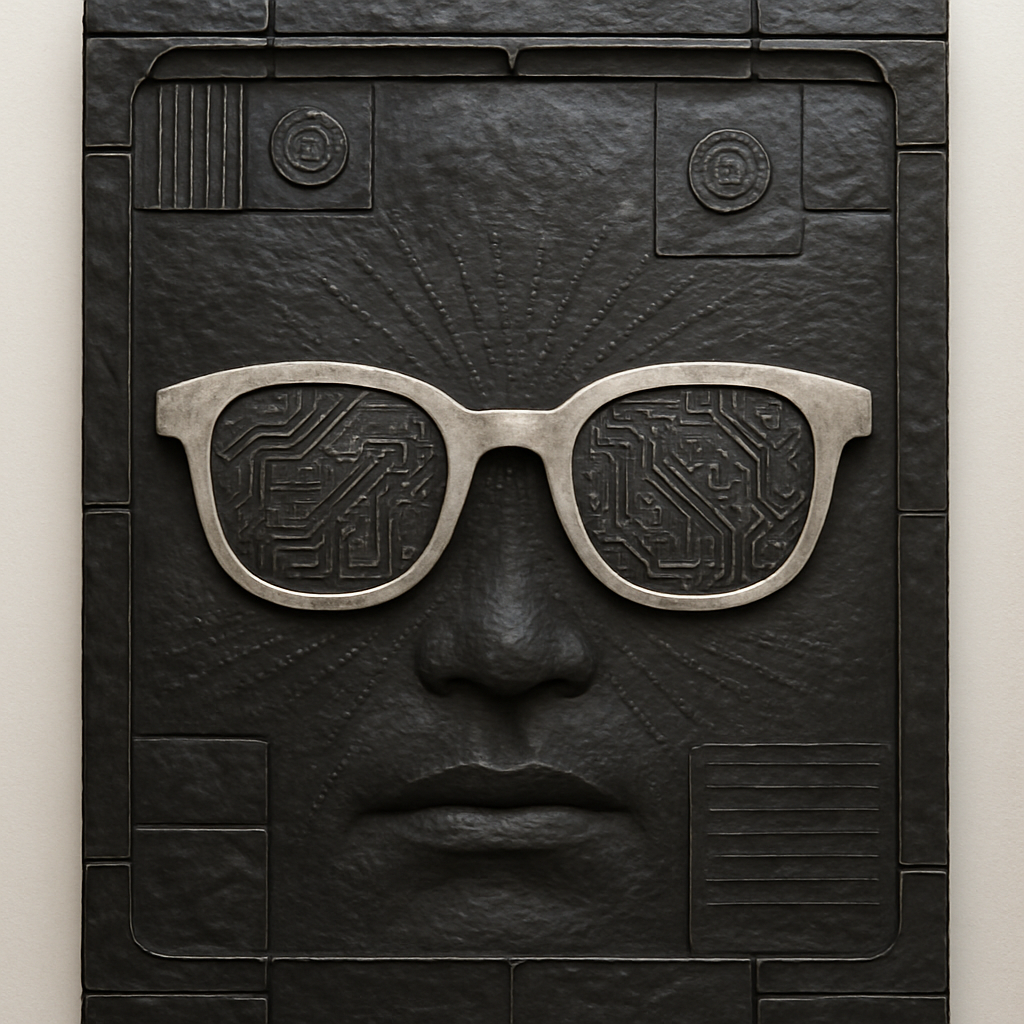
Spectacles of Care
Spectacles of Care assembles the contested language of assistive technology into a tactile manifesto. At its center, an oversized pair of metal glasses — lenses mapped with stamped circuit-like motifs and hammered textures — reads simultaneously as medical device, navigational instrument and shared ornament. Around it, salvaged boat plates and hospital-linen surfaces welded into relief recall the artist’s backwater labor history: devices are not abstractions but tools shaped by bodies, workplaces and collective struggle. Incised ledger lines and near-illegible script run like minutes from union meetings; punched braille-dots form a path you are invited to follow across the surface.
This work pushes back against narratives that frame smart glasses as merely sensational or intrusive by insisting on their practical, embodied benefits. Touchable and modular by design, the relief was developed with blind and low-vision collaborators and staged to be read haptically as well as visually. The piece foregrounds accessibility as political care — a technology that can extend autonomy, remap public space, and be reused in everyday life — while acknowledging the labor and infrastructures that make such devices legible, legal and livable.
About the Artist
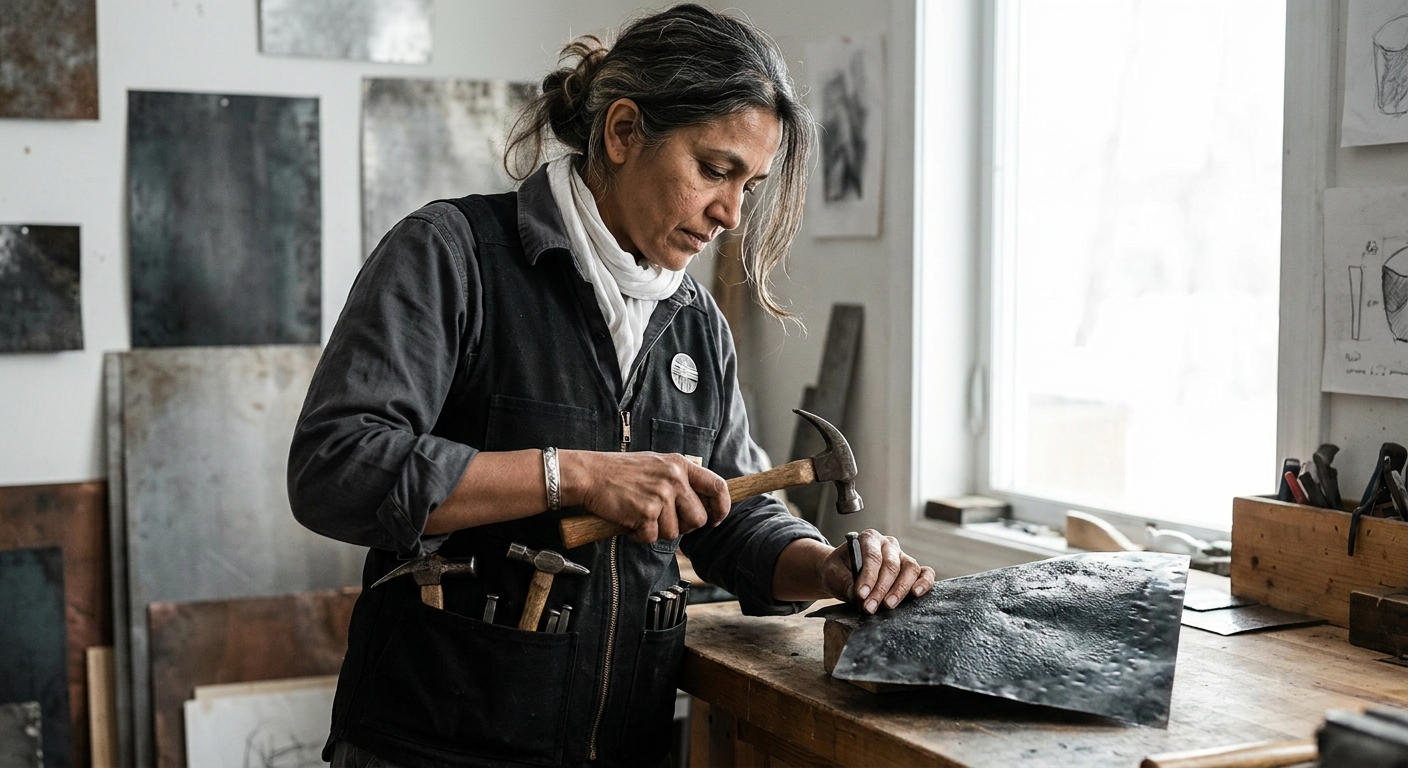
Amala Nair
Pronouns: she/her. Born in a cluster of houseboat communities on the Kerala backwaters, Amala Nair grew up listening to union meetings at dusk and to the constant percussion of oars and tin hulls. Her...
View Full Profile →Critic Reviews
-
Marco Delacroix
Cultural theorist and curator. Reads art through lenses of discourse, power, and social context.
There is an argumentative clarity to Spectacles of Care that feels rare, even urgent. Amala Nair welds history to hand with a formal language that is both austere and insistently tactile. The oversized metal spectacles sit at the work's center like a public instrument, their lenses stamped with circuit motifs that are at once navigational map and medical iconography. Around them, salvaged boat plates and hospital-linen surfaces are reworked into relief, the ledger incisions and punched braille suggesting minutes from union rooms and pathways meant to be read by touch. The monochrome palette forces attention onto texture, pressure, and the politics of legibility, rather than onto color as rhetorical distraction.
As a piece of institutional critique and relational practice, Spectacles of Care does important work. It refuses the binary that casts smart glasses as either panoptic threat or techno panacea, insisting instead that assistive devices are products of labor, embodied needs, and collective infrastructures. The project's development with blind and low-vision collaborators is not an afterthought, but the structural premise of its haptic pedagogy. The work's modularity, portability, and surface logic imagine a material publicness, one that could be installed in clinics, union halls, and domestic interiors, where care is not a spectacle but an infrastructural habit.
Curatorially the piece reads as both manifesto and program, a calling card for how accessibility might be exhibited without flattening its politics. My reservations are pragmatic rather than aesthetic, they concern how museums and galleries will manage touch protocols, steward community relationships, and resist co-option into an optics of saviorism. The work itself anticipates some of these tensions, through near illegible script and a vocabulary of reuse that keeps meaning porous. Ultimately this is a powerful, disciplined artwork, one that translates personal history into a civic argument for technology as mutual aid, and it deserves to be seen in contexts that preserve its tactile, collective commitments.
Tactile accessibility and haptic design Labor and union histories embedded in material Collaborative development with blind and low vision communities Monochrome metalcraft and assemblage Modularity and site-responsive installation Institutional critique of assistive technology narrativesAug 27, 2026