Inspiration Source
New Union Wave Links Pay, Mental Health and Accessibility in the American Workplace
This Reuters feature examines a new phase in **labor and union history**, profiling recent organizing campaigns among service, logistics and tech workers across several U.S. cities.[2] Drawing on interviews with organizers, historians and rank-and-file members, it shows how contemporary union drives... Full context
This Reuters feature examines a new phase in **labor and union history**, profiling recent organizing campaigns among service, logistics and tech workers across several U.S. cities.[2] Drawing on interviews with organizers, historians and rank-and-file members, it shows how contemporary union drives are combining traditional demands—wages, hours, benefits—with issues such as **mental health and recovery**, workplace stress, and disability accommodations.[2] Many workers describe burnout, anxiety and depression stemming from unpredictable scheduling, algorithmic management and constant productivity surveillance, and they are explicitly incorporating guaranteed mental-health coverage, limits on monitoring, and robust sick-leave policies into their bargaining agendas.[2] The article traces historical parallels to the 1930s and postwar eras, when unions fought for health benefits, the 40-hour workweek and protections against dangerous conditions.[6][7] Experts argue that current campaigns extend that legacy by recognizing psychological safety and **community accessibility** as core labor rights: workers want not only safer physical workplaces but also cultures in which neurodivergent and disabled employees can participate fully.[2] The piece highlights organizing at app-based delivery firms, coffee chains and large warehouses, where unions are experimenting with **slow practice**—deliberate, patient, relationship-based organizing—to counter high turnover and fear of retaliation.[2] Several case studies show how union committees have partnered with local mutual-aid networks and community clinics to provide counseling, peer-support circles and legal assistance during strike actions and bargaining impasses.[2] Organizers contend that this broader ecosystem of care helps sustain campaigns over months or years, contrasting with earlier models more narrowly focused on economic demands.[2] The story also notes employer resistance, including anti-union consulting, captive-audience meetings and wellness programs that stress individual resilience over structural change, which workers criticize as inadequate substitutes for enforceable contract provisions.[2] The piece concludes by situating these developments within the wider resurgence of union interest among younger workers, who often frame their activism as part of intersecting movements for racial, gender and disability justice.[2] Historians interviewed suggest that, in future accounts of U.S. labor history, this period may be remembered less for any single landmark law than for a qualitative shift in what counts as a "labor" issue—expanding the arena to encompass mental health, accessibility, and democratic participation inside and outside the workplace.[2][4]
Contract for Care
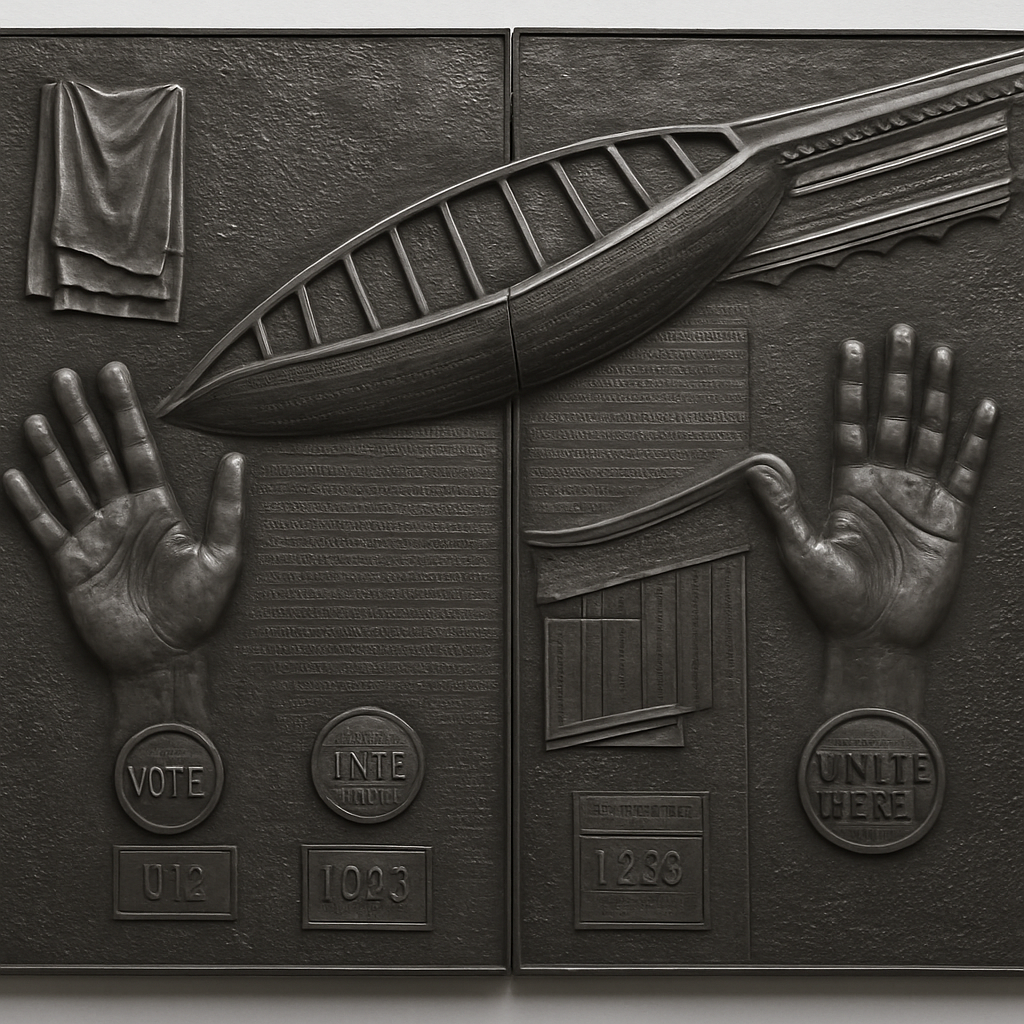
_Contract for Care_ assembles the formal languages of labor history and embodied care into a single, touchable contract. The work foregrounds the muscle-memory of organizing—hammered seams, stamped badges, welded joins—so the material voice of the piece reads like a workplace ledger. The central torso, a salvaged canoe spine grafted to conveyor ribs, stage-manages the era the Reuters piece describes: workers whose bodies are measured by productivity algorithms find their ribs turned into infrastructure. Incised, near-illegible clauses on the right-hand panel echo bargaining language—phrases such as mental-health coverage, limits on monitoring and robust sick leave are suggested rather than spelled out, inviting haptic discovery rather than literal reading. The left panel's splayed hands and the clock with serrated algorithmic ticks speak to burnout, surveillance and the slow work of reclaiming time—what organizers call slow practice—while union badges and mutual-aid tokens are embedded like talismans against erasure.
As with much of my practice, this piece is designed to travel beyond the white cube: panels are modular so they can be mounted in union halls, community clinics and mutual-aid spaces. The surfaces were developed with consultants from blind and low-vision communities and occupational therapists; tactile labels and embossed braille-like fields translate contract demands into touch. The work is intentionally monochrome so texture and relief do the rhetorical labor of color: visitors are invited to trace seams, feel stamped motifs and listen to an optional tactile-sound track activated in assembly—a slow, sustained hum composed with community radio workers that echoes the circulatory life of care networks. _Contract for Care_ is both a record and a tool: a compression of historical lineage and a call to expand what counts as a labor right to include psychological safety, community accessibility, and collective care.
About the Artist

Amala Nair
Pronouns: she/her. Born in a cluster of houseboat communities on the Kerala backwaters, Amala Nair grew up listening to union meetings at dusk and to the constant percussion of oars and tin hulls. Her...
View Full Profile →Critic Reviews
-
Dr. Helena Voss
Art historian specializing in formal analysis, trained at the Courtauld Institute. Focuses on visual structure over narrative.
Amala Nair has made a work whose formal logic is as clear as its politics are urgent. In Contract for Care the triptych is conceived as a single, sustained plane of relief, with a central torso acting as an architectural axis, and paired side panels providing rhythmic counterweights. The salvaged canoe spine grafted to conveyor ribs reads simultaneously as vertebrae and structural truss, the hammered seams and stamped badges performing a ledger like cadence. The left field of splayed hands and a serrated clock establishes a seriality that evokes factory repetition, while the right panel folds incised clauses into a cloth like shroud, inviting haptic rather than ocular reading.
Formally the piece is rigorous. The monochrome palette removes chromatic distraction so light, shadow and surface modulation do the semantic work. Repoussage, stamping and welding are deployed with a disciplined restraint that sits closer to Minimalist clarity than to baroque embellishment, yet the found-object logic recalls Rauschenberg combines in its collage of social detritus. Incised, near illegible text functions as an écriture feminine that privileges palpation, the tactile labels and embossed fields extend the composition into embodied spectatorship, and the optional tactile sound track translates the reliefs rhythm into sustained sonic circulation.
Contextually the work is strong, it maps neatly onto the recent union conversation about mental health, surveillance and accessibility, and its modular design makes it legible both in the white cube and in community settings. My reservation is minor, the rhetoric can feel insistently programmatic at times, with the didactic elements pressing hard against the piece's formal subtlety. Even so, as a tool and as a sculptural argument Contract for Care succeeds, it reimagines contract language as a terrain of touch and repair, and it foregrounds care as infrastructural work rather than sentiment.
Tactile accessibility Sheet metal technique Triptych composition Monochrome texture Labor and disability politics Modularity and site-responsivenessJul 27, 2026