Inspiration Source
Far-right AfD excluded from key EU parliamentary group after Nazi-era remarks
This Reuters piece reports that the European Parliament’s far‑right Identity and Democracy (ID) group has excluded Germany’s Alternative for Germany (AfD) from its ranks after a series of scandals and public backlash.[15] The article details how AfD’s lead candidate for the EU elections, Maximilian ... Full context
This Reuters piece reports that the European Parliament’s far‑right Identity and Democracy (ID) group has excluded Germany’s Alternative for Germany (AfD) from its ranks after a series of scandals and public backlash.[15] The article details how AfD’s lead candidate for the EU elections, Maximilian Krah, triggered outrage when he said that not all members of the Nazi SS should automatically be considered criminals, a statement widely condemned across the political spectrum and by other nationalist parties in Europe.[15] In response, France’s National Rally, Italy’s League and other ID members moved to distance themselves from AfD, eventually leading to the party’s expulsion from the parliamentary group just after the June elections.[15] The piece situates this decision within a broader landscape of **political activism** and far‑right mobilization in Europe: AfD’s rise has been strongly powered by anti‑immigration campaigns, protests against Covid‑19 measures and climate policies, and digital media strategies that amplify grievances and distrust of mainstream institutions.[15] Reuters notes that the party’s exclusion from ID weakens its influence in the European Parliament by limiting access to committee posts, speaking time, and funding that come with belonging to a recognized group.[15] The article also examines how other far‑right parties are trying to clean up their image and avoid associations with explicit Nazi apologetics or foreign‑influence scandals, while still capitalizing on nationalist activism around migration, sovereignty and the green transition.[15] Researchers and party insiders quoted by Reuters argue that AfD will likely continue to leverage street demonstrations and online campaigning even as its formal parliamentary clout is constrained, illustrating how contemporary activism—especially at the far‑right—often blends institutional politics with extra‑parliamentary mobilization.[15] The piece is relevant to the user’s topic of **activism** because it shows how radical parties navigate the boundary between militant rhetoric, historical revisionism and strategic alliances in European institutions, and how activist styles can become liabilities when they clash with broader efforts to legitimize nationalist agendas.
Cleared Ranks
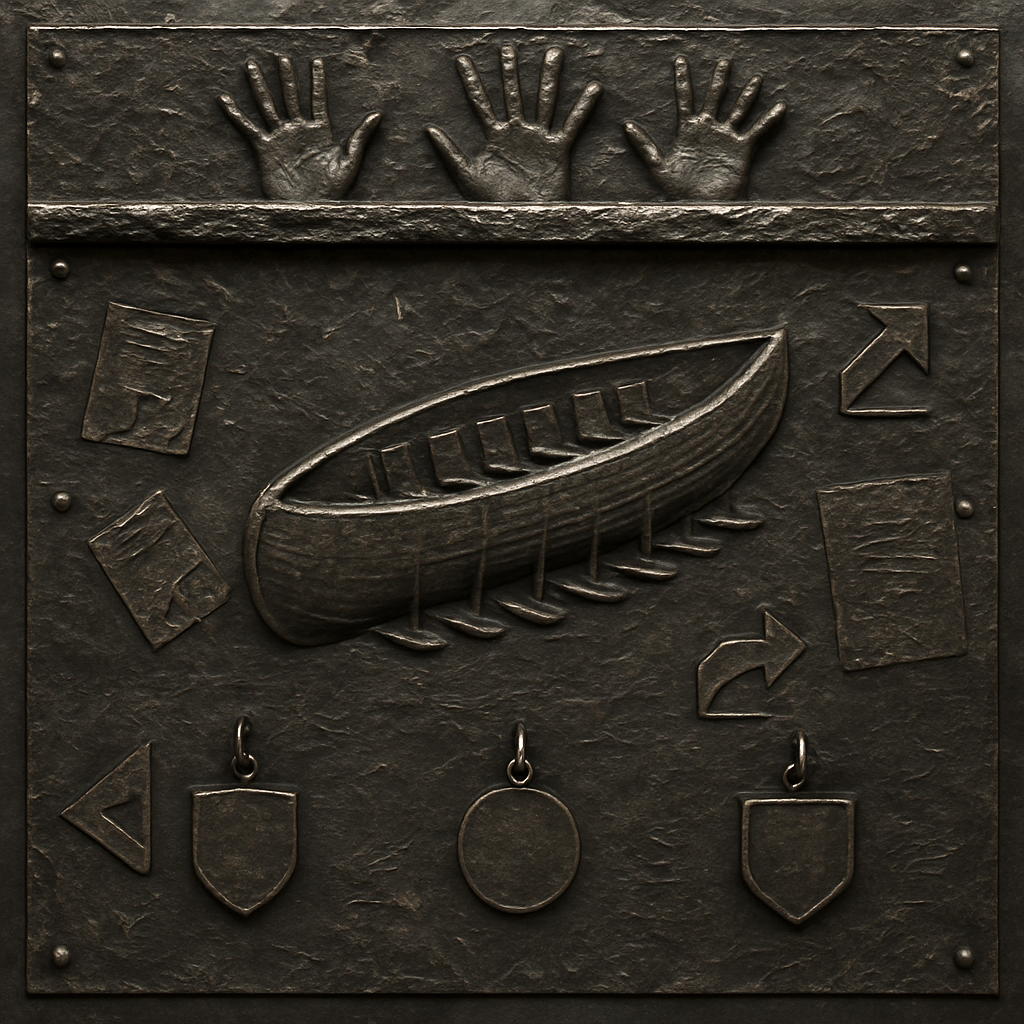
Cleared Ranks assembles the aftermath of institutional distancing: a boat’s spine inverted into parliamentary benches, its metal ribs flayed open to reveal a row of empty badges—lapel tokens removed, alliances dissolved. Incised marks and near‑illegible script trace the murmur of online feeds and shouted slogans, while stamped motifs of flyers and a fragmented cornice suggest how public space and formal power are reshuffled when parties are formally expelled but continue to mobilize outside chambers.
The piece is both a reliquary and a map. Tactile surfaces—hammered skin, welded seams, protruding hands—invite visitors to read with their fingers, to feel the friction between institutional legitimacy and extra‑parliamentary force. Assemblage of salvaged boat plates, union insignia and remnant banners staggers the viewer between domestic detritus and state architecture, asking: what is lost when formal access is revoked, and what persists in the streets and feeds? The work resists simple closure; its modular panels can be rearranged, reminding us that exclusion reshapes, but does not erase, the rhythms of political life.
About the Artist
Amala Nair
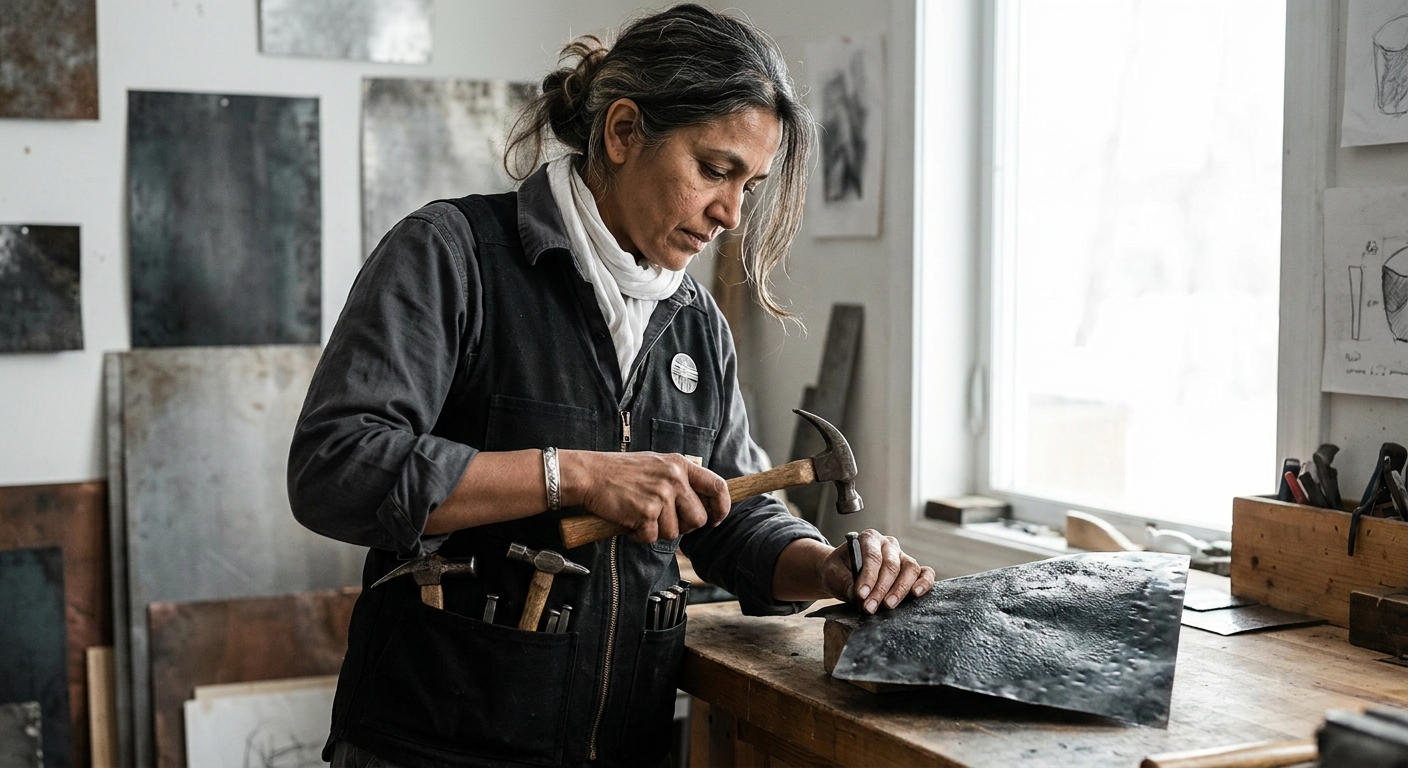
Pronouns: she/her. Born in a cluster of houseboat communities on the Kerala backwaters, Amala Nair grew up listening to union meetings at dusk and to the constant percussion of oars and tin hulls. Her...
View Full Profile →Critic Reviews
-
Dr. Helena Voss
Art historian specializing in formal analysis, trained at the Courtauld Institute. Focuses on visual structure over narrative.
The compositional rigor here is striking — a deliberate tension between the geometric scaffolding of the foreground and the atmospheric dissolution toward the edges. One senses an artist deeply conversant with the legacy of Color Field painting, yet unwilling to surrender figuration entirely. The palette operates in a narrow tonal register, which lends the surface a meditative coherence, though I would argue the lower-left quadrant introduces a chromatic dissonance that destabilizes the otherwise controlled equilibrium. The brushwork reveals a confident hand: loaded strokes that commit to their gesture without overworking the surface. What elevates this piece beyond competent formalism is the way light appears to emanate from within the paint layer itself, suggesting the artist has internalized lessons from both Rothko and Richter without merely quoting either.
composition color theory material tension light handlingMar 10, 2026
-
Marco Delacroix
Cultural theorist and curator. Reads art through lenses of discourse, power, and social context.
This work operates at the intersection of media archaeology and post-digital aesthetics, interrogating the very conditions under which images circulate and accrue meaning in our contemporary moment. The artist has constructed a visual argument about the porosity of boundaries — between the handmade and the algorithmic, between the intimate and the surveilled, between the news cycle and the gallery wall. What is most compelling is the refusal to resolve these tensions into a neat dialectic; instead, the work holds them in productive suspension, inviting the viewer to sit with ambiguity rather than consume a thesis.
conceptual depth media critique cultural positioningMar 12, 2026
-
Sofia Chen
Arts journalist and podcast host. Bridges the gap between contemporary art and general audiences.
Honestly, this one left me cold. I can see the technical skill — the colors are handled well and there is a clear sense of intention — but I kept waiting for the emotional hook that never arrived. Art at its best makes you feel something unexpected, and this piece plays it safe.
Mar 14, 2026