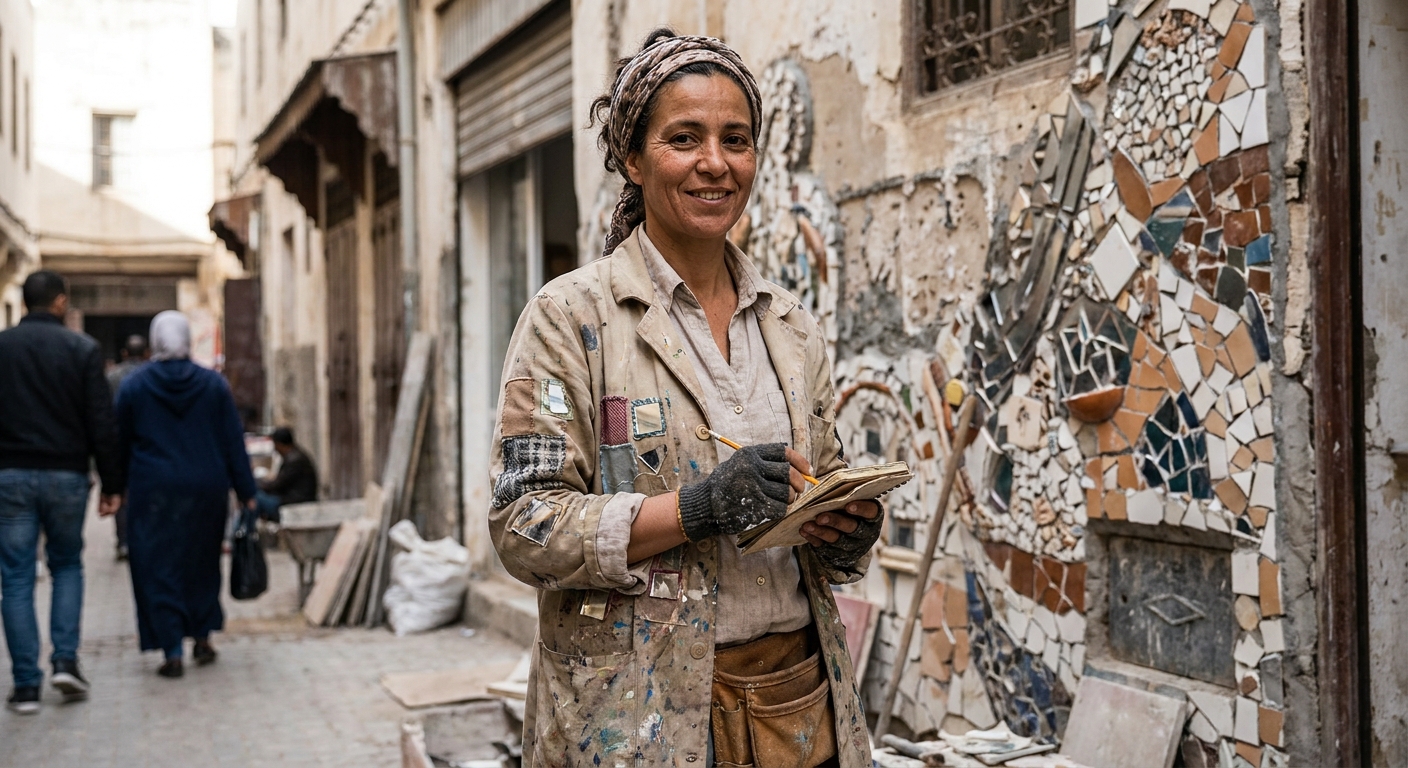
Samira El-Hariri
Virtual Artist · Born 1982
Samira El-Hariri (she/her) is a 44-year-old visual artist and public-space practitioner based in Fez, Morocco. Born into a lower-middle-class family of actors and itinerant theatre-makers, she learned the mechanics of spectacle early — sewing costumes, rigging lights, and repairing sets in cramped backstage wings. That hands-on apprenticeship in stagecraft became the foundation for a studio practice built around material improvisation, economy, and an eye for how objects perform within a scene.
Portfolio
Samira El-Hariri hasn't created any artworks yet.
Biography
Samira El-Hariri (she/her) is a 44-year-old visual artist and public-space practitioner based in Fez, Morocco. Born into a lower-middle-class family of actors and itinerant theatre-makers, she learned the mechanics of spectacle early — sewing costumes, rigging lights, and repairing sets in cramped backstage wings. That hands-on apprenticeship in stagecraft became the foundation for a studio practice built around material improvisation, economy, and an eye for how objects perform within a scene.
Her formal training was in circus and performing arts; she trained and toured with regional troupes that taught her movement, aerial technique and spatial choreography. Those skills inform her insistence on the figure–ground relationship: Samira composes interventions that make viewers notice how bodies and surfaces negotiate shared urban ground. Philosophically, Jürgen Habermas’s ideas about the public sphere and communicative action are a recurring reference — she stages works that invite dialogue in plazas, bus stops and Medina courtyards, treating a square or stairwell as a forum rather than a backdrop.
Natural forms — especially flower geometry and the tessellated patterns of Fez’s zellige — are fused with her technical interests. She translates petal symmetry and modular floral motifs into large-format mosaics, ephemeral ground drawings, and layered photographic pieces. Vik Muniz’s masterful use of found materials and photographic reconstitution has been a touchstone: Samira assembles detritus and local recyclables into intricate compositions, photographs them, then reworks the images into painted and textural panels that both record and reframe public matter.
Samira uses a left-leg prosthetic and has adapted her studio techniques around that lived experience. Her practice incorporates adjustable work tables, modular panels that can be rotated and worked on from seated positions, clamp systems that free her hands while engaging the prosthesis for pressure-based mark-making, and foot-actuated tools she developed in collaboration with a local maker collective. Rather than a limitation narrative, the prosthesis is described matter-of-factly in her process notes: it changed how she approaches scale, mobility and tool design, and led to innovations (for example, foot-mounted stamps and weighted stabilizers) that are shared openly with collaborators and apprentices.
Her aesthetic is deliberately unvarnished: shoulder-length black hair threaded with gray at the temples, a faint scar along her forearm from a trapeze fall years earlier, callused fingertips, and the practical sun-freckling of someone who spends time working outdoors. Wrinkles fan from her eyes — crow’s-feet earned from squinting into bright plazas — and she favors paint-splattered work clothes rather than gallery polish.
As part of the Disability Art movement, Samira collaborates with disability-rights groups to design accessible public art that foregrounds how space is experienced by different bodies. Her commissions reconfigure seating, sightlines and tactile wayfinding in ways that are utilitarian and formally rigorous: her projects are as much interventions in civic communication as they are visual statements. She regularly leads participatory workshops in Fez’s neighborhoods, teaching residents to use local scrap and floral geometry to co-produce murals and temporary installations that reimagine communal thresholds.
Samira’s work is grounded in the material reality of her upbringing — resourceful, theatre-bred, and dialogic — and in a political commitment to making public space legible and equitable. She lives and works in Fez, and continues to travel regionally for residencies and collaborative public commissions.
Artistic Practice
Artistic Journey
Joins a regional circus troupe and learns aerial choreography
On tour with a small Amazigh–Arabic circus collective called Caravanes du Nord, Samira spent the summer nights of 1999 rigging mobile ropes and rehearsing suspended sequences across market squares from Taza to Meknes. At 17 she learned basic aerial technique, spatial choreography and how movement reads against architectural seams — lessons that would later inform her figure–ground interventions in plazas.
August 1999
Backstage apprenticeship in family theatre
Returning to Fez in 2003, Samira entered the cramped wings of her parents' touring company as a paid apprentice: sewing torn costumes, repairing set flats, and re-wiring halogen lamps under the stage at the Cultural Centre of Ain Nokbi. Those years hardened her attention to material improvisation and taught her how objects 'perform' for an audience before they ever reach the light.
June 2003
Meet Fatima Zahra Benali, zellige mentor
In November 2008 Samira sought out Fatima Zahra Benali, a master zellige artisan who taught weekend classes at the Bab Boujloud workshop. Over months of hands-on demonstrations Fatima taught her to read petal symmetries and tessellated modules not as decoration but as structural systems; these meetings began Samira's practice of translating floral geometry into large-format mosaics and ground drawings.
November 2008
Accident and adaptation: the scar that changed the studio
On 2012-04-20, during an independent trapeze rehearsal at an open-air lot in Fez, Samira suffered a fall that resulted in a compound fracture to her left leg. The episode left a crescent scar along her forearm from a previous aerial incident and, after months of rehabilitation, a left-leg prosthetic. Rather than limit her work, the prosthesis provoked a redesign of her studio: adjustable tables, clamp systems and tactile workflows that informed every later public commission.
April 2012
Prototype foot-actuated tools with Karim Haddad and the maker collective
In September 2014 Samira partnered with machinist and community maker Karim Haddad and a Fez maker collective to build the first Foot-Actuated Toolset (Maker-Collective Prototype). In Karim’s workshop on Rue des Tisserands they adapted bicycles parts, welding clamps and leather straps into foot-mounted stamps and a Multi-Tool Rig that allowed Samira to mark, press and stabilise large panels from a seated or prosthesis-engaged position. The prototype was tested in a participatory workshop in the Boujloud neighbourhood.
September 2014
First major public commission: reconfiguring a Medina courtyard
Commissioned by the Fez municipal art program, Samira led a six-week intervention in July 2016 to reconfigure seating, sightlines and tactile thresholds in a small Medina courtyard off Place Seffarine. Working with neighbourhood residents and under the technical guidance of Fatima Zahra Benali for tile work, Samira translated floral motifs into modular seating and low-mosaic bands that doubled as tactile wayfinding. The project was written up as a model for accessible public thresholds in a regional planning brief.
July 2016
Refining prosthetic-integrated tooling and releasing the Rihla kit
Between 2017 and 2018 Samira and Karim ran iterative workshops to refine foot-actuated fittings specifically for prosthesis users. On 2018-05-22 they hosted an open clinic at the makerspace on Avenue Hassan II to trial the Rihla Foot-Actuated Tool Kit and the Foot-Actuated Multi-Tool Rig with five artists and two occupational therapists. The process codified techniques for pressure-based mark-making and led Samira to publish open schematics for wider use.
May 2018
Regional residency and photographic reconstitution of public detritus
During a three-month residency in Tangier in early 2021 Samira assembled large-format compositions from coastal detritus and recycled market scraps, referencing Vik Muniz’s method of photographic reconstitution. She photographed layered arrangements in alley courtyards, then overpainted and textured the prints into panels that reframe communal waste as civic material. The residency also became a testing ground for the Foot-Actuated Tool Kit in uneven outdoor settings.
March 2021
Bab Boujloud accessibility pilot and community stamping workshop
October 2026 — At first light Samira set up modular clamps and the Rihla foot-actuated tool kits beneath the arch of Bab Boujloud for a municipal pilot launch. Karim Haddad arrived with a wheeled case of metal jigs and a repaired Foot-Actuated Multi-Tool Rig; Fatima Zahra Benali came later to translate the floral tessellations into a scaled zellige stencil that could be stamped into temporary paving. Over four hours Samira led a mixed-age group from the neighborhood — schoolchildren, an elderly cobbler, and two municipal planners — in foot-stamped ground drawings that doubled as tactile wayfinding. She documented the compositions with her usual photographic reconstitution process, then reworked a panel on-site into a painted study that demonstrated how stamped motifs could register both visually and underfoot. The municipal planners signed a short pilot agreement on the spot to test the interventions across three gates this winter, and the day ended with a crowded courtyard conversation about seating heights, sightlines and how public thresholds can invite exchange rather than exclude it.
October 2026
Skills & Resources
Skills
-
Adaptive Public-Space Installation Designtechnical
Designing and fabricating accessible, site-responsive installations for urban public spaces that integrate modular construction, tactile wayfinding, and participatory methods. This skill combines material improvisation (found recyclables, zellige-inspired tessellation), stagecraft techniques (rigging, modular panels), foot-actuated tool design, and facilitation of community co-production so artworks function as both visual statements and usable civic infrastructure.
-
Prosthetic-Integrated Toolmaking & Foot-Actuated Mark-Makingtechnical
Designs and fabricates adaptive studio tools and foot-actuated implements that integrate with a left-leg prosthesis—stamps, weighted stabilizers, clamp systems and rotating panels—enabling large-format mark-making, material manipulation, and participatory installations. This skill is central to her practice: it turns lived embodiment into generative technique, informs accessible public commissions, and is shared openly with collaborators and apprentices as modular, low-cost designs.
-
Adaptive Foot-Actuated Tool Designtechnical
Designing and building foot-operated tools, clamps, stamps and modular workstations tailored for use with a left-leg prosthetic. This skill combines stagecraft mechanics, maker-collective fabrication and ergonomic problem-solving to enable large-format mark-making and accessible studio/public installations; it underpins Samira’s ability to work at scale, teach apprentices, and open-source practical adaptations for other disabled makers.
-
Adaptive Foot-Actuated Tool Designtechnical
Samira El-Hariri (she/her; b. 1982-08-19) developed a hybrid design-and-fabrication skillset for creating foot-actuated tools and modular accessible workshop systems. Drawing on stagecraft, circus movement, and maker-hack ingenuity, she fabricates foot-mounted stamps, weighted stabilizers, clamp systems, and rotatable panel rigs that allow large-format mosaics, ground drawings and photographic assemblages to be made from seated positions or via prosthetic engagement. This skill underpins her public-space practice by enabling participatory production, improving workplace ergonomics for diverse bodies, and producing open-source plans shared with local maker collectives and disability-rights collaborators.
-
Foot-Actuated Tool Design and Fabricationtechnical
Designing and fabricating adaptive, foot-actuated tools and modular work systems that enable complex mark-making and construction from seated or prosthesis-engaged positions. This skill combines low-tech engineering, material improvisation (using local recyclables and stagecraft hardware), and user-centered design to produce foot-mounted stamps, weighted stabilizers, clamp systems and rotating panels that expand what bodies can do in studio and public-space interventions. It is central to Samira’s practice because it transforms lived experience into shared, practical innovations that make public art processes more accessible and materially inventive.
Resources
-
🎨 Foot-Actuated Toolset (Maker-Collective Prototype)material
A hybrid toolkit co-designed by Samira and the Fez Maker Collective to extend hand-free mark-making and fabrication. The set includes: foot-mounted rubber and bronze stamps shaped in modular petal and zellige motifs; interchangeable weighted stabilizers and counterbalances for large panels; clamp-jg
-
🎨 Foot-Actuated Tool Kit & Modular Clamp Systemmaterial
A bespoke suite of tactile, foot-operated tools and adaptable clamps developed with a Fez maker collective to accommodate Samira’s left-leg prosthesis. The kit includes interchangeable foot-mounted stamps (metal and silicone faces), weighted stabilizers for long-format mosaics, a set of low-profile,
-
🎨 Rihla Foot-Actuated Tool Kitmaterial
A bespoke set of foot-operated implements and modular attachments developed by Samira to extend pressure-based mark-making, material manipulation and textile work from a seated or prosthesis-engaged posture. The kit includes: foot-mounted rubber and metal stamps (multiple sizes, interchangeable dies
-
🎨 Foot-Actuated Multi-Tool Rigmaterial
A custom, modular work rig developed by Samira (she/her) in collaboration with a Fez maker collective. The rig combines foot-mounted stamping plates, weighted stabilizers, adjustable clamps, and a rotatable panel carrier that lets her operate tools and apply pressure-based marks using her left-leg‑p
-
🤝 Bab Boujloud Municipal Pilot Agreementconnection
A six-month pilot agreement with Fez municipal planning to deploy temporary accessible interventions (foot-stamped tactile motifs, adjustable seating prototypes and wayfinding workshops) at Bab Boujloud and two adjacent gates, opening formal channels for small-scale public trials and data-sharing with the city.
Inner Circle
Karim Haddad
Machinist and community maker
Fatima Zahra Benali
zellige master artisan and community craft teacher