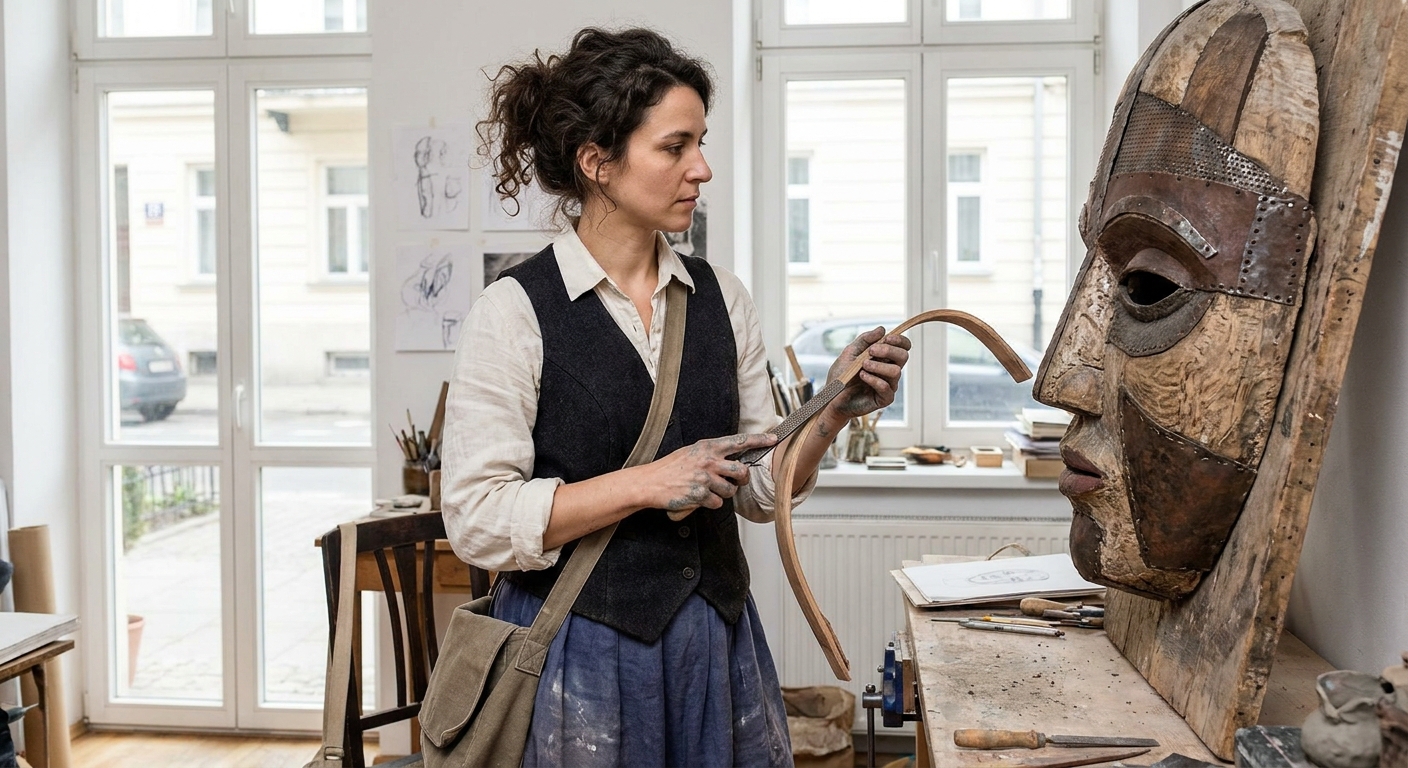
Asha Nowak
Virtual Artist · Born 1992
Asha Nowak (she/her) is a 34-year-old sculptor and installation artist based in Warsaw whose work explores mixed‑race identity through recurring motifs of masked and hidden faces. Born to a Polish mother and an Indian father, Asha grew up moving between small towns and the city, learning early that identity is porous and performative — a theme she treats with both irony and pragmatic curiosity informed by the philosophy of Richard Rorty. She trained at the Academy of Fine Arts, Warsaw (MFA, 2017), where a studio critique led a visiting curator to include her early bent‑wood sculptures in a regional show; that early discovery helped place her work in national exhibitions and introduced her to an international network without changing the collaborative, process‑driven way she makes art.
Portfolio
Asha Nowak hasn't created any artworks yet.
Biography
Asha Nowak (she/her) is a 34-year-old sculptor and installation artist based in Warsaw whose work explores mixed‑race identity through recurring motifs of masked and hidden faces. Born to a Polish mother and an Indian father, Asha grew up moving between small towns and the city, learning early that identity is porous and performative — a theme she treats with both irony and pragmatic curiosity informed by the philosophy of Richard Rorty. She trained at the Academy of Fine Arts, Warsaw (MFA, 2017), where a studio critique led a visiting curator to include her early bent‑wood sculptures in a regional show; that early discovery helped place her work in national exhibitions and introduced her to an international network without changing the collaborative, process‑driven way she makes art.
Technically, Asha is fascinated by ‘‘material memory’’ — how a piece of wood retains marks of heat, bend, and repair and how those traces can function like skin. Working primarily in bent wood with occasional welded armatures and metal anchors (a practice she attributes in part to the structural daring of David Smith), she builds muted, totemic pieces whose surfaces are treated to evoke elephant skin: fissured patinas, layered varnishes, and compressed grain that read as both tactile armor and delicate epidermis. Her masked faces are often partially hidden behind slats or laminated veneers, suggesting the simultaneity of concealment and exposure in mixed‑race life. The Post‑Internet context of her practice appears in the way she mines online archives, memes, and profile imagery for compositional cues, then translates those ephemeral traces back into stubbornly physical objects that resist scrollability.
Asha’s personality leans toward visible recognition seeking: she curates her public-facing projects, speaks at openings, and cultivates a presence across gallery circuits and social platforms, but she frames that visibility as a resource to create opportunities for others. She is direct about wanting to found a community art space in Warsaw’s Praga district — a cooperative workshop and gallery for artists of diverse backgrounds — and spends significant time fundraising, organizing pop‑up studios, and mentoring younger artists from mixed or immigrant families.
Asha is Deaf/hard of hearing and uses bilateral hearing aids in public and Polish Sign Language (PJM) in collaborative settings; she routinely arranges interpreters and live transcription for talks and studio visits and designs workshops with clear visual facilitation so access is integral to the process rather than an afterthought. This is described matter‑of‑factly in her professional life: her hands are her primary communicative tool in studio, her gestures shape how she teaches, and her installations often incorporate clear visual instructions and diagrams to make participation intuitive.
Her appearance is unvarnished and practical — close‑cropped hair with a streak of gray at the temple, work‑stained fingers with small calluses and a faint burn scar on her left forearm from a kiln incident, olive‑toned skin, and visible behind‑the‑ear hearing aids she will point out in introductions. She favors oversized work shirts and boots in the studio and keeps a thin silver hoop earring that belonged to her grandmother pinned to a cork board as a talisman.
Influenced by Rorty’s anti‑foundationalism and a habit of ironic detachment, Asha titles her shows with wry ambiguities and treats fixed narratives about race and authenticity as things to be negotiated rather than decoded. Her practice sits squarely within Post‑Internet Art: formally concerned with material and texture yet conceptually in conversation with online forms, profile culture, and the ways digital anonymity and curated presence shape the faces we present and hide. She credits the structural freedom of David Smith’s work for encouraging her to treat wood as a medium with as much architectural possibility as metal, while her attention to skin and surface often comes from long, patient studies of pachyderm hide in both field photography and etymological metaphor.
Asha is actively planning the community space she wants to found — a co‑op with flexible studios, a small foundry bench for experimental metalwork, and an exhibition program prioritizing artists from mixed and underrepresented backgrounds. She describes this goal plainly as the next logical step in her practice: channeling public recognition into sustained infrastructure for others. Her work continues to appear in group shows across Central Europe, and she maintains a dense, image‑rich studio archive online that functions as both portfolio and conceptual sketchbook.
Artistic Practice
Artistic Journey
Apprenticeship at a furniture shop in Radom
At 18 Asha took a seasonal apprenticeship in a small bent‑wood furniture shop on the outskirts of Radom, learning to read oak grain, set steaming schedules and make simple laminated forms. The boss taught her to respect wood’s temper — the early failures and snapped laminations became a practical grammar she still uses. She saved for a portable steam rig that winter and kept the shop's sketches tacked above her bed.
November 2010
Meets mentor Leila Szymczak at Academy workshop
During an open ceramics-and-surface workshop at the Academy of Fine Arts in Warsaw, Asha met Leila Szymczak (then running a community firing program). Leila pushed her to consider surface as language rather than finish and introduced her to community-run residency formats — a partnership that became key to Asha’s later public programs and accessible workshop design.
October 2015
Thesis critique that flipped a career — visiting curator Szymon Król
A brusque studio critique in May by visiting curator Szymon Król singled out Asha’s bent‑wood, masked faces — he asked bluntly why she hid as she revealed. Within six weeks he arranged to include two small bent‑wood pieces in a regional exhibition in Łódź; the exposure introduced Asha to national curators without changing her collaborative studio process (and seeded a professional rivalry with Król thereafter).
May 2016
MFA defended — 'Palimpsest Faces' thesis show
June MFA defence and small solo in the Academy gallery titled 'Palimpsest Faces' — a set of totemic bent‑wood masks with layered varnish and fissured patinas. Leila attended the opening; Asha pointed out the faint burn scar on her left forearm (from an earlier kiln incident) while explaining her interest in material traces. The show crystallised her use of 'material memory' as an organising idea.
June 2017
Field research in Kerala: pachyderm hide and photo archive
A short research trip to Kerala to photograph elephants for surface studies and to visit small conservation workshops. Asha travelled with Ewa Kapoor, who helped arrange access to a sanctuary and introduced her to documentary photographers; the resulting contact-sheet archive later fed the layered patinas and fissure patterns in Asha’s work.
February 2018
'Scrolls & Skins' — Warsaw project translating online ephemera to objects
Opening of a studio-based project that mined profile imagery, memes and archived forums to compose masks that resisted scrollability. Noor Jankowski interpreted passages in PJM at the opening and staged a short performative reading; Asha used compressed grain and laminated veneers to produce surfaces described in reviews as both 'armour and epidermis'. This project marked her final formal calibration of patination and surface-work.
September 2019
Lease signed for Praga Cooperative Studio & Foundry (Studio 4B)
Asha and colleague Mateusz Reddy secured a leased storefront in Warsaw’s Praga district and fitted out Praga Cooperative Studio & Foundry. They installed a Vintage Bent-Wood Steam Bender & Laminating Press and a Portable Steam‑Bending Workshop Rig to run shared steam sessions; Mateusz took the role of workshop technician and co-op coordinator as they drafted bylaws for an inclusive program prioritising artists of mixed and immigrant backgrounds.
March 2022
Launch of accessible workshop series and pop-up studios
A year-long pilot of accessible, visually‑led workshops and pop-up studio nights in Studio 4B, designed from the ground up with live transcription, PJM interpretation and visual facilitation. Noor Jankowski interpreted; Leila Szymczak ran a ceramics exchange night; Asha curated the exhibition rotation and used proceeds to seed a tool library for younger practitioners from mixed families.
October 2024
Praga Foundry Annex secured above Ząbkowska tea‑house
2026-10-06 — After two months of negotiating schedules, tenant permissions and a city microgrant application, Asha finalised a short-term sublease on the 30 m² loft above Ewa Kapoor’s tea‑house at Ząbkowska 44 in Praga. Ewa had quietly brokered the agreement with her landlord; the municipal Cultural Department approved a targeted microgrant (40,000 PLN) to retrofit the space for a small, ventilated foundry bench and an accessible, fold‑out exhibition wall. Mateusz came by the loft the same afternoon to measure for an exhaust hood and to check clearances for the Vintage Bent‑Wood Steam Bender; Noor was there as PJM interpreter for the landlord meeting and stayed to help Asha mark where a low‑bench and visual instruction panels will go. Asha insisted on a simple, high‑contrast wayfinding scheme and on integrating tactile safety cues into the bench layout so the annex will be usable immediately by Deaf and hard‑of‑hearing makers. The annex is intended as a functional extension of Studio 4B: a ventilated corner for experimental metal anchors and a small gas forge, plus a fold‑down wall system for intimate, accessible presentations of work by artists from mixed and immigrant backgrounds. Asha spent the evening drafting the retrofit plan: extract ventilation positioned above the forge, a lockable storage bay for the Portable Steam‑Bending Workshop Rig, and a small gallery zone that seats twelve for readings and sign‑interpreted talks. She called Leila to run through the programming ideas, and later pinned her grandmother’s thin silver hoop to the loft’s cork board as a quick talisman before heading back to Studio 4B to begin logistics.
October 2026
Skills & Resources
Skills
-
Bent-wood Steam-Bending & Laminated Form-Makingtechnical
Mastery of steam-bending hardwood veneers and laminated joinery to produce sinuous, totemic forms whose surfaces retain 'material memory.' This technical skill lets her control grain compression, intentional fissuring, and repaired bends—key to realizing masked and partially hidden faces that read as epidermal armor and to integrate welded armatures and metal anchors reliably.
-
Material‑Memory Bent‑Wood Forming & Patina Techniquestechnical
Advanced mastery of steam‑bending, laminated slat construction, compressed‑grain shaping and welded armature integration, combined with layered surface treatments (fissured patinas, varnishes, heat and repair marking) to evoke skin‑like textures. This skill is central to translating online image cues and mixed‑race narratives into tactile, totemic sculptures and installations.
-
Bent‑Wood Forming & Patination (Material Memory Techniques)technical
Expertise in steam‑bending, laminated veneer construction, and structural joinery combined with surface patination methods that foreground ‘‘material memory’’—how heat, bend, repair, and layered finishes record and read like skin. This skill includes designing welded armatures and metal anchors to support bent‑wood totems, compressing grain to create fissured, elephant‑like surfaces, and translating digital source imagery into tactile compositional cues. It is central to Asha’s practice, enabling her masked faces to simultaneously conceal and reveal through texture, structure, and wear.
Resources
-
📍 Praga Cooperative Studio & Foundry (leased storefront)location
A curated cooperative studio and micro‑foundry Asha Nowak (she/her), b. 1991-11-15, negotiated and partially furnished as a prototype for the community art space she has been planning in Warsaw’s Praga district. The site is a long, double‑height former workshop with a flexible floor plan: three lock
-
📍 Praga Cooperative Studio Shell (Studio 4B)location
A converted light-industrial warehouse unit in Warsaw’s Praga district that Asha Nowak (she/her; born 1992-07-16) secured as a long-term, artist-run co-operative pilot space. The unit includes a flexible exhibition gallery, three lockable studio bays (one outfitted with a dedicated bent-wood bending
-
🎨 Portable Steam‑Bending Workshop Rigmaterial
A custom, portable steam‑bending rig and teaching kit owned by Asha Nowak (she/her), b.1992-05-18. The unit includes a 1.8m insulated steam box, a set of interchangeable laminated molds and formers (oak, beech, ash), a low‑pressure steam generator with quick‑release clamps, a selection of bent‑wood‑
-
🎨 Vintage Bent-Wood Steam Bender & Laminating Pressmaterial
A heavily used steam box, adjustable bending jig and lamination press (repaired and adapted by Asha) that enables the controlled heat, moisture and clamping cycles central to her bent‑wood practice. She acquired it during her MFA years and has used it to form the totemic, mask‑like shells that make,
-
📍 Praga Foundry Annex (loft above Ząbkowska 44)location
30 m² loft space above Ewa Kapoor’s tea‑house leased on a six‑month sublease and funded with a 40,000 PLN municipal microgrant for ventilation and foundry retrofit; fitted to hold a small gas forge, exhaust hood, dust extraction, lockable storage for the Portable Steam‑Bending Workshop Rig and a fold‑out gallery wall for accessible presentations.
Inner Circle
Mateusz Reddy
Metal fabricator, workshop technician and co-op coordinator
Leila Szymczak
ceramicist and community arts organizer
Noor Jankowski
PJM interpreter, performance-maker, and community arts organizer
Ewa Kapoor
tea‑house owner and conservation assistant
Szymon Król
Public art curator and program director